
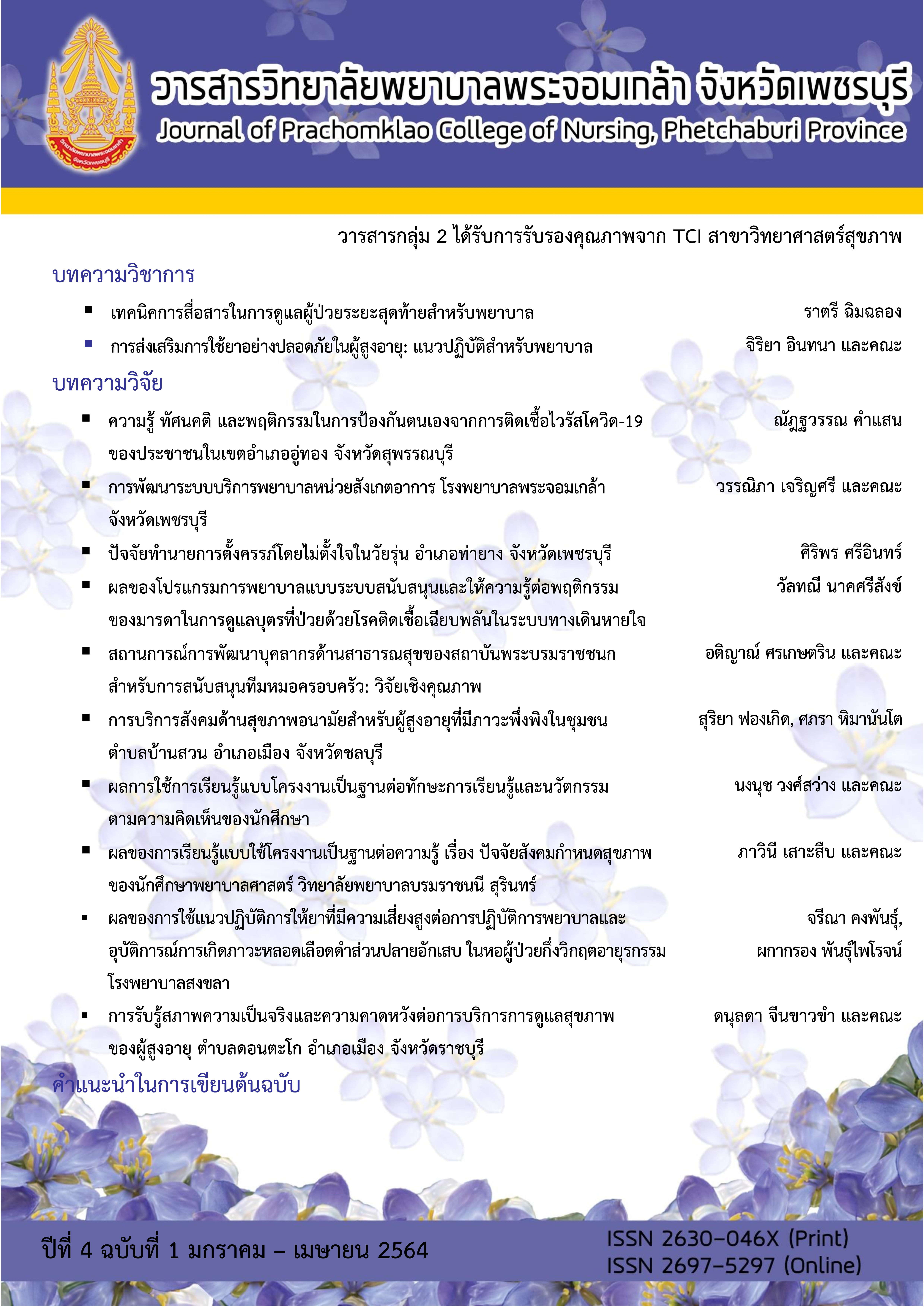
Effects of the Use of High Alert Drug Using Guideline on Nursing Practicum and Peripheral Vein Phlebitis in Medical Sub-Intensive Care Unit, Songkhla Hospital
Article Sidebar
Main Article Content
Abstract
This quasi-experimental research aims to study the effects of the use of a high alert drug-using guideline high-risk dosing guidelines on nursing practicum and peripheral vein phlebitis in the semi-critical care ward in Songkhla Hospital from February to December 2019. The representative samples were professional nurses who took responsible for 18 patients using high alert drugs. The research instruments consisted of 1) a personal data questionnaire, 2) a nursing practice knowledge test, 3) a care practice assessment form, and 4) an incident record form. Data were analyzed by descriptive statistics comparing knowledge scores using paired t-test statistics, performance score comparison using the one sample t-test, and comparing the incidence of venous inflammation using incidence rate.
It is found from the research that after using the guideline, the nurses became knowledgeable about high-risk medications rather than before applying the guidelines. The results were statistically significant (t = -1.86, p = .04). The score of the use of the preventive practice in order to avoid peripheral venous insufficiency was higher to 80% than the threshold statistically significant at the .05 level (t = -2.06, p = .02) and the incidence of venous inflammation decreased from 11.12 times per 1,000 dosing days to 2.88 doses per 1,000 dosing days.
The results of the study suggest that healthcare workers should strictly hold the standard guideline for the prevention of venous inflammation and should be trained regularly to improve the problem as well as find ways to prevent and improve the quality of care for patients to be safe from the occurrence of venous inflammation.
Downloads
Article Details
Content and information published in the Journal of Prachomklao College of Nursing, Phetchaburi Province are the comment and responsibility of the authors. Articles, information, images, etc. published in this journal are the copyright of the Journal of Prachomklao College of Nursing, Phetchaburi Province. If any person or entity wants to take all or part of it for publication for any purposes, please reference the Journal of Prachomklao College of Nursing, Phetchaburi Province.
References
กาญจนา อุดมอัษฎาพร, และมยุรี พรมรินทร์. (2561). ประสิทธิผลของการใช้แนวทางปฏิบัติการป้องกันการ อักเสบของหลอดเลือดดำและการรั่วซึมออกนอกหลอดเลือดดำจากการใช้ยากระตุ้นการหดตัวของหลอดเลือดหอผู้ป่วยหนักโรคหัวใจโรงพยาบาลเชียงรายประชานุเคราะห์. วารสารสาธารณสุขล้านนา, 14(1), 35-45.
จุฑารัตน์ ไกรศรีวรรธนะ. (2554). การพัฒนาแนวปฏิบัติการพยาบาลในการให้สารละลายทางหลอดเลือดดำส่วนปลาย โรงพยาบาลอุดรธานี. วารสารการแพทย์ โรงพยาบาลอุดรธานี, 19(1), 145-156.
ฐิติพร ปฐมจารุวัฒน์. (2559). ผลของการใช้แนวปฏิบัติทางการพยาบาลเพื่อป้องกันและจัดการกับภาวะ extravasation. วารสารสภาการพยาบาล, 31(2), 81-95.
ฐิติพร ปฐมจารุวัฒน์. (2560). การป้องกันและการจัดการกับการบาดเจ็บของเนื้อเยื่อจากการรั่วของหรือสารน้ำ. วารสารพยาบาลสงขลานครินทร์, 37(2), 169-181.
ปาจรีย์ ศักดิ์วาลี้สกุล, และอุษณีย์ ศิริวงศ์พรหม. (2562). ผลของแนวปฏิบัติการพยาบาลเพื่อป้องกันหลอดเลือดดำอักเสบจากการได้รับยานอร์อีพิเนฟริน. วารสารมหาวิทยาลัยคริสเตียน, 25(2), 92-108.
พนิดา กาวินา, ทองปาน เงือกงาม, และศรีสุดา อัศวพลังกูล. (2560). ผลการพัฒนาโปรแกรมส่งเสริมการใช้แนวปฏิบัติการพยาบาลในการป้องกันการ ติดเชื้อปอดอักเสบจากการใช้เครื่องช่วยหายใจ. วารสารกองการพยาบาล, 44(3), 34-57.
วิมลวัลย์ วโรฬาร. (2560). หลอดเลือดดำอักเสบในผู้ป่วยเด็ก: การป้องกันและการดูแล. วารสารพยาบาลโรคหัวใจและทรวงอก, 28(1), 16-28.
ลดาวัลย์ ฤทธิ์กล้า, และ ณรงค์กร ซ้ายโพธิ์กลาง. (2558). ผลของการส่งเสริมการใช้แนวปฏิบัติการ พยาบาลต่อการปฏิบัติของพยาบาลและอุบัติการณ์ปอดอักเสบจากการใช้เครื่องช่วยหายใจในหอผู้ป่วยอายุรกรรมโรงพยาบาธรรมศาสตร์เฉลิมพระเกียรติ. พยาบาลสาร, 42(พิเศษ), 95-104.
สุปาณี เสนาดิสัย, และวรรณภา ประไพพาณิช. (2554). การพยาบาลพื้นฐาน แนวคิดและการปฏิบัติ (พิมพ์ครั้งที่ 13). กรุงเทพฯ: จุดทอง.
Bloom, B.S. (1971). Handbook on formative and summative evaluation of student learning. New York: McGraw–Hill.
Corbett, M., Marshall, D., Harden, M., Oddie, S., Phillips, R., & McGuire, W. (2018). Treatment of extravasation injuries in infants and young children: A scoping review and survey. Health Technology Assessment, 22(46), 1-112. doi 10.3310/hta22460.
Corbett, M., Marshall, D., Harden, M., Oddie, S., Phillips, R., & McGuire, W. (2019). Treating extravasation injuries in infants and young children: A scoping review and survey of UK NHS practice. BMC Pediatrics, 19(1), 6. doi: 10.1186/s12887-018-1387-1.
Faul, F., Erdfelder, E., Lang, A. G., & Buchner, A. (2007). G*Power 3: A flexible statistical power analysis program for the social, behavioral, and biomedical sciences. Behavior Research Methods, 39(2), 175–191.
Hair, J. F., Black, W. C., Babin, B. J. & Anderson, R. E. (2010). Multivariate data analysis (7th ed.). New York: Pearson.
Lee, J. M., Lee, J., Jang, Y. S., & Kim, Y. H. (2018). Factors related to extravasation of non-chemotherapy vesicant drugs in peripheral vein catheters. Journal of Korean Critical Care Nursing, 11(2), 11-20.
Macklin, D. (2003). Phlebitis: A painful complication of peripheral IV catheterization that may be prevented. The American Journal of Nursing, 103(2), 55-60.
Murphy, A. D., Gilmour, R. F., & Coombs, C. J. (2019). Extravasation injury in a paediatric population. ANZ Journal of Surgery, 89(4), 122-126. doi: 10.1111/ans.14104.
