
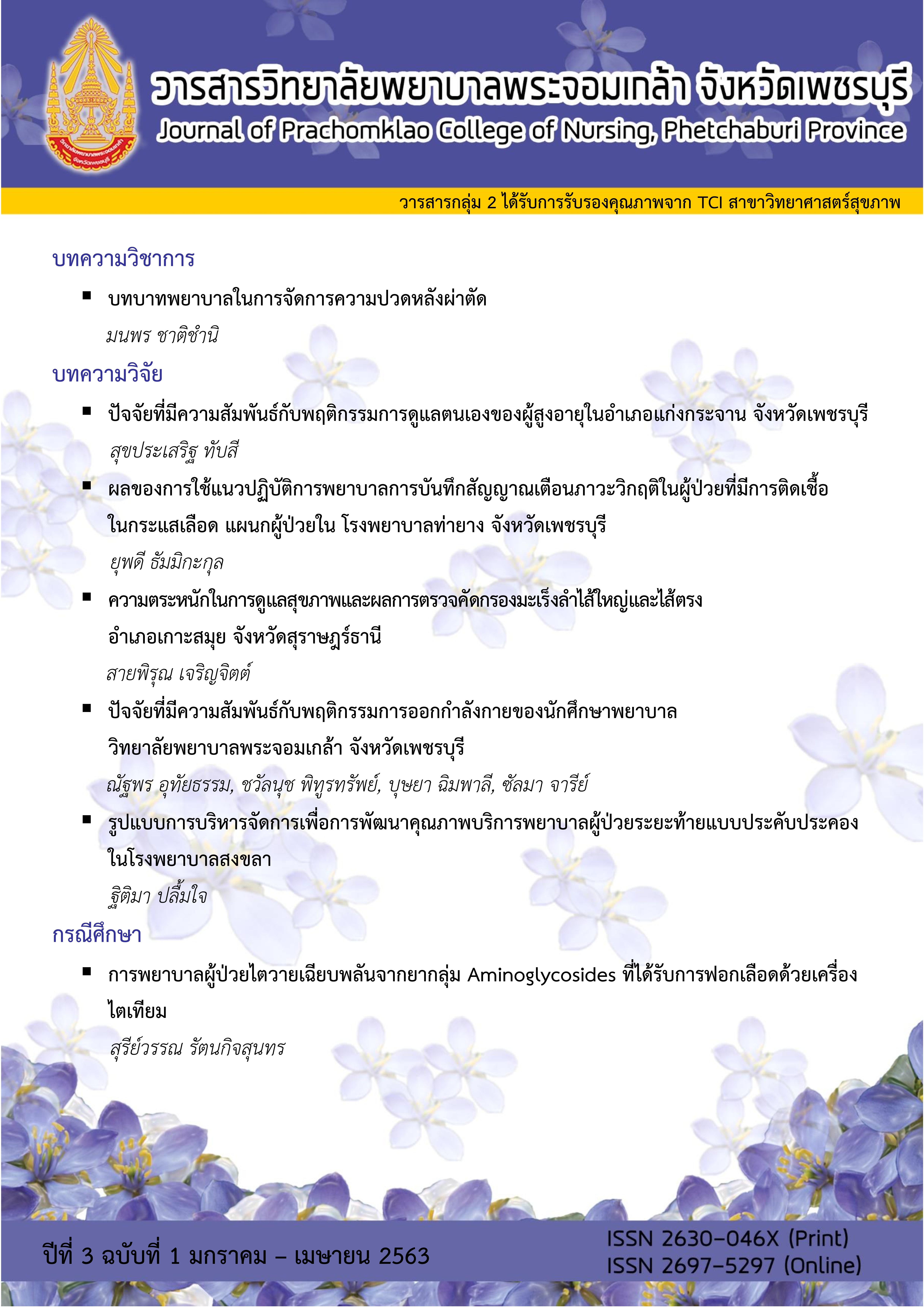
Management Model for Nursing Service Quality Developing of Palliative Care in Songkhla Hospital
Article Sidebar
Main Article Content
Abstract
This action research aimed to: 1) study problems and needs of management, 2) construct a model in management to improve patients' quality of life and end-of-life care, and 3) study the results from the application of a model of management. Palliative care nurses and patients from 12 wards in Songkhla hospital were involved as the participants. The instruments consisted of a data recording form, a semi-structure focus group discussion, and a nursing service quality assessment form and satisfaction questionnaire. Descriptive statistics were used to analyze quantitative data and content analysis was used for the qualitative data. The results revealed that;
- 1. The major problems and needs for management were unclear structure and management, insufficient knowledge and skills of the personnel in taking care of end-of- life palliative patients, lack of continuous supervision and nursing care audit according to the standard and career ethics. Moreover, there were also limitation in workloads and coordination in transferring for continuous cares.
- The model of management to improve the quality of nursing care was called “SK-PCN-CARE Model”. This model consisted of structure, outcome, nursing standard, guideline and pathway, knowledge and skills, holistic care, learning, audit and review, patient center, communication, network and teamwork, clinical supervision, advance plan and discharge planning, resource and relationship, evaluation and quality improvement.
- Nurses are satisfied with a model that can integrate management with nursing services by making it easier to perform and gained more knowledge from learning with practice. Moreover, it is able to cover holistic care and add value to oneself and profession. The overall nursing services quality was at a good level. The overall patients and their family’s satisfaction score were at a high level (M = 4.21, SD = .53).
Downloads
Article Details
Content and information published in the Journal of Prachomklao College of Nursing, Phetchaburi Province are the comment and responsibility of the authors. Articles, information, images, etc. published in this journal are the copyright of the Journal of Prachomklao College of Nursing, Phetchaburi Province. If any person or entity wants to take all or part of it for publication for any purposes, please reference the Journal of Prachomklao College of Nursing, Phetchaburi Province.
References
จอนผะจง เพ็งจาด. (2557). บทบาทพยาบาลในการดูแลแบบประคับประคอง. วารสารวิทยาลัยพยาบาลบรมราชชนนี กรุงเทพ, 30(1), 100-107.
ชุติกาญจน์ หฤทัย, อัมราภัสร์ อรรถชัยวัจน์, และโศภิษฐ์ สุวรรณเกศาวงษ์ (บ.ก.). (2559). ระบบบริการพยาบาลแบบประคับประคอง. นนทบุรี: สื่อตะวัน.
ทัศนีย์ เทศประสิทธิ์, พิมลรัตน์ พิมพ์ดี, ศศิพินทุ์ มงคลไชย, พวงพยอม จุลพันธ์, และยุพยงค์ พุฒธรรม. (2556). การพัฒนาระบบการดูแลแบบประคับประคองในผู้ป่วยระยะสุดท้ายของโรงพยาบาลอุดรธานี. วารสารพยาบาลกระทรวงสาธารณสุข, 23(2), 80-90.
ประชุมสุข โคตรพันธ์, อังศุมาลิน โคตรสมบัติและ สุพัตรา บัวที. (2557). การพัฒนาระบบการจัดการเครือข่ายผู้ดูแลรายกรณีในผู้ป่วยโรคความดันโลหิตสูงและเบาหวาน จังหวัดยโสธร. วารสารการพยาบาลและการดูแลสุขภาพ, 32(3), 102-108.
พิกุล นันทชัยพันธ์, และประทุม สร้อยวงค์. (2558). แนวปฏิบัติการพยาบาลทางคลินิก: การดูแลแบบประคับประคองในผู้ป่วยผู้ใหญ่ (พิมพ์ครั้งที่ 2). นนทบุรี: สภาการพยาบาลและสมาคมพยาบาลแห่งประเทศไทยฯ.
ละเอียด แจ่มจันทร์, และ สายสมร เฉลยกิตติ. (2560). แนวโน้มการดูแลผู้ป่วยแบบประคับประคอง ในหลักสูตรพยาบาลศาสตรบัณฑิต. วารสารพยาบาลทหารบก, 18(1), 22-28.
วินัย สวัสดิวร. (2558). เครือข่ายดูแลผู้ป่วยระยะสุดท้าย. วารสารก้าวใหม่หลักประกันสุขภาพ, 8(30), 1-2.
วีระยุทธ์ ชาตะกาญจน์. (2558). การวิจัยเชิงปฏิบัติการ. วารสารราชภัฏสุราษฎร์ธานี, 2(1), 29-49.
ศศิวิมล ปานุราช, เยาวรัตน์ มัชฌิม, และบวรลักษณ์ ทองทวี. (2561). ความรู้ในการดูแลแบบประคับประคองของพยาบาลในพื้นที่เครือข่ายสำนักงานหลักประกันสุขภาพ เขตบริการที่ 4 และปัจจัยที่เกี่ยวข้อง. ใน มหาวิทยาลัยศรีนครินทรวิโรฒ, การประชุมวิชาการระดับชาติ มศว วิจัยครั้งที่ 11 (น. 1070-1082). กรุงเทพฯ: มหาวิทยาลัยศรีนครินทรวิโรฒ.
ศิริเพ็ญ ชั้นประเสริฐ, ทัศนีย์ เชื่อมทอง, และสุปรานี ศรีพลาวงษ์. (2559). การพัฒนาระบบบริการพยาบาลแบบประคับประคองกลุ่มการพยาบาล โรงพยาบาลชลบุรี. วารสารศูนย์การศึกษาแพทยศาสตร์คลินิกโรงพยาบาลพระปกเกล้า, 33(4), 326-339.
สถาบันรับรองคุณภาพสถานพยาบาล (องค์การมหาชน). (2561). มาตรฐานโรงพยาบาลและบริการสุขภาพ ฉบับที่ 4 (พิมพ์ครั้งที่ 2). นนทบุรี: สถาบันรับรองคุณภาพสถานพยาบาล (องค์การมหาชน).
สมจิตต์ วงศ์สุวรรณสิริ, อุไรพร จันทะอุ่มเม้า, พัชรีย์ กลัดจอมพงษ์, และชัชนน เทพวงค์ (บ.ก.). (2562). แนวทางการจัดเก็บตัวชี้วัดการพัฒนาคุณภาพบริการพยาบาล ประจำปีงบประมาณ 2563. กรุงเทพฯ: สื่อตะวัน.
สมจิตร ประภากร, ศิริพร สวยพริ้ง, อัญชลี สุขขัง, ศุภรักษ์ มั่นน้อย, วราภรณ์ พันธุ์อร่าม, และสุจิรา ฟุ้งเฟื่อง. (2558). การพัฒนาระบบบริการพยาบาลแบบประคับประคองในผู้ป่วยมะเร็งที่เข้ารับการรักษาในสถาบันมะเร็งแห่งชาติ. วารสารกองการพยาบาล, 42(3), 50-66.
สำนักการพยาบาล กระทรวงสาธารณสุข. (2554). เครื่องมือประเมินคุณภาพการพยาบาลตามมาตรฐานการพยาบาลในโรงพยาบาล. กรุงเทพฯ: สามเจริญ.
สำนักการพยาบาล กระทรวงสาธารณสุข. (2558). แนวทางการดำเนินงานตามประเด็นหลักการพัฒนาการพยาบาลภาพรวมประเทศ ปีงบประมาณ 2558. สืบค้นจาก https://www.nursing.go.th/ Meeting_documents/2014-12-11/scan109.pdf
สำนักการพยาบาล กระทรวงสาธารณสุข. (2559). ระบบบริการพยาบาลแบบประคับประคอง. กรุงเทพฯ : สื่อตะวัน.
สำนักงานคณะกรรมการสุขภาพแห่งชาติ. (2557). แผนยุทธศาสตร์ระดับชาติว่าด้วยการสร้างเสริมสุขภาวะในระยะท้ายของชีวิต พ.ศ.2556-2559 (พิมพ์ครั้งที่ 2). กรุงเทพฯ: สามดี พริ้นติ้งอีควิปเมนท์.
สำนักนโยบายและยุทธศาสตร์ กระทรวงสาธารณสุข. (2559). สถิติสาธารณสุข พ.ศ.2558. กรุงเทพฯ: สามเจริญ.
อัมภา ศรารัชต์. (2557). คุณภาพและการรับรองคุณภาพการพยาบาล. วารสารกองการพยาบาล, 41(1), 1-6.
อุมาภรณ์ ไพศาลสุทธิเดช. (2556). บทบาทพยาบาลในการดูแลผู้ป่วยระยะสุดท้าย. ใน สมาคมพยาบาลโรคมะเร็งแห่งประเทศไทย, การประชุมฟื้นฟูวิชาการ วิทยาการก้าวหน้าในการพยาบาลผู้ป่วยโรคมะเร็ง. กรุงเทพฯ: โรงพยาบาลกรุงเทพ.
Ayed, A., Sayej, S, Harazneh, L., Fashafsheh, I., & Eqtait, F. (2015). The nurses' knowledge and attitudes towards the palliative care. .Journal of Education and Practice, 6(4), 91-99.
Cooper, J., & Hewison, A. (2002). Implementing audit in palliative care: An action research approach. Journal of Advanced Nursing, 39(4), 360–369.
Dobrina, R., Tenze, M, & Palese, A. (2014). An overview of hospice and palliative care nursing models and theories. International Journal of Palliative Nursing, 20(2), 75-81.
Hagan, T. L., Xu, J., Lopez, R. P., & Bressler, T. (2017). Nursing’s role in leading palliative care: A call to action. Nurse Education Today, 61, 216-219.
Mororo, D. D. S., Enders, B. C., Lira, A. L. B. C., Silva, C. M. B., & Menezes, R. M. P. (2017). Concept analysis of nursing care management in the hospital context. Acta Paulista de Enfermagem, 30(3), 323-332.
Okaisu, E.M. (2014). Improving the quality of nursing documentation: An action research project. Curationis, 37(2), e1-11. doi: 10.4102/curationis.v37i2.1251.
Prem, V., Karvannan, H., Kumar, S. P., Karthikbabu, S., Syed, N., Sisodia, V., & Jaykumar, S. (2012). Study of nurses’ knowledge about palliative care: A quantitative cross-sectional survey. Indian Journal of Palliative Care, 18(2), 122–127.
Ramsbottom, K., & Kelley, M. L. (2014). Developing strategies to improve advance care planning in long term care homes: Giving voice to residents and their family members. International Journal of Palliative Care, 1-8. doi: 10.1155/2014/358457 2014.
Sekse, R. J. T., Hunskår, I., & Ellingsen, S. (2017). The nurse's role in palliative care: A qualitative meta-synthesis. Journal of Clinical Nursing, 17(1-2), 21-38.
Sierko, E., Werpachowska, M. T., Sokół, M., & Wojtukiewicz, M. Z. (2011). Quality of nursing care of colorectal cancer patients undergoing first line palliative chemotherapy- A questionnaire study in a single institution in Poland. Advances in Palliative Medicine, 10(2), 65-72.
Stewart, K., Doody, O., Bailey, M., & Moran, S. (2017). Improving the quality of nursing documentation in a palliative care setting: A quality improvement initiative. International Journal of Palliative Nursing, 23(12), 577-585.
World Health Organization. (2016). Planning and implementing palliative care services: A guide for programme managers. Geneva: World Health Organization. Retrieved from https://apps.who.int/iris/bitstream/handle/10665/250584/9789241565417-eng.pdf.
