
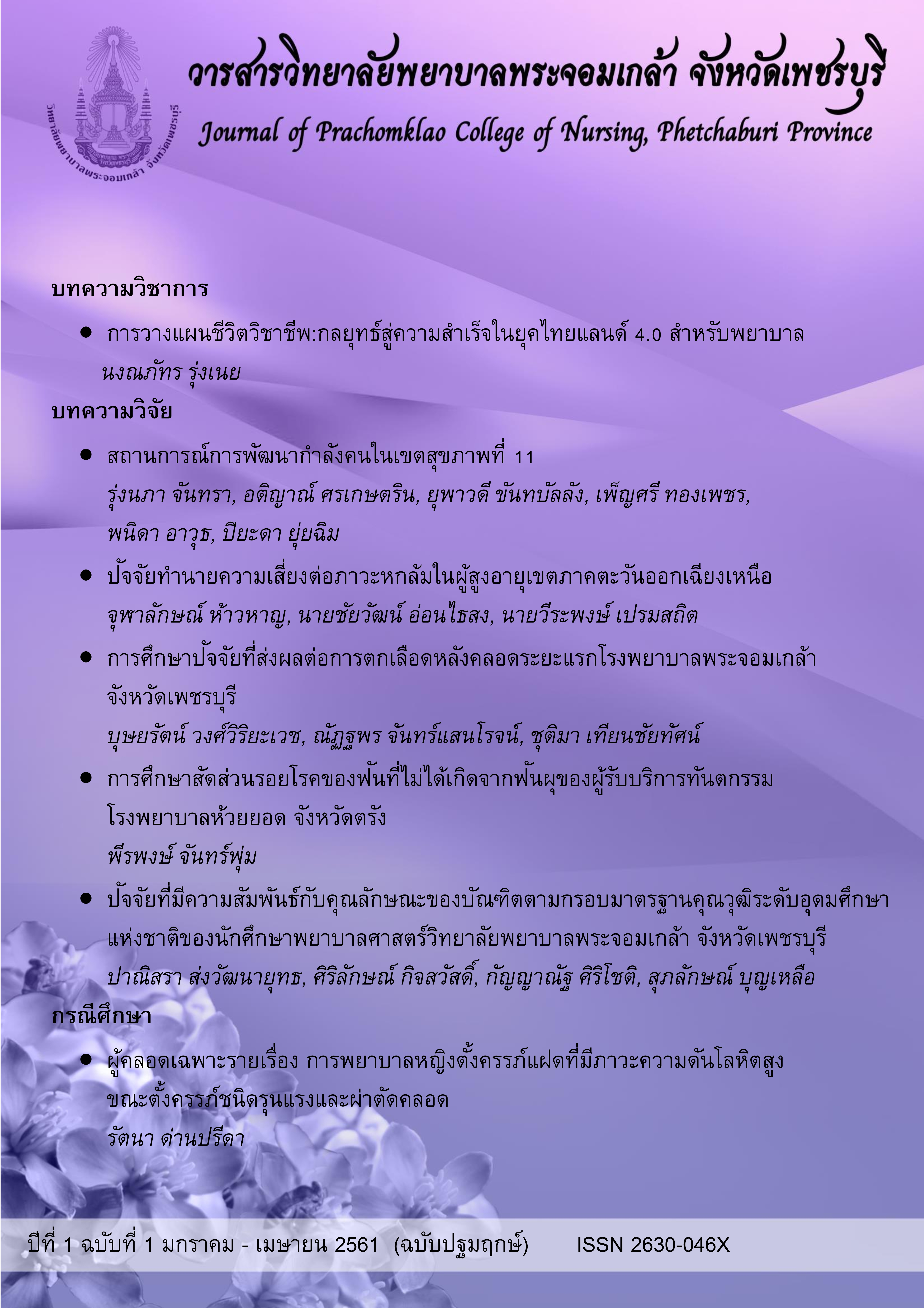
Factors Predicted Falls among Elderly in Northeastern Thailand
Article Sidebar
Main Article Content
Abstract
This descriptive study aimed to determine factors predicted falls among elderly in Northeastern Thailand. The target group included the elderly aged 60 years and over. Cluster sampling was administered by dividing the Northeastern region into 2 groups by Index of Aging (IoA). The Setting were 6 provinces which were simple random sampling from 80-99.9% IoA of province consist of Nakhonratchasima, Khonkaen, and Mahasarakham province and the others provinces form 60-79.9 % IoA consist of Surin, Udonthani and Ubonratchathani. Data were collected by geriatric screening form which was developed by Elderly Medicine Institute. Descriptive study was used to describe the findings. K-Mean Cluster was used to category the elder by risky factors and multiple logistics regression were used to find factors predicted falls among elderly.
The finding revealed that mean age was 70.47 (SD. = 7.65; Min-Max: 60-96) and 61.1 % were male. Regarding to ADL scores, most of elderly were well elderly (96.40%) with 3.00% were home bound and were 0.60% were bed bound. ADL and all of clinical sign and symptoms of osteoarthritis (stiffness, crepitus, bony tenderness, bony enlargement, no palpable warmth) were statistically significant related to fall at p<.001.
Activities daily living and all of clinical sign and symptoms of osteoarthritis (stiffness, crepitus, bony tenderness, bony enlargement, no palpable warmth) were related to fall at p<.001. Together were statistically significant predict risk for falls among elderly 20.7% .
Downloads
Article Details
Content and information published in the Journal of Prachomklao College of Nursing, Phetchaburi Province are the comment and responsibility of the authors. Articles, information, images, etc. published in this journal are the copyright of the Journal of Prachomklao College of Nursing, Phetchaburi Province. If any person or entity wants to take all or part of it for publication for any purposes, please reference the Journal of Prachomklao College of Nursing, Phetchaburi Province.
References
ดาราวรรณ รองเมือง, ฉันทนา นาคฉัตรีย์, จีราพร ทองดี, และจิตติยา สมบัติบูรณ์. (2561). อุบัติการณ์ของ การหกล้ม และ ปัจจัยที่มีความสัมพันธ์กับการหกล้มในผู้สูงอายุที่อาศัยในชุมชน จังหวัด สุราษฎร์ธานี. วารสารวิทยาลัยพยาบาลพระปกเกล้า จันทบุรี, 27(3), 123-138.
นงนุช วรไธสง. (2551). การศึกษาปัจจัยเสี่ยงต่อการหกล้มของผู้สูงอายุกลุ่มเสี่ยงที่อาศัยอยู่ในชุมชนจังหวัดขอนแก่น วิทยานิพนธ์ปริญญามหาบัณฑิต, มหาวิทยาลัยขอนแก่น.
เปรมกมล ขวนขวาย. (2550). ปัจจัยที่เกี่ยวข้องกับการหกล้มของผู้สูงอายุที่อาศัยอยู่ในชุมชน วิทยานิพนธ์ปริญญามหาบัณฑิต, มหาวิทยาลัยขอนแก่น.
รังสิยา นารินทร์, วิลาวัณย์ เตือนราษฎร์, และวราภรณ์ บุญเชียง. (2556). รายงานการศึกษาวิจัยการ พัฒนารูปแบบการเสริมสร้างสมรรถภาพผู้สูงอายุข้อเข่าเสื่อมในชุมชน กรณีศึกษาตำบลไชยสถานอำเภอสารภี จังหวัดเชียงใหม่. เชียงใหม่: คณะพยาบาลศาสตร์ มหาวิทยาลัยเชียงใหม่.
มูลนิธิสถาบันวิจัยและพัฒนาผู้สูงอายุไทย. (2558). สถานการณ์ผู้สูงอายุไทย พ.ศ.2557. กรุงเทพฯ: อมรินทรพริ้นติ้งแอนด์พับลิชชิ่ง.
ละออม สร้อยแสง, จริยาวัตร คมพยัคฆ์, และกนกพร นทีธนสมบัติ. (2557). การศึกษาแนวทางการป้องกันการล้มในผู้สูงอายุชุมชนมิตรภาพพัฒนา. วารสารพยาบาลทหารบก, 15(1), 122-129.
ลัดดา เถียมวงศ์, และจอม สุวรรณโณ. (2557). ปัจจัยเสี่ยงที่เกี่ยวข้องกับการทรงตัวบกพร่องของผู้สูงอายุในชุมชนชนบท. วารสารพยาบาลตำรวจ, 6(2), 56-69.
วิภาวี กิจกำแหง, นิพัธ กิตติมานนท์, และศุภสิทธิ์ พรรณารุโณทัย. (2549). ปัจจัยเสี่ยงต่อการหกล้มของผู้สูงอายุในชุมชน. วารสารวิชาการสาธารณสุข,15(5), 787-799.
สุกัลยา อมตฉายา, เยาวราภรณ์ ยืนยงค์, และวัณทนา ศิริธราธิวัตร. (2553). การทรงตัว การล้ม และคุณภาพชีวิตของผู้สูงอายุที่ออกกำลังกายและไม่ออกกำลังกายเป็นประจำ. ศรีนครินทร์เวชสาร, 25(2), 103-108.
ทธิชัย จิตะพันธ์กุล. (2542). การวิเคราะห์ผู้สูงอายุ ใน หลักสำคัญทางเวชศาสตร์ผู้สูงอายุ. กรุงเทพฯ : โรงพิมพ์แห่งจุฬาลงกรณ์ มหาวิทยาลัย.
Bird, M. L., Pittaway, J. K., Cuisick, I., Rattray, M., & Ahuja, K. D. (2013). Age-related changes in physical fall risk factors: Results from a 3year follow-up of community dwelling olderadults in Tasmania, Australia. International Journal of Environmental Research and Public Health, 10(11), 5989-5997.
Bloch, F., Thibaud, M., Dugué, B., Brèque, C.,Rigaud, A. S., & Kemoun, G. (2010). Episodes of falling among elderly people: A systematic review and meta-analysis of social and demographic pre-disposing characteristics. Clinics, 65(9), 895-903.
Chang, C.M., Chen, M.J., Tsai, C.Y., Ho, L.H., Hsieh, H.L., Chau, Y.L., Liu C.Y. (2011). “Medical conditions and medications as risk factors of falls in the inpatient older people: a case-control study,” Int J Geriatr Psychiatry. 26, 602-607.
Dong, C.P.,& Seung, G.Y. (2013). “Aging,” The Korean Audio logical Society. 17, 39-44.
El Haber, N., Erbas, B., Hill, K. D., & Wark, J. D.(2008). Relationship between age and measures of balance, strength and gait: Linear and non-linear analyses. Clinical science,114(12), 719-727.
Hochberg, M.C., et al. (2012). American College of Rheumatology (ACR) 2012: Recommenda-tions for the use of non-pharmacologic and pharmacologic therapies in Osteoarthritis of the hand, hip, and knee. Arthritis Care & Research.64(4) : 465-474.
Legters, K., Verbus, N. B., Kitchen, S., Tomecsko, J., & Urban, N. (2006). Fear of falling, balance confidence and health-related quality of life in individuals with postpolio syndrome. Physiotherapy theory and practice, 22(3), 127-135.
Mahoney, F. I., & Barthel, D. W. (1965). FUNCTIONAL EVALUATION: THE BARTHEL INDEX. Maryland state medical journal, 14, 61-65.
Pillemer, K., Burnes, D., Riffin, C., & Lachs, M. S. (2016). Elder abuse: global situation, risk factors, and prevention strategies. The Gerontologist, 56(2), 194-205.
Pereira, V. V., Maia, R. A., & Silva, S. M. C. (2013).The functional assessment Berg Balance Scale is better capable of estimating fall risk in the elderly than the posturographic Balance Stability System. Arquivos de Neuro-Psiquiatria,71(1), 5-10.
Public Health Agency of Canada. (2014). Seniors ‘falling in Canada second Report. Retrieved 20, January 2018 from, https://www.phacaspc.gc.ca/seniorsaines/ publications/public/injuryblessure/seniors_falls-chutes_aines/assets/pdf/seniors_ falls- chutes_aines-eng.pdf.
Viswanathan, A., & Sudarsky, L. (2012). Balance and gait problems in the elderly. Handbook of Clinical Neurology, 103, 623-634.
Yoo, J. S., Kim, C. G., Yim, J., & Jeon, M. Y. (2016). Factors influencing falls in the frail elderly individuals in urban and rural areas. Aging Clinical and Experimental Research, 28(4), 687-697.
