
บทบาทพยาบาลผดุงครรภ์ในการให้คำปรึกษาและสนับสนุนการเลือกวิธีคุมกำเนิดที่เหมาะสม สำหรับสตรีวัยเจริญพันธุ์
คำสำคัญ:
บทบาทพยาบาลผดุงครรภ์, การคุมกำเนิด, การให้คำปรึกษา, การตัดสินใจอย่างมีข้อมูล, สตรีวัยเจริญพันธุ์บทคัดย่อ
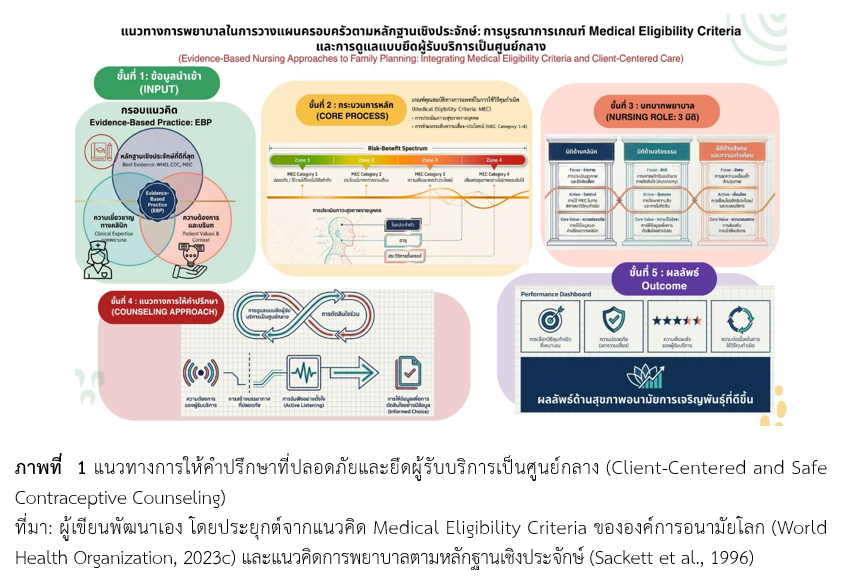
ประเทศไทยกำลังเผชิญความท้าทายด้านอนามัยการเจริญพันธุ์ จากแนวโน้มการลดลงของอัตราการเจริญพันธุ์โดยรวมของประเทศ ขณะเดียวกันยังคงพบปัญหาการตั้งครรภ์ที่ไม่พึงประสงค์ในสตรีวัยเจริญพันธุ์บางกลุ่ม ซึ่งมีความสัมพันธ์กับการเลือกใช้วิธีคุมกำเนิดที่ไม่เหมาะสม การเข้าถึงข้อมูลการคุมกำเนิดที่มีคุณภาพอย่างจำกัด และอิทธิพลของบริบททางสังคม วัฒนธรรมและเศรษฐกิจ พยาบาลในฐานะผู้ให้บริการสุขภาพแนวหน้าจึงมีบทบาทสำคัญในการสนับสนุนให้ผู้รับบริการสามารถตัดสินใจเลือกใช้วิธีคุมกำเนิดได้อย่างมีข้อมูลและสอดคล้องกับบริบทชีวิตของ แต่ละบุคคล บทความนี้มีวัตถุประสงค์เพื่อสังเคราะห์หลักฐานเชิงวิชาการและนำเสนอกรอบแนวคิดเกี่ยวกับบทบาทของพยาบาลในการให้คำปรึกษาและสนับสนุนการเลือกวิธีคุมกำเนิดที่เหมาะสมสำหรับสตรีวัยเจริญพันธุ์ โดยอาศัยการทบทวนเอกสารวิชาการและแนวทางปฏิบัติจากแหล่งข้อมูลระดับนานาชาติ ได้แก่ องค์การอนามัยโลก (World Health Organization: WHO) ศูนย์ควบคุมและป้องกันโรคแห่งสหรัฐอเมริกา (Centers for Disease Control and Prevention: CDC) และ Faculty of Sexual and Reproductive Healthcare (FSRH) รวมทั้งงานวิจัยที่เกี่ยวข้องระหว่างปี พ.ศ. 2561–2567 เพื่อนำมาวิเคราะห์บทบาทของพยาบาลและปัจจัยที่มีอิทธิพลต่อการตัดสินใจเลือกวิธีคุมกำเนิด ผลการสังเคราะห์พบว่า บทบาทสำคัญของพยาบาลในการสนับสนุนการเลือกวิธีคุมกำเนิดประกอบด้วย 5 ประเด็น ได้แก่ 1) การประเมินภาวะสุขภาพตามเกณฑ์ความเหมาะสมทางการแพทย์ 2) การให้ข้อมูลและคำปรึกษา 3) การสนับสนุนการตัดสินใจร่วมและด้านอารมณ์จิตสังคม 4) การส่งเสริมการเข้าถึงบริการคุมกำเนิด 5) การติดตามและประเมินผล บทบาทดังกล่าวช่วยให้ผู้รับบริการสามารถเลือกวิธีคุมกำเนิดได้อย่างเหมาะสมตามภาวะสุขภาพ วิถีชีวิต บริบททางสังคมวัฒนธรรมและเป้าหมายด้านการเจริญพันธุ์ของตนเอง กรอบแนวคิดที่นำเสนอสามารถใช้เป็นแนวทางในการพัฒนาการปฏิบัติการพยาบาลและการจัดบริการด้านอนามัยการเจริญพันธุ์ เพื่อส่งเสริมสุขภาวะของประชาชนและสนับสนุนการพัฒนาสังคมอย่างยั่งยืน
เอกสารอ้างอิง
กรมอนามัย กระทรวงสาธารณสุข. (2560) . คู่มืออนามัยการเจริญพันธุ์และการวางแผนครอบครัว. นนทบุรี. กรมอนามัย.
กรมอนามัย กระทรวงสาธารณสุข. (2566) . คู่มือบริการวางแผนครอบครัวและอนามัยการเจริญพันธุ์. นนทบุรี: กรมอนามัย.
Centers for Disease Control and Prevention. (2024a). Contraceptive Methods: Effectiveness and Use. Atlanta, GA: CDC.
Centers for Disease Control and Prevention. (2024b). U.S. Medical Eligibility Criteria for Contraceptive Use, 2024.Atlanta, GA: CDC.
Centers for Disease Control and Prevention. (2024c). U.S. Selected Practice Recommendations for Contraceptive Use, 2024. Atlanta, GA: CDC.
Charles, C., Gafni, A., & Whelan, T. (1997). Shared decision-making in the medical encounter: What does it mean? (or it takes at least two to tango). Social Science & Medicine, 44(5), 681–692.
Department of Health, Ministry of Public Health. (2017). Adolescent Reproductive Health Situation 2018. Nonthaburi: Ministry of Public Health.
Dehlendorf, C., Levy, K., Kelley, A., Grumbach, K., & Steinauer, J. (2013). Women’s preferences for contraceptive counseling and decision making. Contraception, 88(2), 250–256.
Faculty of Sexual & Reproductive Healthcare. (2023a). Combined Hormonal Contraception: Clinical Guideline. London: FSRH.
Faculty of Sexual & Reproductive Healthcare. (2023b). Emergency Contraception: Clinical Guideline. London: FSRH.
Hatcher, R. A., Trussell, J., Nelson, A. L., Cates, W., & Kowal, D. (2018). Contraceptive Technology (21st ed.). New York: Ardent Media.
Tangmunkongvorakul, A., Banwell, C., Carmichael, G., Utomo, I. D., Seubsman, S. A., Kelly, M., & Sleigh, A. (2012). Use and perceptions of sexual and reproductive health services among Northern Thai adolescents. Southeast Asian Journal of Tropical Medicine and Public Health, 43(2), 479–500.
Sackett, D. L., Rosenberg, W. M. C., Gray, J. A. M., Haynes, R. B., & Richardson, W. S. (1996). Evidence based medicine: What it is and what it isn’t. BMJ, 312(7023), 71–72.
Sychareun, V., Vongxay, V., Houaboun, S., Thammavongsa, V., Phummavongsa, P., Chaleunvong, K., & Durham, J. (2018). Determinants of adolescent pregnancy and access to reproductive and sexual health services for married and unmarried adolescents in rural Lao PDR: A qualitative study. BMC Pregnancy and Childbirth, 18, 219.
United Nations. (2023). Sustainable Development Goals Report 2023. New York: United Nations.
World Health Organization. (2023a). Family planning/contraception methods: Key facts. Geneva: WHO. https://www.who.int/news-room/fact-sheets/detail/family-planning-contraception
World Health Organization. (2023b). Family Planning: A Global Handbook for Providers. Geneva: WHO.
World Health Organization. (2023c). Medical eligibility criteria for contraceptive use (6th ed.)
ดาวน์โหลด
เผยแพร่แล้ว
รูปแบบการอ้างอิง
ฉบับ
ประเภทบทความ
สัญญาอนุญาต
ลิขสิทธิ์ (c) 2026 วารสารพยาบาลศาสตร์ มหาวิทยาลัยสยาม

อนุญาตภายใต้เงื่อนไข Creative Commons Attribution-NonCommercial-NoDerivatives 4.0 International License.
เนื้อหาและข้อมูลที่เผยแพร่ในวารสารพยาบาลศาสตร์ มหาวิทยาลัยสยามถือเป็นข้อคิดเห็นและความรับผิดชอบของผู้นิพนธ์บทความโดยตรง
บทความ เนื้อหา ข้อมูล รูปภาพ ฯลฯ ที่ได้รับการเผยแพร่ในวารสารพยาบาลศาสตร์ มหาวิทยาลัยสยาม ถือเป็นลิขสิทธิ์ของวารสารพยาบาลศาสตร์ มหาวิทยาลัยสยาม หากบุคคลหรือหน่วยงานใดต้องการนำทั้งหมดหรือส่วนหนึ่งส่วนใดไปเผยแพร่หรือเพื่อกระทำการใด ๆ จะต้องอ้างอิงวารสารพยาบาลศาสตร์ มหาวิทยาลัยสยามทุกครั้ง

