
ความสัมพันธ์ระหว่างการปฐมนิเทศกับความต้องการพัฒนาตนเองของอาจารย์พยาบาลในมหาวิทยาลัยเอกชนแห่งหนึ่งในเขตกรุงเทพมหานคร
คำสำคัญ:
การปฐมนิเทศ, อาจารย์พยาบาล , ความต้องการพัฒนาตนเอง, ประสบการณ์การสอนบทคัดย่อ
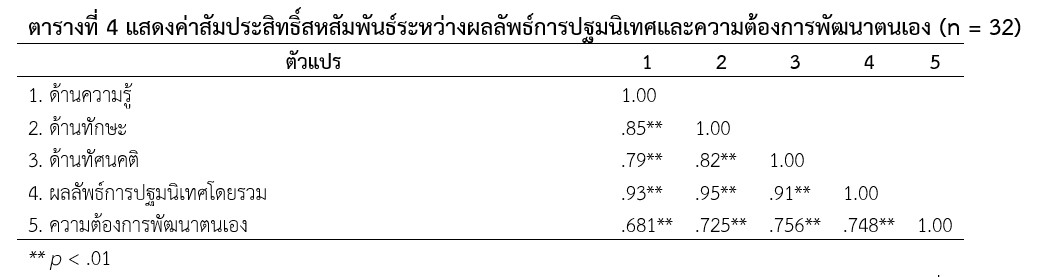
การวิจัยเชิงสหสัมพันธ์นี้มีวัตถุประสงค์เพื่อศึกษาผลลัพธ์การปฐมนิเทศ ความต้องการพัฒนาตนเอง ความสัมพันธ์ระหว่างผลลัพธ์การปฐมนิเทศกับความต้องการพัฒนาตนเอง และเปรียบเทียบตามประสบการณ์การสอนของอาจารย์พยาบาล กลุ่มตัวอย่างเป็นอาจารย์พยาบาลที่ปฏิบัติงานในมหาวิทยาลัยเอกชนแห่งหนึ่งในเขตกรุงเทพมหานครที่ผ่านการปฐมนิเทศจำนวน 32 คน เก็บข้อมูลโดยใช้แบบสอบถาม 2 ชุด (α = 0.968 และ 0.975) วิเคราะห์ข้อมูลด้วยสถิติเชิงพรรณนา สหสัมพันธ์แบบเพียร์สัน และ one-way ANOVA ผลการวิจัยพบว่า ผลลัพธ์ การปฐมนิเทศโดยรวมอยู่ในระดับมาก (M = 4.35, SD = 0.57) โดยด้านทัศนคติมีค่าสูงสุด (M= 4.46) ความต้องการพัฒนาตนเองโดยรวมอยู่ในระดับมาก (M = 4.18, SD = 0.75) โดยด้านการสอนมีค่าสูงสุด (M = 4.42) พบ ความสัมพันธ์ทางบวกระดับสูงระหว่างผลลัพธ์การปฐมนิเทศกับความต้องการพัฒนาตนเอง (r = .748, p < .01) และพบความแตกต่างของตัวแปรทั้งสองเมื่อจำแนกตามประสบการณ์การสอนอย่างมีนัยสำคัญ (p < .05) โดยอาจารย์ที่มีประสบการณ์มากกว่า 7 ปีมีผลลัพธ์การปฐมนิเทศสูงสุด และอาจารย์ที่มีประสบการณ์ 1–3 ปีมีความต้องการพัฒนาตนเองสูงสุด ผลการศึกษาสะท้อนให้เห็นว่าการปฐมนิเทศมีความสัมพันธ์กับความพร้อมและแรงจูงใจในการพัฒนาตนเองของอาจารย์พยาบาล สถาบันการศึกษาควรพัฒนาโปรแกรมปฐมนิเทศให้สอดคล้องกับประสบการณ์การสอนและจัดกิจกรรมพัฒนาอย่างต่อเนื่อง
เอกสารอ้างอิง
ทศพร มะหะหมัด, ชูศักดิ์ เจนประโคน, ประเสริฐ สุขศาสน์กวิน, และวิชญพงศ์ ศรีคชา. (2564). การให้ทัศนะความเข้าใจการปฐมนิเทศเพื่อสร้างประโยชน์ต่อการทำงานในองค์กร. วารสารเครือข่ายส่งเสริมการวิจัยทางมนุษยศาสตร์และสังคมศาสตร์, 4(3), 129–138.
ประภัสสร พลาบดีวัฒน, อาภรณ์ ดีนาน, และนุจรี ไชยมงคล. (2560). ปัญหาและความต้องการพัฒนาตนเองของบุคลากรคณะพยาบาลศาสตร์ มหาวิทยาลัยบูรพา. วารสารคณะพยาบาลศาสตร์ มหาวิทยาลัยบูรพา, 25(4), 21–31.
สมาคมพยาบาลแห่งประเทศไทย. (2565). สถานการณ์กำลังคนพยาบาลวิชาชีพในประเทศไทย. สมาคมพยาบาลแห่งประเทศไทย.
Benner, P. E. (2020). From novice to expert: Excellence and power in clinical nursing practice (Commemorative ed.). Prentice Hall.
Best, J. W. (1977). Research in education (3rd ed.). Prentice-Hall.
Cox, C., Jordan, E., Valiga, T., & Zhou, Q. (2021). New faculty orientation for nurse educators: Offerings and needs. Journal of Nursing Education, 60(5), 273–276.
Herzberg, F. (2017). Motivation to work. Routledge. (Original work published 1959) https://doi.org/10.4324/9781315124827
Kirkpatrick, J. D., & Kirkpatrick, W. K. (2021). Kirkpatrick's four levels of training evaluation. ATD Press.
Knowles, M. S., Holton III, E. F., & Swanson, R. A. (2020). The adult learner: The definitive classic in adult education and human resource development (9th ed.). Routledge. https://doi.org/10.4324/9780429299612
Kramer, M. (1974). Reality shock: Why nurses leave nursing. C. V. Mosby.
National League for Nursing. (2018). NLN core competencies for nurse educators: A decade of influence. National League for Nursing.
Penn, B. K., Wilson, L. D., & Rosseter, R. (2008). Transitioning from nursing practice to a teaching role. Online Journal of Issues in Nursing, 13(3), Manuscript 3.
Schoening, A. M. (2013). From bedside to classroom: The nurse educator transition model. Nursing Education Perspectives, 34(3), 167–172.
Weidman, J. C. (2006). Socialization of students in higher education: Organizational perspectives. In C. C. Conrad & R. C. Serlin (Eds.), The SAGE handbook for research in education: Engaging ideas and enriching inquiry (pp. 253–262). Sage Publications.
World Health Organization. (2021). Global strategic directions for nursing and midwifery 2021–2025. World Health Organization.
ดาวน์โหลด
เผยแพร่แล้ว
รูปแบบการอ้างอิง
ฉบับ
ประเภทบทความ
สัญญาอนุญาต
ลิขสิทธิ์ (c) 2025 วารสารพยาบาลศาสตร์ มหาวิทยาลัยสยาม

อนุญาตภายใต้เงื่อนไข Creative Commons Attribution-NonCommercial-NoDerivatives 4.0 International License.
เนื้อหาและข้อมูลที่เผยแพร่ในวารสารพยาบาลศาสตร์ มหาวิทยาลัยสยามถือเป็นข้อคิดเห็นและความรับผิดชอบของผู้นิพนธ์บทความโดยตรง
บทความ เนื้อหา ข้อมูล รูปภาพ ฯลฯ ที่ได้รับการเผยแพร่ในวารสารพยาบาลศาสตร์ มหาวิทยาลัยสยาม ถือเป็นลิขสิทธิ์ของวารสารพยาบาลศาสตร์ มหาวิทยาลัยสยาม หากบุคคลหรือหน่วยงานใดต้องการนำทั้งหมดหรือส่วนหนึ่งส่วนใดไปเผยแพร่หรือเพื่อกระทำการใด ๆ จะต้องอ้างอิงวารสารพยาบาลศาสตร์ มหาวิทยาลัยสยามทุกครั้ง

