
The Relationship Between Perception and Preventive Behaviors for Office Syndrome Among Supportive Personnel at a University in Chanthaburi Province
Keywords:
Preventive behaviors for office syndrome, Health belief model, Supportive personnelAbstract
This study employed a descriptive correlational research design to examine the relationship between health belief patterns and preventive behaviors for office syndrome among 200 support personnel in a university located in Chanthaburi Province. The sample size was determined using Krejcie and Morgan’s formula. The participants were selected through proportional allocation followed by simple random sampling from each department. Data were collected using a self-administered questionnaire comprising six sections: (1) personal information; (2) perceived susceptibility to office syndrome; (3) perceived severity of office syndrome; (4) perceived benefits of preventive behaviors; (5) perceived barriers to preventive behaviors; and (6) preventive behaviors for office syndrome. The reliability of parts 2 to 6 was tested using Cronbach’s alpha coefficient, yielding values of .86, .81, .90, .70, and .77, respectively. Data were analyzed using descriptive statistics, and the relationships were analyzed using Pearson’s correlation coefficient.
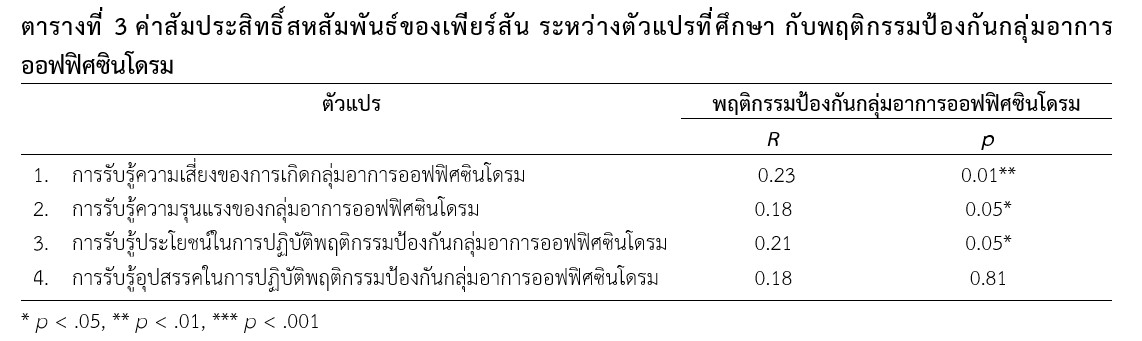
The findings revealed that the participants demonstrated a moderate level of preventive behaviors for office syndrome. Perceived susceptibility to office syndrome was positively correlated at a low level with preventive behaviors (r = 0.23, p < .01). Perceived severity showed a very low positive correlation with preventive behaviors (r = 0.18, p < .05). Perceived benefits of preventive behaviors had a low positive correlation with preventive behaviors (r = 0.21, p < .05). In contrast, perceived barriers to preventive behaviors were not significantly associated with preventive behaviors for office syndrome. These findings suggest that nurses or relevant personnel should organize health promotion activities utilizing the Health Belief Model as a conceptual framework to prevent Office Syndrome.
References
คม ยิบประดิษฐ์ และภัทรสุดา สินสวัสดิ์. (2567). ความสัมพันธ์ระหว่างการรับรู้ตามแบบแผนความเชื่อด้านสุขภาพกับพฤติกรรมการป้องกันโรคไข้เลือดออกของประชาชนในเขตโรงพยาบาลส่งเสริมสุขภาพตำบลบางตะบูน อำเภอบ้านแหลม จังหวัดเพชรบุรี. วารสารวิชาการเพื่อการพัฒนาระบบสุขภาพปฐมภูมิและสาธารณสุข. 2(1), 1-14
จุฬาลักษณ์ ฐิตินันทิวัฒน์ และนเรศน์ ฐิตินันทิวัฒน์. (2567). ปัจจัยคัดสรรตามแบบแผนความเชื่อด้านสุขภาพที่ส่งผลต่อกับพฤติกรรมการใช้หมวกนิรภัยในการป้องกันอุบัติเหตุของนักเรียนในสังกัดโรงเรียนของเทศบาลเมือง เขตสุขภาพที่ 3. วารสารวิชาการกรมสนับสนุนบริการสุขภาพ, 20(1), 1-12.
ชุติมา สร้อยนาค, จริยาวัตร คมพยัคฆ์ และพรศิริ พันธสี. (2561). การศึกษาแบบแผนความเชื่อด้านสุขภาพและความเสี่ยงการเกิดโรคเบาหวานชนิดที่ 2 ของมุสลิมวัยทำงาน. วารสารพยาบาลทหารบก, 19(ฉบับพิเศษ), 267-277.
ณัฐกร โต๊ะสิงห์, โชติรส นพพลกรัง และทิพย์สุดา กุมผัน. (2563). การศึกษาปัจจัยที่มีผลต่อการสวมหมวกนิรภัย และแนวทางการส่งเสริมการสวมหมวกนิรภัย โดยประยุกต์ใช้ทฤษฎีแบบแผนความเชื่อด้านสุขภาพ ในพื้นที่เทศบาลเมืองศรีสะเกษ อำเภอเมืองศรีสะเกษ จังหวัด ศรีสะเกษ. ศรีษะเกษ: มหาวิทยาลัยราชภัฏศรีษะเกษ.
ทรงฤทธิ์ ทองมีขวัญ และสกุนตลา แซ่เตียว. (2561). พฤติกรรมการป้องกันและการรับรู้ความเสี่ยงต่อการเกิดกลุ่มอาการคอมพิวเตอร์ซินโดรมของบุคลากรสายสนับสนุน. วารสารพยาบาลศาสตร์ มหาวิทยาลัยสยาม, 19(37), 69-83.
ปาจรา โพธิหัง, นนทกร ดำนงค์ และอโนชา ทัศนาธนชัย. (2564). ความสัมพันธ์ระหว่างความรอบรู้ด้านสุขภาพเกี่ยวกับกลุ่มอาการออฟฟิตซินโดรมกับพฤติกรรมการป้องกันกลุ่มอาการออฟฟิตซินโดรมของบุคลากรสายสนับสนุน ในมหาวิทยาลัยแห่งหนึ่ง. วารสารพยาบาลสภากาชาดไทย, 14(2), 235-250.
พัชนิดา ศิลานนท์. (2561). การบริหารความปลอดภัยในการทำงานและการรับรู้ตามแบบแผนความเชื่อด้านสุขภาพที่ส่งผลต่อพฤติกรรมความปลอดภัยในการทำงานของพนักงานก่อสร้างโครงการรถไฟฟ้าสายสีเขียวเหนือ (หมอชิต-สะพานใหม่-คูคต). (วิทยานิพนธ์ปริญญามหาบัณฑิต มหาวิทยาลัยรังสิต)
พิทยารัตน์ จิกยอง, นภชา สิงห์วีรธรรม และสินีนาฏ ชาวตระการ. (2567). ความสัมพันธ์ระหว่างแบบแผนความเชื่อด้านสุขภาพกับการตรวจคัดกรองมะเร็งปากมดลูกในสตรีอายุ 30-60 ปี อำเภอเมืองเชียงใหม่ จังหวัดเชียงใหม่. วารสารพยาบาลและการศึกษา, 17(2), 67-77.
สมโรจน์ จิริวิภากร. (2564). การป้องกันและรักษากลุ่มอาการออฟฟิศซินโดรมของกำลังพลกองทัพอากาศแบบองค์รวม. แพทยสารทหารอากาศ, 68(1), 40-48.
สาริษฐา สมทรัพย์, จุฑารัตน์ ปฏิเวทย์, โกวิท เป็งวงศ์, จีรภา น้อยสีเหลือง และขวัญใจ แว่นใหญ่. (2562). แนวทางส่งเสริมและอนามัยสิ่งแวดล้อมในสถานประกอบการ PACKAGE 6 พิชิตออฟฟิศซินโดรม. บริษัท เอ็มดี ออล กราฟิก.
สิวิตรา คนแรง, เอมอัชฌา วัฒนบุรานนท์, ยุวดี รอดจากภัย, เสาวนีย์ ทองนพคุณ และดนัย บวรเกียรติกุล. (2566). ปัจจัยทำนายพฤติกรรมป้องกันการเกิดโรคการกดทับเส้นประสาทบริเวณข้อมือของพนักงานธนาคารเพื่อการเกษตรและสหกรณ์การเกษตร จังหวัดชลบุรี. วารสารธารณสุขมหาวิทยาลัยบูรพา, 17(2), 67-83.
Becker, M. H. (1974). The health belief model and sick role behavior. In M. H. Becker (Ed.), The health belief model and personal health behavior (pp. 82-92). Charles B. Slack.
Best, J. W. (1977). Research in education (3rd ed.). Prentice Hall.
Rosenstock, M. I., Strecher, J. V., & Becker, H. M. (1988). Social learning theory and the health belief model. Health Education & Behavior, 15(2), 175-183. doi:10.1177/109019818801500203.
Downloads
Published
How to Cite
Issue
Section
License
Copyright (c) 2025 Journal of Nursing, Siam University

This work is licensed under a Creative Commons Attribution-NonCommercial-NoDerivatives 4.0 International License.
Content and information published in the Journal of Nursing, Siam University is the comment and responsibility of the authors.
Articles, information, images, etc. published in the Journal of Nursing. Siam University is the copyright of the Journal of Nursing, Siam University. If any person or entity wants to take all or part of it for publication for any purposes, please reference the Journal of Nursing, Siam University.

