
Development of a Gamification Prototype to Enhance Learning of Rational Psychotropic Drug Use among Nursing Students
Keywords:
Gamification, Nursing students, Rational psychotropic drug use, Nursing studentsAbstract
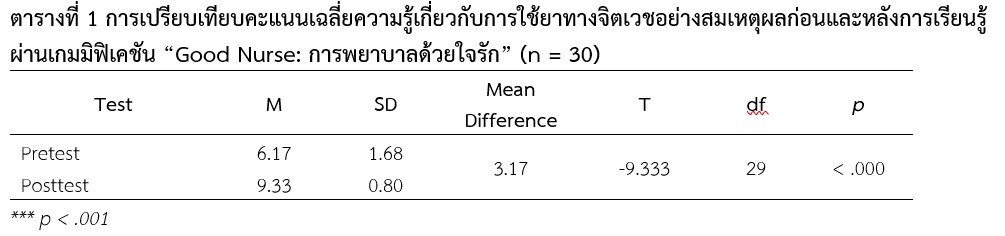
This research and development study aimed to develop and evaluate the effectiveness of a gamification prototype entitled “Good Nurse: Nursing with Compassion” to enhance nursing students’ learning of rational psychotropic drug use, based on the ADDIE Model framework. Participants were thirty fourth-year nursing students selected through purposive sampling. The research instruments comprised: (1) the gamification prototype “Good Nurse: Nursing with Compassion,” which was validated by experts and achieved a content validity index (CVI) of 1.00; (2) a knowledge test on rational psychotropic drug use with a Pearson’s correlation coefficient (r) of 0.82; and (3) a questionnaire assessing learning effectiveness and satisfaction, yielding a Cronbach’s alpha coefficient of 0.92. The results demonstrated that students’ post-test knowledge scores (M = 9.33, SD = 0.80) were significantly higher than their pre-test scores (M = 6.17, SD = 1.68) (t = –9.333, p < .001). Furthermore, students reported a high level of satisfaction with the learning experience (M = 4.20, SD = 0.86). These findings suggest that the gamification prototype effectively enhances learning outcomes and can serve as an innovative digital educational tool to foster motivation and engagement in rational psychotropic drug use learning among nursing students.
References
สภาการพยาบาล. (2562). คู่มือการจัดการเรียนการสอนการใช้ยาอย่างสมเหตุผลในหลักสูตรพยาบาลศาสตรบัณฑิต. สภาการพยาบาล.
ศุกร์ใจ เจริญสุข, ทุติยรัตน์ รื่นเริง, เกศราภรณ์ ชูพันธ์, ชรริน ขวัญเนตร, กมลรัตน์ เทอร์เนอร์, และสุนทราวดี เธียรพิเชฐ. (2568). ผลของสื่อปฏิสัมพันธ์ เรื่อง การใช้ยาอย่างสมเหตุผลในการพยาบาลจิตเวช ต่อความรู้และความพึงพอใจของนักศึกษาพยาบาล. วารสารพยาบาลกระทรวงสาธารณสุข, 35(1), 71–84.
American Psychiatric Association. (2021). The American Psychiatric Association practice guideline for the treatment of patients with schizophrenia (3rd ed.). American Psychiatric Association.
Amin, S. M., El-Fattah Mahgoub, S. A., Tawfik, A. F., Khalil, D. E., El-Sayed, A. A. I., Atta, M. H. R., Albzia, A., & Morsy Mohamed, S. R. (2025). Nursing education in the digital era: The role of digital competence in enhancing academic motivation and lifelong learning among nursing students. BMC Nursing, 24(1), 571. https://doi.org/10.1186/s12912-025-03199-2
Gini, F., Bassanelli, S., Bonetti, F., Mogavi, R. H., Bucchiarione, A., & Marconi, A. (2025). The role and scope of gamification in education: A scientometric literature review. Acta Psychologica, 259, 105418. https://doi.org/10.1016/j.actpsy.2025.105418
Kolb, D. A., & Fry, R. (1975). Toward an applied theory of experiential learning. In C. Cooper (Ed.), Studies of group process (pp. 33–57). Wiley.
Lee, M., Shin, S., Lee, M., & Hong, E. (2024). Educational outcomes of digital serious games in nursing education: A systematic review and meta-analysis of randomized controlled trials. BMC Medical Education, 24(1), 1458. https://doi.org/10.1186/s12909-024-01458-0
Li, M., Ma, S., & Shi, Y. (2023). Examining the effectiveness of gamification as a tool promoting teaching and learning in educational settings: A meta-analysis. Frontiers in Psychology, 14, 1253549. https://doi.org/10.3389/fpsyg.2023.1253549
McGriff, S. J. (2000). Instructional system design (ISD): Using the ADDIE model. https://www.lib.purdue.edu/sites/default/files/directory/butler38/ADDIE.pdf
Moonchai, K., Vatanasin, D., Pramnoi, P., & Thamruangrit, S. (2025). Gamified learning enhances psychiatric symptom knowledge in nursing students. Teaching and Learning in Nursing. Advance online publication. https://doi.org/10.1016/j.teln.2025.07.028
Nylén-Eriksen, M., Stojiljkovic, M., Lillekroken, D., Lindeflaten, K., Hessevaagbakke, E., Flølo, T. N., Hovland, O. J., Solberg, A. M. S., Hansen, S., Bjønners, A. K., & Tørris, C. (2025). Game-thinking: Utilizing serious games and gamification in nursing education—A systematic review and meta-analysis. BMC Medical Education, 25(1), 140. https://doi.org/10.1186/s12909-024-06531-7
Ryan, R. M., & Deci, E. L. (2000). Self-determination theory and the facilitation of intrinsic motivation, social development, and well-being. American Psychologist, 55(1), 68–78. https://doi.org/10.1037/0003-066X.55.1.68
World Health Organization. (2019). Promoting rational use of medicines: Core components. WHO Press. https://apps.who.int/iris/handle/10665/67438
Downloads
Published
How to Cite
Issue
Section
License
Copyright (c) 2025 Journal of Nursing, Siam University

This work is licensed under a Creative Commons Attribution-NonCommercial-NoDerivatives 4.0 International License.
Content and information published in the Journal of Nursing, Siam University is the comment and responsibility of the authors.
Articles, information, images, etc. published in the Journal of Nursing. Siam University is the copyright of the Journal of Nursing, Siam University. If any person or entity wants to take all or part of it for publication for any purposes, please reference the Journal of Nursing, Siam University.

