
Self-management of Elderly with COVID-19 Pneumonia after Discharge from the Hospital.
Keywords:
Self-management, Elderly with COVID-19 PneumoniaAbstract
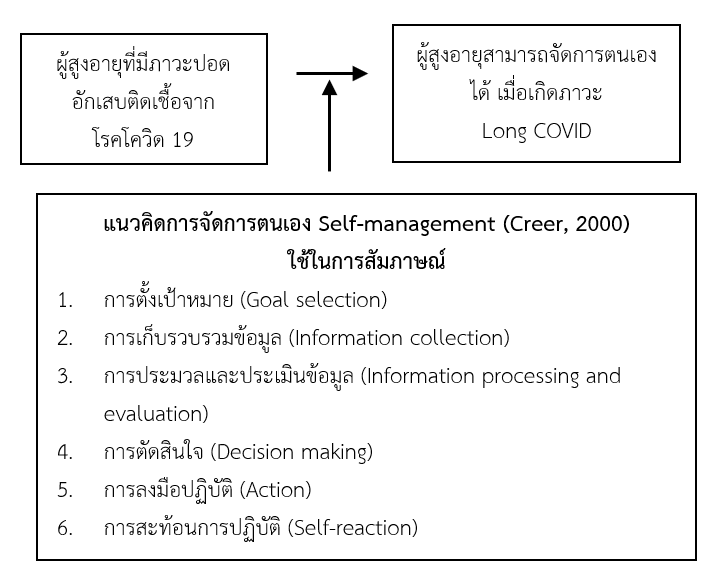
The current outbreak of the coronavirus (COVID-19) is spreading rapidly. Most patients with COVID-19 Pneumonia are elderly. This Qualitative research studies aimed to study the Self-management of elderly with COVID-19 pneumonia after discharge from the hospital by applying the concept of self-management from Creer in nursing to the context of the elderly. Data was collected from November 2022 to April 2024. The interview consisted of 1) questionnaire on personal data such as gender, age, education level, status, occupation, monthly income, residence, and underlying diseases. 2) Assessment of self-management of the elderly. 3) Inquiry into self-management of the elderly. 4) Assessment of follow-up of symptoms of elderly with COVID-19 Pneumonia after discharge from the hospital. A specific sample of 30 people aged 60 years and over was selected. Symptoms were followed up twice after discharge: the first interview was for 3 months, and the second interview was for 6 months. The researcher analyzed the data: 1) General data using descriptive statistics, percentages, means, and standard deviations; 2) Data was collected and analyzed according to the conceptual framework. Self-management of elderly with COVID-19 Pneumonia after discharge from the hospital was good.
The results showed that: The concept of Self-Management has been applied to nursing care for the Self-management of elderly with COVID-19 Pneumonia after discharge from the hospital. When returning home, they can live their daily lives with quality and reduce the risk of long-term complications.
References
กรมควบคุมโรค . (2564). การติดเชื้อไวรัสโคโรนา 2019 (COVID-19). https://ddc.moph.go.th/covid19-dashboard/
ชดช้อย วัฒนะ. (2558). การสนับสนุนการจัดการตนเอง: กลยุทธ์ในการส่งเสริมการควบคุมโรค. วารสารวิทยาลัยพยาบาลพระปกเกล้า จันทบุรี, 26(1), 117-127.
บรรลุ ศิริพานิช และสมศักดิ์ ชุณหรัศมิ. (2563). สถานการณ์ผู้สูงอายุไทย พ.ศ. 2562. สถาบันวิจัยประชากรและสังคม มหาวิทยาลัยมหิดล มูลนิธิสถาบันวิจัยและพัฒนาผู้สูงอายุไทย (มส.ผส.).
โรงพยาบาลสามพราน. (2565). รายงานสถิติจากโรงพยาบาลสามพราน. (2565). [เอกสารราชการไม่ได้ตีพิมพ์].
สุทัศนา ลิขิตกุลธนพร, บุญเตือน วัฒนกุล และรัสนา เลิศรุ่งชัยสกุล. (2565). พัฒนารูปแบบสนับสนุนการจัดการตนเองต่อพฤติกรรมการจัดการสุขภาพตนเองในภาวะอาการหลงเหลือของผู้ป่วยโควิด 19 หลังรักษาหาย. วารสารกรมการแพทย์, 47(3), 104 - 112.
สุพัตรา สิทธิวัง, ศิวพร อึ้งวัฒนา, และเดชา ทำดี. (2560). ผลของโปรแกรมส่งเสริมการจัดการตนเองต่อพฤติกรรมและระดับความดันโลหิตของผู้ที่เป็นโรคความดันโลหิตสูงที่ควบคุมไม่ได้. พยาบาลสาร, 47(2), 85 – 97.
อรวรรณ แผนคง. (2553). การพยาบาลผู้สูงอายุ (พิมพ์ครั้งที่ 2). บริษัท ธนาเพรส จำกัด.
อนุศร การะเกษ, วรรณชาติ ตาเลิศ, เกตุนรินทร์ บุญคล้าย และพิสมัย ประสมศรี. (2566).พัฒนารูปแบบการจัดการตนเองในกลุ่มอาการ Long COVID – 19 ในผู้รับบริการ หลังการติดเชื้อ COVID – 19 คลินิกโรคติดเชื้อทางเดินหายใจเฉียบพลัน: บริบทโรงพยาบาลชุมชน. วารสารโรงพยาบาลมหาสารคาม, 20(3), 34-19.
อิทธิพล ดวงจินดา, ชวนพิศ ศิริไพบูลย์ และศรีสุรางค์ เคหะนาค. (2564). การรับรู้ความสามารถของการดูแลตนเองและพฤติกรรมการป้องกันโรคโควิด-19 กับคุณภาพชีวิตผู้สูงอายุจังหวัดสุพรรณบุรี. วารสารวิจัยสาธารณสุขศาสตร์ มหาวิทยาลัยขอนแก่น, 14(4). 111-126
Downloads
Published
How to Cite
Issue
Section
License
Copyright (c) 2025 Journal of Nursing, Siam University

This work is licensed under a Creative Commons Attribution-NonCommercial-NoDerivatives 4.0 International License.
Content and information published in the Journal of Nursing, Siam University is the comment and responsibility of the authors.
Articles, information, images, etc. published in the Journal of Nursing. Siam University is the copyright of the Journal of Nursing, Siam University. If any person or entity wants to take all or part of it for publication for any purposes, please reference the Journal of Nursing, Siam University.

