
Factors Influencing Preventive Behaviors for Recurrent Stroke among Older Adults in Urban
Keywords:
Recurrent stroke, Preventive health behavior, Health literacy, Personal perception, Social supportAbstract
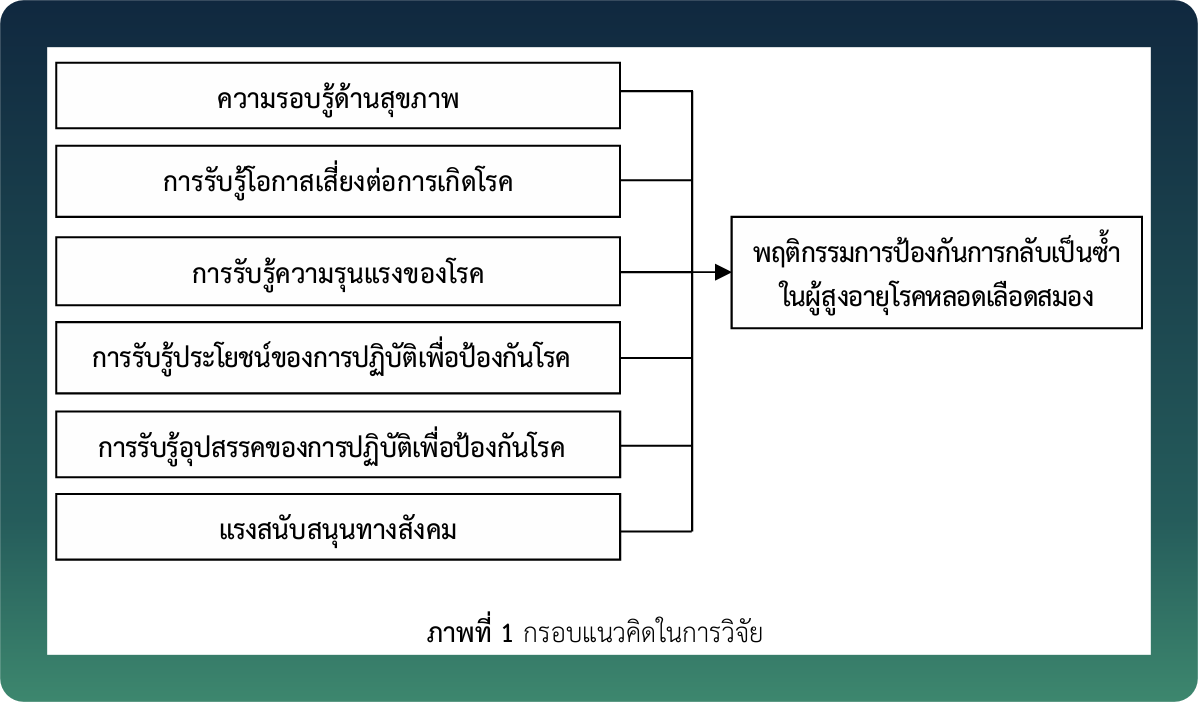
This predictive correlational research aimed to determine the predictive factors of preventive behaviors for recurrent stroke among older adults. The sample consisted of 145 older adult patients with cerebrovascular disease who received treatment at a tertiary hospital in Bangkok. Participants were selected using simple random sampling. The research instruments included: 1) a health literacy questionnaire, 2) a personal perception questionnaire, 3) a social support questionnaire and 4) a questionnaire on behavior to prevent recurrent stroke. The reliability was analyzed using Cronbach’s alpha coefficient, which were .98, .80, .91 and .94, respectively. Data were analyzed using descriptive statistics and multiple regression analysis.
The results revealed that behaviors to preventive recurrence of stroke are at a moderate level (Mean = 2.44, SD = .51). The factors of health literacy (β = .249), perception severity (β = .217), and social support (β = .184) can jointly predict recurrent of stroke prevention behavior by 22.80% (R2 = .228) were significantly (p-value < .05). The findings of this study concluded that health literacy was the most relevant variable. Nurses should promote patients in terms of health literacy which will help them to have the correct skills and knowledge for preventing the recurrence of strokes in the future.
References
Department of Older Persons. Situation of the Thai older persons. Bangkok: Amarin Corporations; 2023. (in Thai)
Tiamkao S. Incidence of stroke in Thailand. Thai Journal of Neurology 2023;39(2):39-46. (in Thai)
American Stroke Association. Stroke symptoms and warning signs [Internet]. 2024 [cited 2024 Mar 22]. Available from: https://www.stroke.org/en/about-stroke/stroke-symptoms
Han J, Mao W, Ni J, Wu Y, Liu J, Bai L, et al. Rate and determinants of recurrence at 1 year and 5 years after stroke in a low-income population in rural China. Frontiers in Neurology 2020;11:2. doi: 10.3389/fneur.2020.00002.
Erdur H, Scheitz JF, Ebinger M, Rocco A, Grittner U, Meisel A, et al. In-hospital stroke recurrence and stroke after transient ischemic attack: frequency and risk factors. Stroke 2015;46(4):1031-7. doi: 10.1161/STROKEAHA.114.006886.
Aunthakot K, Loahasiriwong W, Tiamkao S. Recurrence stroke of ischemic stroke patients in Thailand: a nationwide study. International Journal of Public Health Science 2023;12(2):614-20. doi: 10.11591/ijphs.v12i2.22504.
Pimsri N. The results of the study on the recurrence of stroke patients in Waeng Noi district, Khon Kaen province [Internet]. 2023 [cited 2024 Mar 22]. Available from: https://www.kkh.go.th/wp-content/uploads/2023/07/นางนงลักษณ์-พิมพ์ศรี-รพ.แวงน้อย.pdf (in Thai)
Allen NB, Holford TR, Bracken MB, Goldstein LB, Howard G, Wang Y, et al. Geographic variation in one-year recurrent ischemic stroke rates for elderly Medicare beneficiaries in the USA. Neuroepidemiology 2010;34(2):123-9. doi: 10.1159/000274804.
Khumsa-ard S, Thiangtham W, Suwan-ampai P. Behavior factors related to recurrent stroke. Journal of Public Health Nursing 2017;31 Suppl 1:S13-26. (in Thai)
Nutbeam D. Health literacy as a public health goal: a challenge for contemporary health education and communication strategies into the 21st century. Health Promotion International 2000;15(3):259-67. doi: 10.1093/heapro/15.3.259.
Becker MH. The health belief model and sick role behavior. Health Education Monographs 1974;2(4):409-19. doi: 10.1177/109019817400200407.
House JS. Work stress and social support. Boston: Addison-Wesley; 1981.
Engström HE, Flink M, Lindblom S, von Koch L, Ytterberg C. Association between general self-efficacy and health literacy among stroke survivors 1-year post-discharge: a cross-sectional study. Scientific Reports 2024;14(1):7308. doi: 10.1038/s41598-024-57738-z.
Toonsiri C, Jullamate P, Sianghwong H, Acedera LC. Factors related to health literacy of recurrent stroke prevention among older adult stroke survivors. Working With Older People 2025;29(2):182-90. doi: 10.1108/WWOP-06-2024-0028.
Wang Y, Liu D, Aldhabi M, Chen Z, Feng L, Gao H, et al. Risk prediction model for poor prognosis after intravenous thrombolysis among ischemic stroke patients aged ≥ 80 years and analysis of follow-up. Scientific Reports 2025;15:1354. doi: 10.1038/s41598-024-84912-00.
Yoo JW, Hong BY, Jo L, Kim JS, Park JG, Shin BK, et al. Effects of age on long-term functional recovery in patients with stroke. Medicina (Kaunas) 2020;56(9):451. doi: 10.3390/medicina56090451.
Department of Disease Control. Handbook on health literacy processes for disease prevention and control and health hazards. Nonthaburi: RNPP WATER; 2021. (in Thai)
Kleindorfer DO, Towfighi A, Chaturvedi S, Cockroft KM, Gutierrez J, Lombardi-Hill D, et al. 2021 guideline for the prevention of stroke in patients with stroke and transient ischemic attack: a guideline from the American Heart Association/American Stroke Association. Stroke 2021;52(7):e364-467. doi: 10.1161/STR.0000000000000375.
Trongsakul S. Correlation between cognitive impairment and depressive mood of Thai elderly with type 2 diabetes in a primary care setting. Malaysian Family Physician 2015;10(1):11-8.
Department of Medical Services. Manual for screening and health assessment of older persons B.E. 2564 (2021) [Internet]. 2021 [cited 2024 Jan 19]. Available from: https://ddc.moph.go.th/uploads/ckeditor2/files/คู่มือการคัดกรองและประเมินสุขภาพผู้สูงอายุ%20พ.ศ.%202564.pdf (in Thai)
Cohen J. Statistical power analysis for the behavioral sciences. 2nd ed. New York: Routledge; 1988.
Srisatidnarakul B. Effect size, power analysis, optimal sample size calculations using G*power software. Bangkok: Chulalongkorn University Press; 2020. (in Thai)
Kotalux C. Factors related to health behavior of elderly with recurrent stroke [Dissertation]. Chonburi: Burapha University; 2020. (in Thai)
Lortajakul C. The development of the quality of life instrument in Thai patients with post myocardial infarction [Dissertation]. Bangkok: Chulalongkorn University; 2006. (in Thai)
Kongkaew O. Illness representation and recurrence prevention behaviors in elderly with stroke [Dissertation]. Songkhla: Prince of Songkla University; 2018. (in Thai)
Saramad N, Petsirasan R, Sowanno J, Ratborirak K. Predicting factors of the targeted blood pressure control among patients with post-acute ischemic stroke at a general hospital, Sichon district, Nakhon Si Thammarat. Journal of the Police Nurses 2020;12(1):100-13. (in Thai)
Amarenco P, Tonkin AM. Statins for stroke prevention: disappointment and hope. Circulation 2004;109(23 Suppl 1):III44-9. doi: 10.1161/01.CIR.0000131518.25959.8F.
Chuamworakul W. Vascular risk factors for recurrent stroke in Nonsung hospital. Journal of Environmental and Community Health 2024;9(2):527-34. (in Thai)
Anadani M, Turan TN, Yaghi S, Spiotta AM, Gory B, Sharma R, et al. Change in smoking behavior and outcome after ischemic stroke: post-hoc analysis of the SPS3 trial. Stroke 2023;54(4):921-7. doi: 10.1161/STROKEAHA.121.038202.
Shani SD, Varma RP, Sarma SP, Sreelakshmi RS, Harikrishnan R, Kutty VR, et al. Treatment in a stroke unit and risk factor control reduce recurrent stroke risk. Cerebrovascular Diseases Extra 2022;12(2):85-92. doi: 10.1159/000525716.
Ramu G, Gayathri C. Assessing the effects of diet and lifestyle changes in the prevention of recurrent ischemic stroke. International Journal of Tropical Medicine 2023;18(4):11-4. doi: 10.59218/makijtm.2023.4.11.14.
Lei R, Zhang M, Gui G, Yang D, He L. How perceived risk of recurrence strengthens health management awareness in stroke patients: the chain mediating role of risk fear and health literacy. Frontiers in Public Health 2025;13:1524492. doi: 10.3389/fpubh.2025.1524492.
Ambarika R, Anggraini NA. Family support for prevention of recurrent stroke events for stroke patients. Journal of Global Research in Public Health 2022;7(1):8-16. doi: 10.30994/jgrph.v7i1.363.
Chen X, Samartkit N, Masingboon K. Factors associated with self-management behaviors among Chinese adults with ischemic stroke: a cross-sectional study. Belitung Nursing Journal 2024;10(3):285-93. doi: 10.33546/bnj.3267.
Ouyang W, Wang R, He Y, Song Y, Mo L, Feng L. Status and influential factors of health literacy in patients with ischemic stroke: a cross-sectional study. PLoS One 2024;19(7):e0307928. doi: 10.1371/journal.pone.0307928.
Rahmawati RN, Lahdji A, Anggraini MT. The relationship of perceived severity and recurrent stroke prevention behavior at post-non-hemorrhagic stroke patients. South East Asia Nursing Research 2024;6(1):25-31. doi: 10.26714/seanr.6.1.2024.25-31.
Downloads
Published
How to Cite
Issue
Section
License
Copyright (c) 2025 Kuakarun Journal of Nursing

This work is licensed under a Creative Commons Attribution-NonCommercial-NoDerivatives 4.0 International License.