
Development and Efficiency Evaluation of the “Im-Oun” Smartphone Application Innovation on Risk of Malnutrition in Patients Undergoing Hemodialysis
Keywords:
Smartphone application, Malnutrition risk, Hemodialysis patientsAbstract
This research and development study aimed to develop and examine the effectiveness of the “Im-Oun” smartphone application in reducing the risk of malnutrition among patients undergoing hemodialysis. The sample consisted of 28 hemodialysis patients receiving services at the Dialysis Center, Thammasat University Hospital. The research instrument was the “Im-Oun” application. Data were collected using the Malnutrition Inflammation Score (MIS), and the reliability of the instrument was tested using Cronbach’s alpha coefficient, yielding a reliability value of .89. Data were analyzed using descriptive statistics, t-test, and analysis of variance.
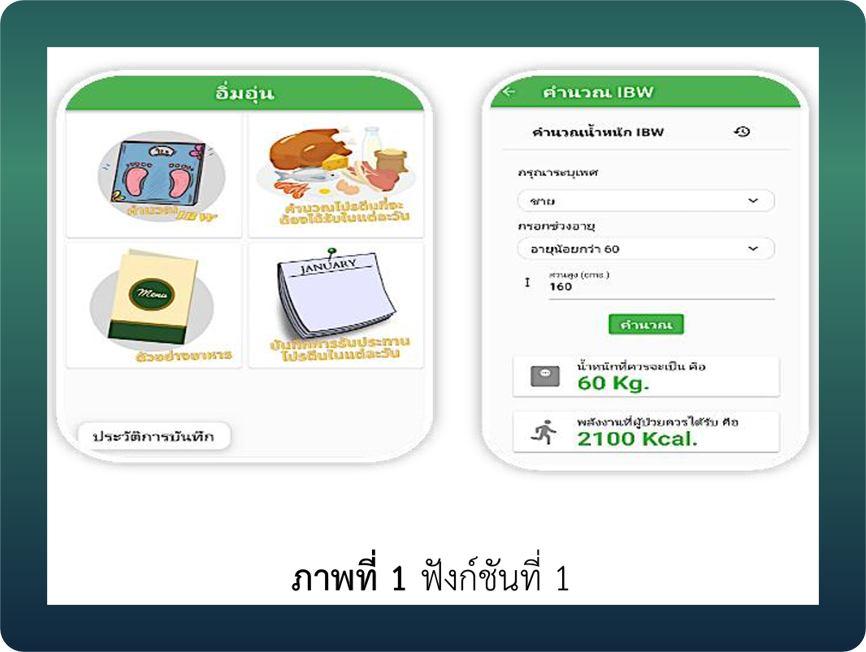
The “Im-Oun” smartphone application was designed to promote nutritional status in hemodialysis patients. Its main functions include dietary intake recording, displaying individualized energy and protein values, and monitoring progress in collaboration with the healthcare team. After using the application, patients demonstrated a statistically significant reduction (F = 8.34, p-value < .001) in mean malnutrition risk scores compared to baseline, both at week 4 (Mean = 5.18, SD = .44) and week 8 (Mean = 5.18, SD = .44). The findings indicate that the “Im-Oun” application can be used as an effective tool to promote appropriate nutritional status in patients undergoing hemodialysis.
References
The Nephrology Society of Thailand. Annual report Thailand renal replacement therapy 2023 [Internet]. 2025 [cited 2024 Mar 20]. Available from: https://www.nephrothai.org/wp-content/uploads/2025/03/Ebook-TRT-book-2023-10-Mar-2025Final.pdf (in Thai)
Rhee CM, Wang AYM, Biruete A, Kistler B, Kovesdy CP, Zarantonello D, et al. Nutritional and dietary management of chronic kidney disease under conservative and preservative kidney care without dialysis. Journal of Renal Nutrition 2023;33(6S):S56-66. doi: 10.1053/j.jrn.2023.06.010.
Piccoli GB, Cederholm T, Avesani CM, Bakker SJL, Bellizzi V, Cuerda C, et al. Nutritional status and the risk of malnutrition in older adults with chronic kidney disease - implications for low protein intake and nutritional care: a critical review endorsed by ERN-ERA and ESPEN. Clinical Nutrition 2023;42(4):443-57. doi: 10.1016/j.clnu.2023.01.018.
Xi WZ, Wu C, Liang YL, Wang LL, Cao YH. Analysis of malnutrition factors for inpatients with chronic kidney disease. Frontiers in Nutrition 2023;9:1002498. doi: 10.3389/fnut.2022.1002498.
Blankestijn PJ, Vernooij RWM, Hockham C, Strippoli GFM, Canaud B, Hegbrant J, et al. Effect of hemodiafiltration or hemodialysis on mortality in kidney failure. New England Journal of Medicine 2023;389(8):700-9. doi: 10.1056/NEJMoa2304820.
Fadem SZ, Moura-Neto JA, Golper TA. Complications in dialysis: a clinical guide. New York: Springer Nature; 2023.
Chong CH, Au EH, Davies CE, Jaure A, Howell M, Lim WH, et al. Long-term trends in infection-related mortality in adults treated with maintenance dialysis. American Journal of Kidney Diseases 2023;82(5):597-607. doi: 10.1053/j.ajkd.2023.03.018.
Rashid I, Tiwari P, Cruz SD, Jaswal S. Rates and determinants of fast chronic kidney disease progression distinguished by nutritional status, and the impact of malnutrition on mortality - evidence from a clinical population. Clinical Nutrition ESPEN 2023;57:683-90. doi: 10.1016/j.clnesp.2023.08.008.
Rashid I, Sahu G, Tiwari P, Willis C, Asche CV, Bagga TK, et al. Malnutrition as a potential predictor of mortality in chronic kidney disease patients on dialysis: a systematic review and meta-analysis. Clinical Nutrition 2024;43(7):1760-9. doi: 10.1016/j.clnu.2024.05.037.
Cupisti A, Kovesdy CP, D’Alessandro C, Kalantar-Zadeh K. Dietary approach to recurrent or chronic hyperkalaemia in patients with decreased kidney function. Nutrients 2018;10(3):261. doi: 10.3390/nu10030261.
Pack S, Lee J. Randomised controlled trial of a smartphone application-based dietary self-management program on haemodialysis patients. Journal of Clinical Nursing 2021;30(5-6):840-8. doi: 10.1111/jocn.15627.
Teong LF, Khor BH, Ng HM, Sahathevan S, Purba KR, Narayanan SS, et al. Effectiveness of a nutritional mobile application for management of hyperphosphatemia in patients on hemodialysis: a multicenter open-label randomized clinical trial. Journal of Personalized Medicine 2022;12(6):961. doi: 10.3390/jpm12060961.
Khoury CFE, Crutzen R, Schols JMGA, Halfens RJG, Karavetian M. A dietary mobile app for patients undergoing hemodialysis: prospective pilot study to improve dietary intakes. Journal of Medical Internet Research 2020;22(7):e17817. doi: 10.2196/17817.
Kaewboonsert D, Chuayunan N, Khamnuan P. The development of care model for patients with chronic kidney disease at Phayao hospital and network. Journal of Phrae Public Health for Development 2023;3(2):1-16. (in Thai)
Ghozali MT, Satibi S, Forthwengel G. The impact of mobile health applications on the outcomes of patients with chronic kidney disease: a systematic review and meta-analysis. Journal of Medicine and Life 2023;16(9):1299-309. doi: 10.25122/jml-2023-0153.
Borg WR, Gall MD. Educational research. An introduction. 5th ed. White Plains, New York: Longman; 1989.
Rattanaruang R, Prapaipanich W, Visudtibhan PJ, Lekhyananda S. Effects of a food intake focused on protein promoting program in end-stage renal disease patients undergoing hemodialysis. Ramathibodi Nursing Journal 2014;20(3):341-55. (in Thai)
Pairojkittrakul S, Harnirattisai T, Thitiarchakul S. The effect of a shared care-promoting program on shared care, nutritional status and, exit site infection among continuous ambulatory peritoneal dialysis patients. Ramathibodi Nursing Journal 2014;20(3):325-40. (in Thai)
Kalantar-Zadeh K, Kopple JD, Block G, Humphreys MH. A malnutrition-inflammation score is correlated with morbidity and mortality in maintenance hemodialysis patients. American Journal of Kidney Diseases 2001;38(6):1251-63. doi: 10.1053/ajkd.2001.29222.
The Nephrology Society of Thailand. Thai version of Malnutrition Inflammation Score (MIS), translated and validated tool. In: Clinical Nutrition Guidelines for CKD Patients. Bangkok: The Nephrology Society of Thailand; 2022. p. 67-70.
Norman D. The design of everyday things. New York: Basic Books; 2013.
Wongsaree C, Praneetham W. The study of relationships and factors influencing dietary and fluid consumption among end stage renal disease patients receiving hemodialysis. Journal of The Royal Thai Army Nurses 2018;19(3):117-25. (in Thai)
Nateetanasombat K, Pantasri P, Meekun S. Effects of transaction on food consumption behaviors and serum albumin levels in chronic kidney disease patients receiving hemodialysis [Dissertation]. Bangkok: Huachiew Chalermprakiet University; 2014. (in Thai)
Sanbanditi T. Development of care model using self-management in patients with chronic kidney failure who received hemodialysis using hemodialysis machine, Pla Pak hospital Nakhon Phanom province. Journal of Environmental and Community Health 2024;9(3):291-6. (in Thai)
Downloads
Published
How to Cite
Issue
Section
License
Copyright (c) 2025 Kuakarun Journal of Nursing

This work is licensed under a Creative Commons Attribution-NonCommercial-NoDerivatives 4.0 International License.