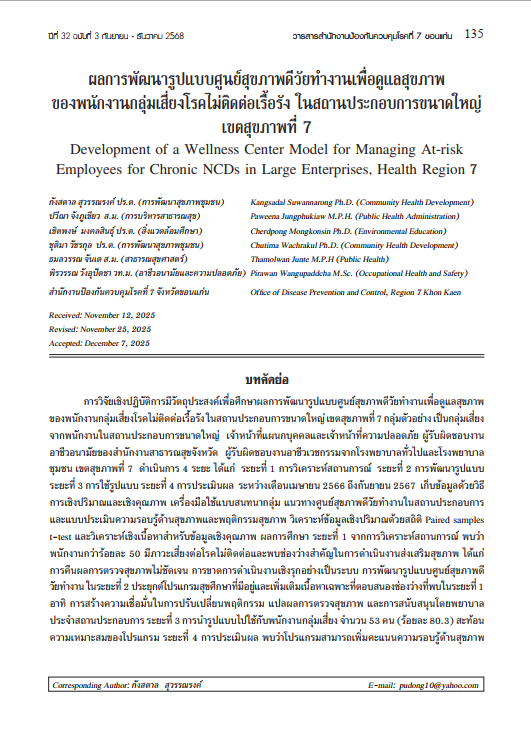
Development of a Wellness Center Model for Managing At-risk Employees for Chronic NCDs in Large Enterprises, Health Region 7
Keywords:
Wellness Center, At-Risk Employees, NCDs, Large Enterprises, Health Region 7Abstract
This action research aimed to develop a Wellness Center Model for Managing at-risk Employees with non-communicable diseases (NCDs) in large-scale establishments in Health Region 7. The participants included at-risk employees from large-scale establishments, human resources and safety officers, occupational health personnel from Provincial Health Offices, and occupational medicine staff from general and community hospitals in Health Region 7. The study was conducted in four phases between April 2023 and September 2024: Phase 1, situation analysis; Phase 2, model development; Phase 3, model implementation; and Phase 4, evaluation. Data were collected using both quantitative and qualitative methods. Research instruments included focus group discussion guides, guidelines for implementing the Wellness Center Model for Managing At-Risk Employees in establishments, and questionnaires assessing health literacy and health behaviors. Quantitative data were analyzed using a paired samples t-test, while qualitative data were analyzed through content analysis. Phase 1 situation analysis revealed that over 50% of employees were at risk for NCDs, with significant gaps identified in health promotion implementation, including unclear feedback on health examination results and a lack of systematic proactive interventions. Phase 2 involved developing the Wellness Center Model for Managing At-Risk Employees by adapting existing health education programs and incorporating additional content specifically addressing the gaps identified in Phase 1, such as building confidence in behavior modification, interpreting health examination results, and providing support by workplace nurses. Phase 3 implemented the model with 53 at-risk employees (representing 80.3% participation), reflecting the program's appropriateness. Phase 4 evaluation demonstrated that the program significantly increased health literacy scores by 4.81 points (p <0.001), with the greatest improvement observed in the information access and communication domain. Research recommendations suggest that large-scale establishments should support workplace nurses to perform surveillance and monitor the health status of at-risk employees. Future research should conduct long-term follow-up and evaluate effectiveness in medium and small-scale establishments.
Downloads
References
กระทรวงแรงงาน. สถิติแรงงานประจำปี 2565. กรุงเทพฯ: กองเศรษฐกิจการแรงงาน สำนักงานปลัดกระทรวงแรงงาน; 2566.
World Health Organization. Assessing national capacity for the prevention and control of noncommunicable diseases: report on 2023 global survey. Geneva: World Health Organization; 2023.
พัชรินทร์ มณีพงศ์, วลัยพร สิงห์จุ้ย, สัญญา สุขขำ, เพ็ชรน้อย ศรีผุดผ่อง. ความสัมพันธ์ระหว่างความรอบรู้ด้านสุขภาพกับพฤติกรรมสุขภาพ 3อ 2ส ของประชาชนจังหวัดสุพรรณบุรี. วารสารวิทยาลัยพยาบาลบรมราชชนนี สุพรรณบุรี 2563; 4(1): 84-93.
เริงฤดี ปธานวนิช, บรรณาธิการ. การสำรวจสุขภาพประชาชนไทยโดยการตรวจร่างกาย ครั้งที่ 7 พ.ศ. 2567-2568. นนทบุรี: คณะแพทยศาสตร์โรงพยาบาลรามาธิบดี มหาวิทยาลัยมหิดล; 2568.
กองโรคไม่ติดต่อ กรมควบคุมโรค. รายงานสถานการณ์โรค NCDs เบาหวาน ความดันโลหิตสูงและปัจจัยเสี่ยงที่เกี่ยวข้อง พ.ศ. 2562. กรุงเทพฯ: อักษรกราฟฟิคแอนด์ดีไซน์; 2563.
สำนักงานป้องกันควบคุมโรคที่ 7 จังหวัดขอนแก่น. สถานการณ์โรคเบาหวานในพื้นที่เขตสุขภาพที่ 7 [อินเทอร์เน็ต]. 2567 [เข้าถึงเมื่อ 14 พ.ย. 2567]. เข้าถึงได้จาก: https://ddc.moph.go.th/odpc7/news.php?news=47616&deptcode=odpc7&news_views=575.
ศูนย์พัฒนาวิชาการอาชีวอนามัยและสิ่งแวดล้อม จังหวัดสมุทรปราการ. แนวทางการดำเนินงานศูนย์สุขภาพดีคนทำงานองค์รวม. นนทบุรี: กรมควบคุมโรค กระทรวงสาธารณสุข; 2565.
Gernert M, Stassen G, Schaller A. Association between health literacy and work ability in employees with health-related risk factors: a structural model. Front Public Health. 2022; 10: 804390. doi: 10.3389/fpubh.2022.804390.
Nutbeam D, McGill B, Premkumar P. Improving health literacy in community populations: a review of progress. Health Promot Int 2018; 33(5): 901-11. doi: 10.1093/heapro/dax015.
Sorensen K, Van den Broucke S, Fullam J, Doyle G, Pelikan J, Slonska Z, et al. Health literacy and public health: a systematic review and integration of definitions and models. BMC Public Health 2012; 12(1): 80. doi: 10.1186/1471-2458-12-80.
กองสุขศึกษา กรมสนับสนุนบริการสุขภาพ กระทรวงสาธารณสุข. คู่มือการดูแลสุขภาพตามหลัก 3อ.2ส. สำหรับแกนนำสุขภาพ [อินเทอร์เน็ต]. นนทบุรี: กรมสนับสนุนบริการสุขภาพ; ม.ป.ป. [เข้าถึงเมื่อ 10 ม.ค. 2568]. เข้าถึงได้จาก: https://hed.hss.moph.go.th/wp-content/uploads/2024/05/คู่มือการดูแลสุขภาพตามหลัก-3อ.2ส.-สำหรับแกนนำสุขภาพ.pdf.
Suka M, Odajima T, Okamoto M, Sumitani M, Igarashi A, Ishikawa H, et al. Relationship between health literacy, health information access, health behavior, and health status in Japanese people. Patient Educ Couns 2015; 98(5): 660-8. doi: 10.1016/j.pec.2015.02.013.
Nutbeam D. Health literacy as a public health goal: a challenge for contemporary health education and communication strategies into the 21st century. Health Promot Int 2000; 15(3): 259-67. doi: 10.1093/heapro/15.3.259.
Parker R. Health literacy: a challenge for American patients and their health care providers. Health Promot Int 2000; 15(4): 277-83. doi: 10.1093/heapro/15.4.277.
Chang LC. Health literacy, self‐reported status and health promoting behaviours for adolescents in Taiwan. J Clin Nurs 2011; 20(1-2): 190-6. doi: 10.1111/j.1365-2702.2009.03181.x.
Berkman ND, Sheridan SL, Donahue KE, Halpern DJ, Crotty K. Low health literacy and health outcomes: an updated systematic review. Ann Intern Med 2011; 155(2): 97-107. doi: 10.7326/0003-4819-155-2-201107190-00005.
วิมล โรมา, สายชล คล้อยเอี่ยม. ผลสำรวจความรอบรู้ด้านสุขภาพของประชาชนไทย อายุ 15 ปีขึ้นไป พ.ศ. 2562. นนทบุรี: สถาบันวิจัยระบบสาธารณสุข; 2562.
พรภัทรา แสนเหลา, ศรีอุบล อินแป้น, สายนาถ หวานนุรักษ์, ณัฐกฤตา ลีเบาะ. ความรอบรู้ด้านสุขภาพและพฤติกรรมตามหลัก 3อ.2ส. ของผู้ป่วยโรคเบาหวานวัยผู้ใหญ่ ตำบลนาฝาย อำเภอเมือง จังหวัดชัยภูมิ. วารสารสำนักงานสาธารณสุขจังหวัดขอนแก่น 2568; 7(1): e269948.
McCambridge J, Witton J, Elbourne DR. Systematic review of the Hawthorne effect: New concepts are needed to study research participation effects. J Clin Epidemiol 2014; 67(3): 267-77. doi: 10.1016/j.jclinepi.2013.08.015.
ศุภวรรณ พงศ์ทอง. ประสิทธิผลของโปรแกรมการปรับเปลี่ยนพฤติกรรมสุขภาพ 3อ.2ส. ด้านความรอบรู้ด้านสุขภาพของผู้ป่วยโรคไม่ติดต่อเรื้อรัง ในหมู่บ้านจัดการสุขภาพตำบลแก้มอ้น อำเภอจอมบึง จังหวัดราชบุรี. วารสารสหวิชาการเพื่อสุขภาพ 2566; 5(2): 35-43.
ณัทณพงศ์ พีรภัคพงศ์, ประสิทธิ์ กมลพรมงคล. การพัฒนาความรอบรู้ด้านสุขภาพในการส่งเสริมพฤติกรรมสุขภาพ 3อ.2ส. ของแรงงานกัมพูชาที่ทำงานในสถานประกอบการ จังหวัดชลบุรี. วารสารวิจัยและพัฒนาระบบสุขภาพ 2567; 17(3): 213-25.
จุฑามาศ ปุญญปุระ. การพัฒนารูปแบบการสร้างเสริมความรอบรู้ด้านสุขภาพของพนักงานโรงงานในจังหวัดนครสวรรค์. วารสารสาธารณสุขมูลฐาน (ภาคเหนือ) 2567; 34(2): 4-11.
Knowles MS. The Adult Learner: A Neglected Species. 3rd ed. Houston: Gulf Publishing; 1984.
Prochaska JO, Norcross JC, Diclemente CC. Changing for Good: a Revolutionary Six-Stage Program for Overcoming Bad Habits and Moving Your Life Positively Forward. New York: Harper Collins Publishers; 2006.
พรสวรรค์ ทรัพย์เย็น. ผลของการใช้โปรแกรมสุขศึกษาเสริมสร้างความรอบรู้ด้านสุขภาพและพฤติกรรมสุขภาพตาม 3อ.2ส. ในผู้ป่วยโรคเอดส์ที่คลินิกรับยาต้านไวรัสเอดส์ โรงพยาบาลบ้านโป่ง. วารสารวิจัยเพื่อการส่งเสริมสุขภาพและคุณภาพชีวิต 2565; 2(1): 1-12.
Bandura A. Social learning theory. Englewood Cliffs, NJ: Prentice Hall; 1977. p77.
Downloads
Published
How to Cite
Issue
Section
License
Copyright (c) 2025 สำนักงานป้องกันควบคุมโรคที่7จังหวัดขอนแก่น

This work is licensed under a Creative Commons Attribution-NonCommercial-NoDerivatives 4.0 International License.
ความรับผิดชอบ
บทความที่ลงพิมพ์ในวารสารสำนักงานป้องกันควบคุมโรคที่ 7 ขอนแก่น ถือเป็นผลงานทางวิชาการหรือวิจัย และวิเคราะห์ตลอดจนเป็นความเห็นส่วนตัวของผู้เขียน ไม่ใช่ความเห็นของวารสารสำนักงาน ป้องกันควบคุมโรคที่ 7 จังหวัดขอนแก่น หรือ ของกองบรรณาธิการแต่ประการใด ผู้เขียนต้องรับผิดชอบต่อบทความของตนเอง
ลิขสิทธ์บทความ
บทความที่ได้รับการตีพิมพ์จะถือเป็นลิขสิทธิ์ของสำนักงานป้องกันตวบคุมโรคที่ 7 จังหวัดขอนแก่น