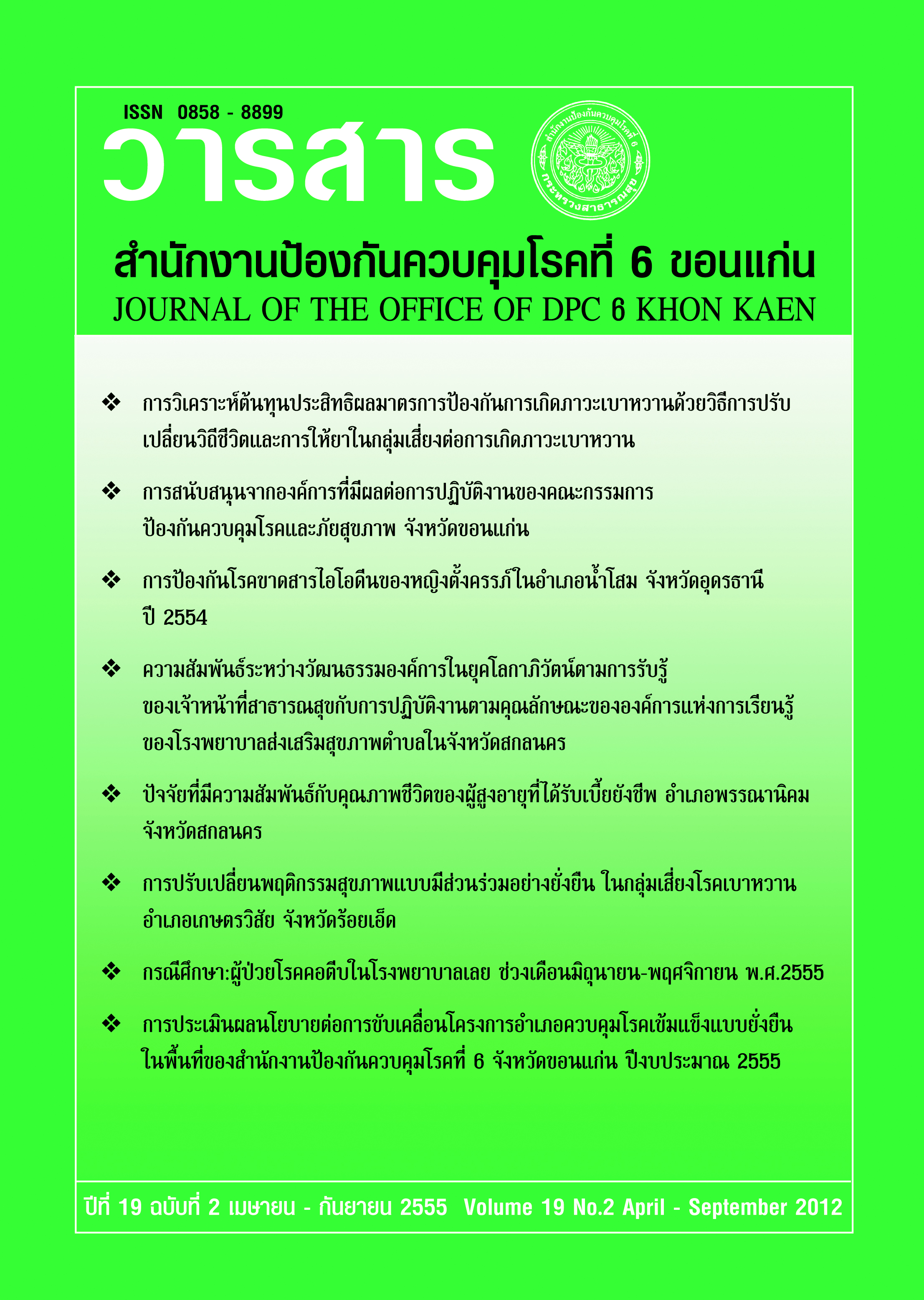
Evaluation of policy related to the implementation of the programme on competent district in Disease control in responsible area of The office of Disease prevention and control 6, Khon Kaen, 2012
Keywords:
Disease control competent district, Evaluation, PolicyAbstract
The objective of this evaluation research was to evaluate policy according to the program on competent district in disease control which has been implemented between January 2011 and September 2012 by using CIPP Model as a tool for evaluation. Four components including context, input, process and output were evaluated by CIPP model among 108 related and responsible Health personnel from 43 organizations. Data collection was made by interview, focus group, questionnaire and gathering from report, documents. Research instrument validation and content reliability were analyzed. Data verified by triangulation technique. The study was conducted between January 2011 and September 2012. The result revealed the strong and appropriate policy relevant to the implementation of the program on competent district in disease which fit very well to the situation. Most of health personnel from provincial level suggested that the policy was quite appropriate and feasible for further implementation. Fifty three point three percent of them viewed that the budget allocation for improvement of potential of the District SRRT was somewhat delayed, together with similar delay in communication of policy to the district level in the first year. More than 70 percent agreed with the training module of district SRRT but suggested that 1 day course was not sufficient for completed all content. In terms of investigation and disease control outcome. In addition, most district teams were more inclined to select and focus only the successful operation from endemic disease in their area as issue to be evaluated such as dengue hemorrhagic fever, leptospirosis, food poisoning and tuberculosis respectively. Attempts were made for management to better support of program on competent district in disease control both regional and provincial level. The impact of successful implementation of policy could make more effective outcome in terms of decreasing of morbidity and mortality from communicable and non communicable disease, together with better improve of surveillance system for routine work which subsequently related to mutual benefit of stakeholders in the future.
Authors have made relevant recommendation on more effective policy to be a prime mover for successful implementation of program in competent district on disease control in the near future.
Downloads
Downloads
Published
How to Cite
Issue
Section
License
ความรับผิดชอบ
บทความที่ลงพิมพ์ในวารสารสำนักงานป้องกันควบคุมโรคที่ 7 ขอนแก่น ถือเป็นผลงานทางวิชาการหรือวิจัย และวิเคราะห์ตลอดจนเป็นความเห็นส่วนตัวของผู้เขียน ไม่ใช่ความเห็นของวารสารสำนักงาน ป้องกันควบคุมโรคที่ 7 จังหวัดขอนแก่น หรือ ของกองบรรณาธิการแต่ประการใด ผู้เขียนต้องรับผิดชอบต่อบทความของตนเอง
ลิขสิทธ์บทความ
บทความที่ได้รับการตีพิมพ์จะถือเป็นลิขสิทธิ์ของสำนักงานป้องกันตวบคุมโรคที่ 7 จังหวัดขอนแก่น