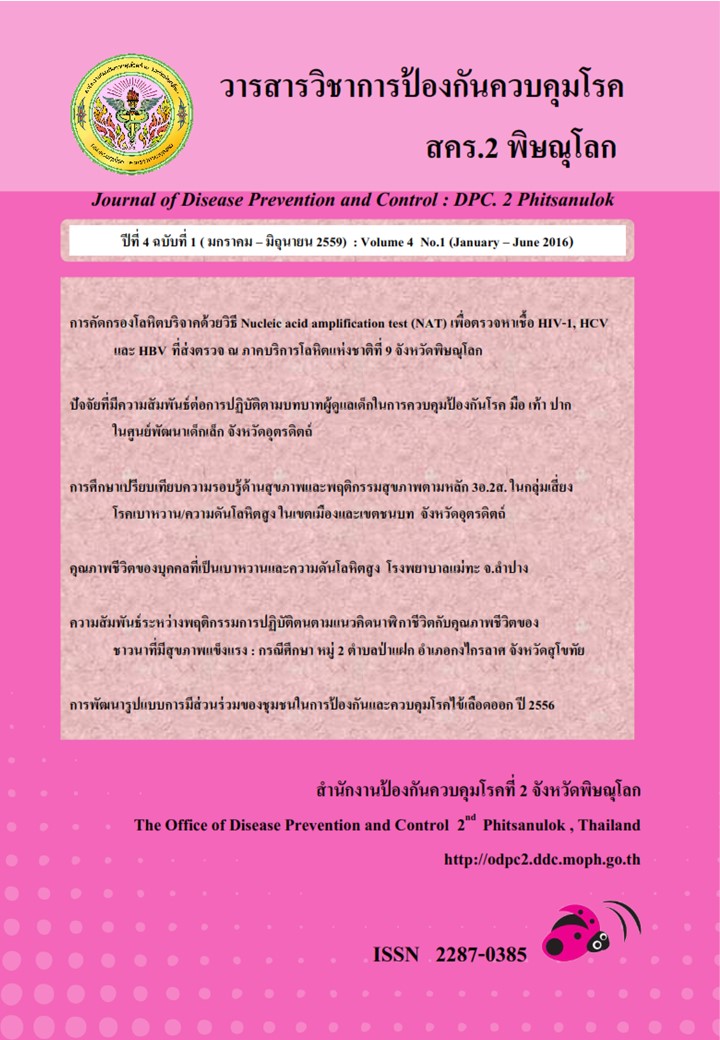
Nucleic acid amplification test (NAT) screening for Human Immunodeficiency Virus-1, Hepatitis C Virus and Hepatitis B Vivus of blood donation at The Regional Blood Centre 9, Phisanulok Provinc
Article Sidebar
Main Article Content
Abstract
The National Blood Service Region 9, Phitsanulok screened blood donors by nucleic acid amplification test (NAT), including six samples to detect HIV-1, HCV and HB. At present it has produced synthetic blood but it has various features. There is no substitute for human blood since it is a synthetic non-biodegradable matrix
metabolic process of the body ooze. Screening blood donations are made with NAT blood safety to recipients by meeting the standards of the World Health Organization. The purpose of this study was to study the rate of detection of HIV-1, HCV and HBV testing with NAT (NAT yield rate) to reduce the risk of infection, four from the blood and makes blood more secure level. The patients were studied for the benefit of NAT testing on samples of blood specimens donated to the National Blood Service Region 9, Phitsanulok. The NAT Phitsanulok introduced into used in February 2554 and a sample study to September 2556, if an example by the way Serologic test results were negative, it would confirmed with NAT testing included six samples (minipool 6). Based on blood samples NAT, 119,335 samples (representing 39.1 % of blood donors who tested NAT at the National Blood Service at 9 Phitsanulok) The test results Serologic was a negative total of 115,654 samples. The experiment with how NAT cannot detect HIV RNA, detected HCV RNA of one or HCV NAT yield rate 1:50,237 detectable HBV number 84 or HBV NAT yield rate 1: 1,377 which was consistent with the prevalence of HBV and HCV in Northern. The result demonstrated that the technique used in conjunction with NAT testing methods Serologic in the selection of blood donors it was necessary and useful to enhance the safety of blood and blood components to donate to their patients.
Article Details
ข้อลิขสิทธิ์วารสาร
บทความหรือข้อคิดเห็นใดๆ ที่ปรากฏในวารสารวิชาการป้องกันควบคุมโรค สคร. 2 พิษณุโลก เป็นวรรณกรรมของผู้เขียน กองบรรณาธิการวิชาการ และ สำนักงานป้องกันควบคุมโรคที่ 2 จังหวัดพิษณุโลกไม่จำเป็นต้องเห็นพ้องด้วยทั้งหมดหรือร่วมรับผืิดชอบใดๆ
References
2. Stramer SL, Caglioti S, Strong DM. NAT of the United States and Canadian Blood supply. Transfusion. 2000; 40: 1165-8.
3. Coste J, Reesink HW, Engelfried CP, et al. Implementation of donor screening forinfectious agents transmitted by blood bynucleic acid technology: update to 2003.Vox Sang. 2005; 88: 289-303.
4. Seed CR, Cheng A, Ismay SL, et al.Assessing the accuracy of three viral risk models in predicting the outcome of implementing HIV and HCV NAT donor
screening Australia and the implications for future HBV NAT. Transfusion. 2002; 42: 1365-72.
5. Murokawa H, Yoshikawa A, Ohnuma H, et al. Epidemiology of blood donors in Japan. Positive for hepatitis B virus and hepatitis C virus by nucleic acid amplification testing. Vox sang. 2005;88:10-6.
6. Tanprasert S. Nucleic Acid Technique Screening: Feasibility study in Thailand. J Hematol Transfus Med. 2001; 11: 173-7.
7. Phikulsod S, Oota S, Tirawatnapong T, et al. and the working Group for NAT Study in Thai Blood Donations. One-year experience
of nucleie acid technology testing for human immunodeficiency virus Type 1, hepatitis C virus, and hepatitis B virus in Thai blood donations. Transfusion. 2009;
49: 1126-35.
8. Department Of Disease Control, Miniatry Of Public Health. National Blood Policy. 2"ed. 2010:17-8.
9. The National Blood Centre, The Thai Red Cross Society. Standards for Blood Banks and Transfusion Services. 2"ed. 2008: 15-6.
10.Niazi SK, Bhatti FA, Salamat N, et al. Impact of nucleic acid amplification test on screening of blood donors in Northern Pakistan. Transfusion. 2015; Feb 4.
11. Dong J, Wu Y, Zhu H, et al. A pilot study on screening blood donors with individual- donation nucleic acid testing in China.Blood Transfus. 2014; 12(2): 172-9.
12. Chigurupati P, Murthy KS. Automatenucleic acid amplification testing in blood banks : An additional layer of blood safety. Asian J Transfus Sci.2015; 9(1): 9-11.
13. Yang Z, Xu L, Liu L, et al. Routine screening of blood donations at Qingdao central blood bank, China, for hepatitis B viruc(HBV) DNA with a real-time, multiplex nucleic acid test for HBV, hepatitis C virus, and human immunodeficiency virus Types 1 and 2. Tranfusion. 2013; 53(10 pt 2): 2538-44.
14. Tasanee Sakuldamrongpanich,Sineenart Oota, Patcharakom Kramkratok, et al. NAT Screening for Human Immunodeficiency Virus-1, Hepatitis C Virus and Hepatitis B Virus in Blood Dononations at the Nation Blood centre and Regional Blood Centres of the Thai Red Cross. Joumnal of Hematology and Transfusion Medicine. 2012; 22: 93-100.
15. Nantachit N, Thaikruea L, Thingsawat S, et al. Evaluation of a multiplex human immunodeficiency virus-1, hepatitis C virus and hepatitis B virus nucleic acid testing assay to detect viremic blood donors in northem Thailand. Transfusion. 2007: 47: 1803-8.
