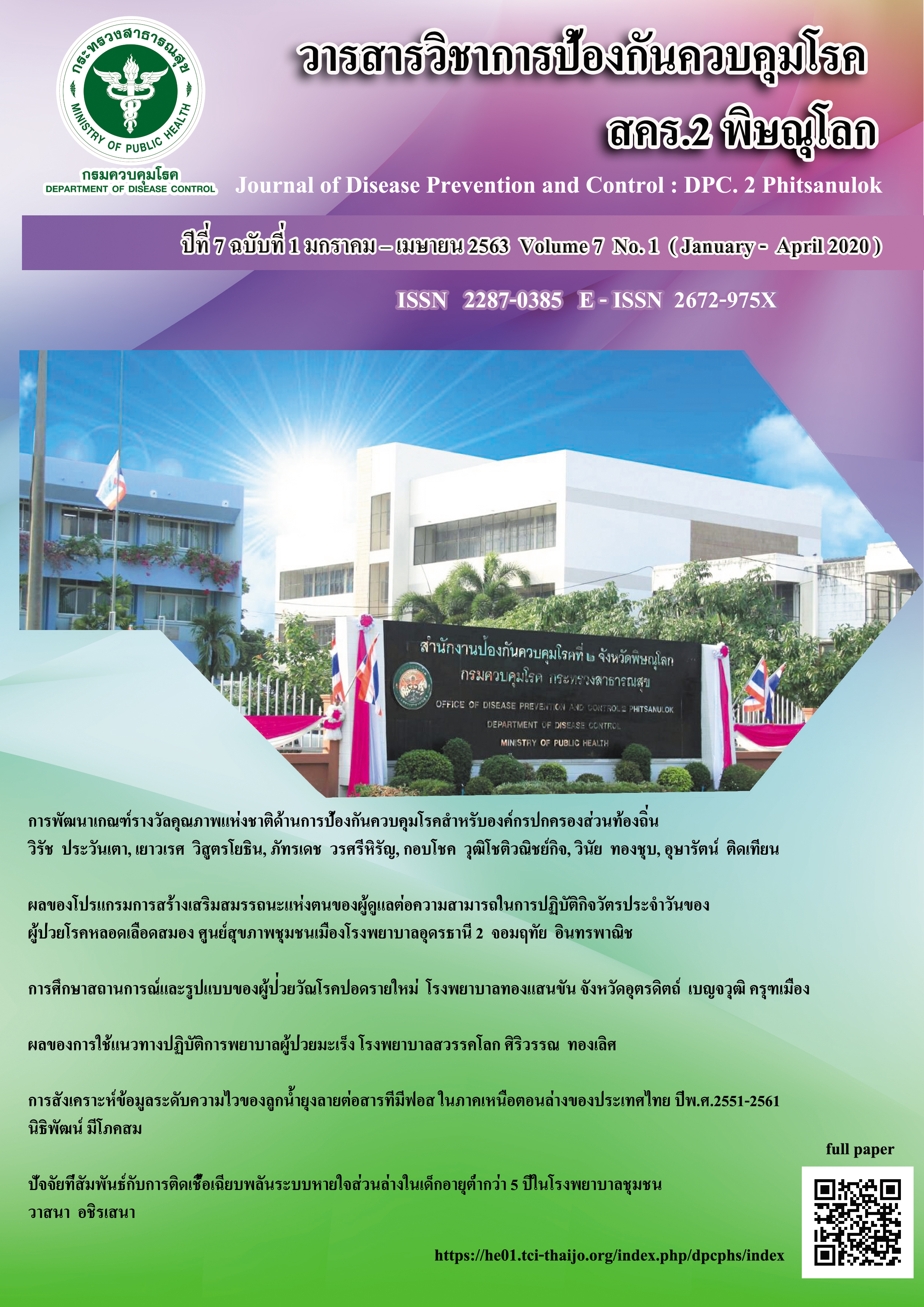
The effectiveness of self-efficacy promotion program among caregivers on activities of daily living in stroke patients Udonthani hospital 2 primary care unit.
Article Sidebar
Main Article Content
Abstract
This quasi-experimental research aimed to investigate the effectiveness of self-efficacy promotion program among caregivers on activities of daily living in stroke patients. The 30 samples were purposively selected based on the inclusion criteria. The instruments used in this research by using the Bandura’s self-efficacy framework. The samples received the Self-efficacy application program included (1) outcome expectancies (2) efficacy beliefs for 8 weeks. The implementation were consisted of different activities such as lecture, a training demonstration, a good model presentation, Knowledge Sharing, discussion of practice outcomes, and follow up through home visit. Collected data by questionnaires. Its content validity was confirmed by experts and Cronbach's alpha coefficient to test the reliability of the test to measure knowledge and activities of daily living in stroke patients was 0.86 - 0.93 respectively. Data analyzed by descriptive statistics such as frequency, percentage, mean, standard deviation. Estimative data for comparative mean score were analyzed by Paired t- test.
The results showed that after the program was significant increased mean scores of knowledge, activities of daily living in stroke patients from 4.70 to 10.3, and 1.68 to 2.76 respectively statistically significant (p<0.001). The study suggested that the program should be applied in the development plan to enhance self-care ability and efficacy of caregivers in caring for stroke patients.
Article Details
ข้อลิขสิทธิ์วารสาร
บทความหรือข้อคิดเห็นใดๆ ที่ปรากฏในวารสารวิชาการป้องกันควบคุมโรค สคร. 2 พิษณุโลก เป็นวรรณกรรมของผู้เขียน กองบรรณาธิการวิชาการ และ สำนักงานป้องกันควบคุมโรคที่ 2 จังหวัดพิษณุโลกไม่จำเป็นต้องเห็นพ้องด้วยทั้งหมดหรือร่วมรับผืิดชอบใดๆ
References
http://www.worldstrokecampaign.org/images/wsd- 017/brochures2017/WSD_brochure_
FINAL_sponsor_.pdf
2. American Heart Association. Heart Disease and Stroke Statistics-2015 update:a report from the American Heart Association,Calculation 2015; 131: 29-322.
3. สำนักนโยบายและยุทธศาสตร์กระทรวงสาธารณสุข. สถิติสาธารณสุข ปี พ.ศ. 2557. [อินเตอร์เน็ต]. [เข้าถึง เมื่อวันที่ 18 พฤศจิกายน 2562]. เข้าถึงได้จาก
https://www.udo.moph.go.th/
4. กองโรคไม่ติดต่อ สำนักสื่อสารความเสี่ยงฯ กรมควบคุมโรค. [อินเตอร์เน็ต]. [เข้าถึงเมื่อวันที่ 18 พฤศจิกายน 2562]. เข้าถึงได้จาก https://www.hfocus.org/content/2019/10/17959
5. แผนยุทธศาสตร์ด้านสุขภาพ สำนักงานสาธารณสุขจังหวัดอุดรธานี. [อินเตอร์เน็ต]. [เข้าถึงเมื่อวันที่ 11 พฤศจิกายน 2562]. เข้าถึงได้จาก https://www.udo.moph.go.th/docs_temp/plan2561.pdf
6. สถาบันประสาทวิทยา กรมการแพทย์. โรคหลอดเลือดเสมองตีบหรืออุดตันสำหรับแพทย์.[อินเตอร์เน็ต]. [เข้าถึงเมื่อวันที่ 9 ธันวาคม 2562]. เข้าถึงได้จาก https://www.pni.go.th/pnigoth/wp-content/uploads/2019/12/cpgforischemicstroke2019.pdf
7. พัชราภรณ์ สิรินธรานนท์. โปรแกรมการสอนแนะผู้ดูแลต่อความสามารถในการปฏิบัติกิจวัตรประจำวันของผู้ป่วยโรคหลอดเลือดสมอง.[วิทยานิพนธ์พยาบาลศาสตรมหาบัณฑิต] จุฬาลงกรณ์มหาวิทยาลัย : 2558
8. วาสนา มูลฐีและคณะ. ผลของโปรแกรมการดูแลผู้ป่วย โรคหลอดเลือดสมองและญาติผู้ดูแลระยะเปลี่ยนผ่านจากโรงพยาบาลสู่บ้านต่อความสามารถในการปฏิบัติกิจวัตรประจำวันภาวะแทรกซ้อน และความพึงพอใจของผู้ป่วย. วารสารสภาการพยาบาล 2559; 31: 95-110
9. นิชธิมา ศรีจำนงและคณะ. ผลของโปรแกรมการส่งเสริมการรับรู้ความสามารถตนเองของญาติผู้ดูแลผู้ป่วยโรคหลอดเลือดสมองที่บ้าน. วารสารพยาบาลราชนนี กรุงเทพ 2560; 26:113-118.
10. อมรวรรณ กวีภัทรนนท์. ผลของโปรแกรมการส่งเสริมสมรรถนะแห่งตนในการดูแลผู้ป่วยของผู้ดูแลผู้ป่วยโรคหลอดเลือดสมองในระยะเปลี่ยนผ่านจาก
โรงพยาบาลสู่บ้าน. วารสารพยาบาลศาสตร์ จุฬาลงกรณ์ มหาวิทยาลัย 2556; 25:93-105.
11. Bandura, Albert. Self – efficacy : The exercise of control. New York : W.H. Freeman and company; 1997.
12. ดร.นำชัย ศุภฤกษ์ชัยสกุล. หัวข้อสถิติที่น่าสนใจสำหรับการวิจัย สถาบันวิจัยพฤติกรรมศาสตร์ มหาวิทยาลัยศรีนครินทรวิโรฒ. [อินเตอร์เน็ต]. [เข้าถึงเมื่อวันที่ 11 พฤศจิกายน 2562]. เข้าถึงได้จาก http://rlc.nrct.go.th/ewt_dl.php?nid=860
13. พรทิพย์พา ธิมายอม. ผลการใช้โปรแกรมพัฒนาการรับรู้ ความสามารถของตนที่มีต่อพฤติกรรมการดูแลตนเองของผู้รับบริการอัมพาตครึ่งซีก. [วิทยานิพนธ์วิทยาศาสตรมหาบัณฑิต มหาวิทยาลัยศรีนครินทรวิโรฒ: 2554
14. Bloom, Benjamin. Taxonomy of education obectives the classification of educational Goals handbook I: Cognative domain. New York : David Mckay; 1970.
15. จินดา รัตนกุล. ผลของการให้การพยาบาลระบบสนับสนุน ในการดูแลตนเองของผู้ป่วยโรคหลอดเลือดสมองโรงพยาบาลเสลภูมิ จังหวัดร้อยเอ็ด. วารสารโรงพยาบาล มหาสารคาม 2562;16: 114-120
