Holistic Quality of Life Enhancement Model of the Older Adults in the New Normal
Keywords:
holistic quality of life, new normal, older adults, 4H-PENTA ModelAbstract
Background: Older adults in Nawang Subdistrict are experiencing social, economic, and technological changes in the New Normal, affecting their lifestyles and well-being. Meanwhile, health promotion encompasses all dimensions of well-being. Therefore, this study aimed to examine factors influencing the holistic quality of life of older adults, develop a quality-of-life enhancement model, and evaluate its appropriateness by experts.
Methods: A mixed-methods research design was employed. The quantitative phase involved 256 older adults eligible for the elderly allowance for fiscal year 2024 under the Nawung Subdistrict Administrative Organization, Mueang District, Phetchaburi Province. Data were collected using questionnaires and analyzed using descriptive statistics and stepwise multiple regression. The qualitative phase involved in-depth interviews with nine older adults, and the findings were used to develop the model. Five experts reviewed and certified the model. Qualitative data were analyzed using content analysis.
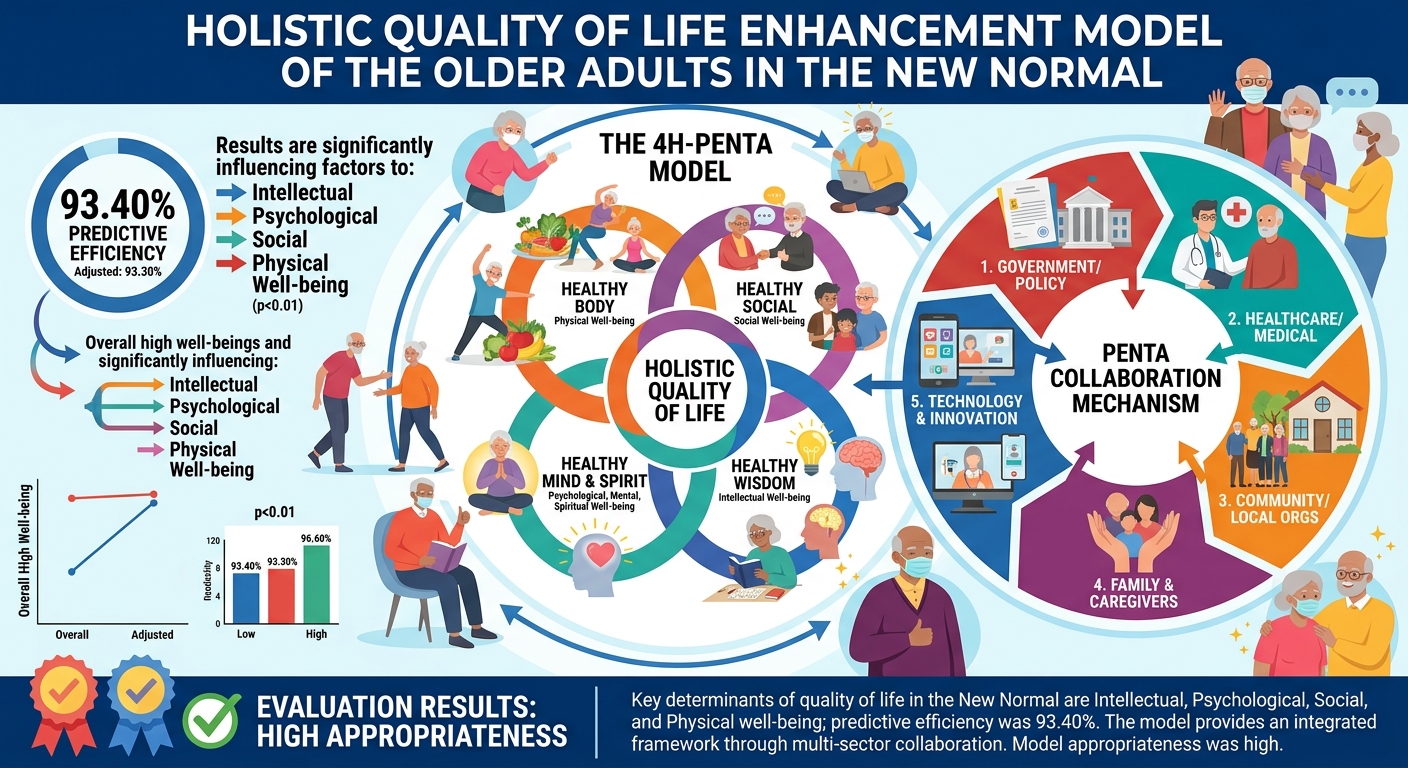
Results: The holistic well-being factors and quality of life of older adults in the New Normal are overall high. Findings revealed that holistic well-being, namely intellectual, psychological, social, and physical well-being, significantly influenced older adults' quality of life in the New Normal, statistically significant at the .01 level. Together, predictive efficiency was 93.40%, and adjusted predictive efficiency was 93.30%. Based on the findings, the “4H-PENTA Model” was developed. The model consists of four well-being dimensions: Healthy Body, Healthy Social, Healthy Mind & Spirit, and Healthy Wisdom, encompassing physical, social, mental, spiritual, and intellectual well-being, respectively. PENTA represents a mechanism driving implementation of the model through collaboration among five relevant sectors. Evaluation results indicated that the developed model demonstrated high appropriateness.
Conclusion: Intellectual, psychological, social, and physical well-being are key determinants of older adults’ quality of life in the New Normal; predictive efficiency was 93.40%. The 4H-PENTA Model provides an integrated framework to promote holistic well-being through multi-sector collaboration. The developed model’s appropriateness was high.
References
นัสมล บุตรวิเศษ, อุปริฏฐา อินทรสาด. ปัจจัยที่ส่งผลต่อคุณภาพชีวิตของผู้สูงอายุ: กรณีศึกษาอำเภอพระนครศรีอยุธยา จังหวัดพระนครศรีอยุธยา. รายงานการวิจัยคณะวิทยาศาสตร์และเทคโนโลยี มหาวิทยาลัยเทคโนโลยีราชมงคลสุวรรณภูมิ ศูนย์พระนครศรีอยุธยา; 2564.
ธนาคารแห่งประเทศไทย. จิตใจที่ปรับตัวได้ในภาวะปกติใหม่. นิตยสาร BOT 2563;8:8-10.
ปริญญาภร ธนะบุญปวง. การดูแลสุขภาวะและคุณภาพชีวิตผู้สูงอายุในยุคปกติถัดไป. วารสารวิจัย เพื่อการส่งเสริมสุขภาพและคุณภาพชีวิต 2565;2:74-84.
องค์การบริหารส่วนตำบลนาวุ้ง. การบริการพื้นฐาน [อินเทอร์เน็ต]. 2567 [เข้าถึงเมื่อ 28 เม.ย.2568] เข้าถึงได้จาก: http://www.nawong.go.th/site/index.php?option=com_content&view=article&id=88&Itemid=122
ดวงกมล ศักดิ์เลิศสกุล. แผนธุรกิจของสถานบริการสุขภาพแบบองค์รวม. ขอนแก่น: มหาวิทยาลัยขอนแก่น.
Beadle-Brown J, Murphy G, and DiTerlizzi M. “Quality of life for the Camberwell cohort”. Journal of Applied Research in Intellectual Disabilities 2008;24:380-90.
กองสวัสดิการสังคม องค์การบริหารส่วนตำบลนาวุ้ง. ประกาศองค์การบริหารส่วนตำบลนาวุ้งเรื่อง บัญชีรายชื่อผู้มีสิทธิรับเงินเบี้ยยังชีพผู้สูงอายุขององค์การบริหารส่วนตำบลนาวุ้ง ประจำปีงบประมาณ พ.ศ.2567 อำเภอเมืองเพชรบุรี จังหวัดเพชรบุรี [อินเทอร์เน็ต]. 2567 [เข้าถึงเมื่อ 28 เม.ย. 2568] เข้าถึงได้จาก: https://shorturl.asia/zJMjx
Krejcie RV, Morgan DW. “Determining sample size for research activities”. Educational and Psychological Measurement 1970;30:607-10.
ยุทธ ไกยวรรณ์. หลักสถิติวิจัยและการใช้โปรแกรม SPSS. พิมพ์ครั้งที่ 6. กรุงเทพฯ: สำนักพิมพ์จุฬาลงกรณ์มหาวิทยาลัย; 2562.
Cronbach LJ. Essentials of psychological testing. 5th ed. New York: Harper Collins Publishers; 1970.
Engel GL. The need for a new medical model: a challenge for biomedicine. Science 1977;196:129-36.
World Health Organization. Definition of an older or elderly person. Geneva: World Health Organization; 2010.
ณัฎฐ์สิชา ภาภัคธนานันท์. รูปแบบการเสริมสร้างสุขภาวะแบบองค์รวมของผู้สูงอายุในสถานสงเคราะห์คนชรา ภาคตะวันออกเฉียงเหนือ [วิทยานิพนธ์ปรัชญาดุษฎีบัณฑิต สาขาวิชายุทธศาสตร์การพัฒนา]. อุดรธานี: มหาวิทยาลัยราชภัฏอุดรธานี; 2562.
Joyce B, Weil M. Models of Teaching. 6th ed. Boston: Allyn and Bacon; 2000.
ทิศนา แขมมณี. รูปแบบการเรียนการสอนทางเลือกที่หลากหลาย. กรุงเทพฯ: จุฬาลงกรณ์มหาวิทยาลัย; 2559.
Downloads
Published
How to Cite
Issue
Section
License
Copyright (c) 2026 Boromarajonani College of Nursing Sunpasitthiprasong

This work is licensed under a Creative Commons Attribution-NonCommercial-NoDerivatives 4.0 International License.
บทความที่ได้รับการตีพิมพ์เป็นลิขสิทธิ์ของวารสารวิทยาศาสตร์สุขภาพ วิทยาลัยพยาบาลบรมราชชนนี สรรพสิทธิประสงค์ ข้อความที่ปรากฏในบทความแต่ละเรื่องเป็นความคิดเห็นส่วนตัวของผู้เขียนแต่ละท่านไม่เกี่ยวข้องกับวิทยาลัยพยาบาลบรมราชชนนี สรรพสิทธิประสงค์ และคณาจารย์ท่านอื่นๆ ในวิทยาลัยพยาบาลฯ ความรับผิดชอบเกี่ยวกับบทความแต่ละเรื่องผู้เขียนจะรับผิดชอบของตนเอง