
Development of a Multimedia-Based Instructional Program to Promote Home Self-Care among Patients after Cataract Surgery, Nong Bua Daeng Hospital
Keywords:
instructional program, multimedia, self-care, patients after cataract surgeryAbstract
Background: Cataract surgery among older adults commonly requires self-care to prevent postoperative complications. However, rural patients struggle to understand and remember instructions. This study developed a multimedia self-care program and evaluated its quality and impact on patients' knowledge, behaviors, satisfaction, and complications within 30 days.
Methods: Two-phase design was employed. Phase 1 involved development and evaluation by five experts. Phase 2 used a quasi-experimental two-group pretest–posttest design with 60 cataract surgery patients at Nong Bua Daeng Hospital. Patients purposively assigned to control or experimental groups, with 30 in each group, based on consecutive data-collection periods to prevent contamination. Instruments included a multimedia program, information questionnaire, a knowledge test (KR-20 = .78), a self-care behavior scale (Cronbach's alpha = .86), and satisfaction scale (alpha = .91). Statistical analysis used paired and independent t-tests.
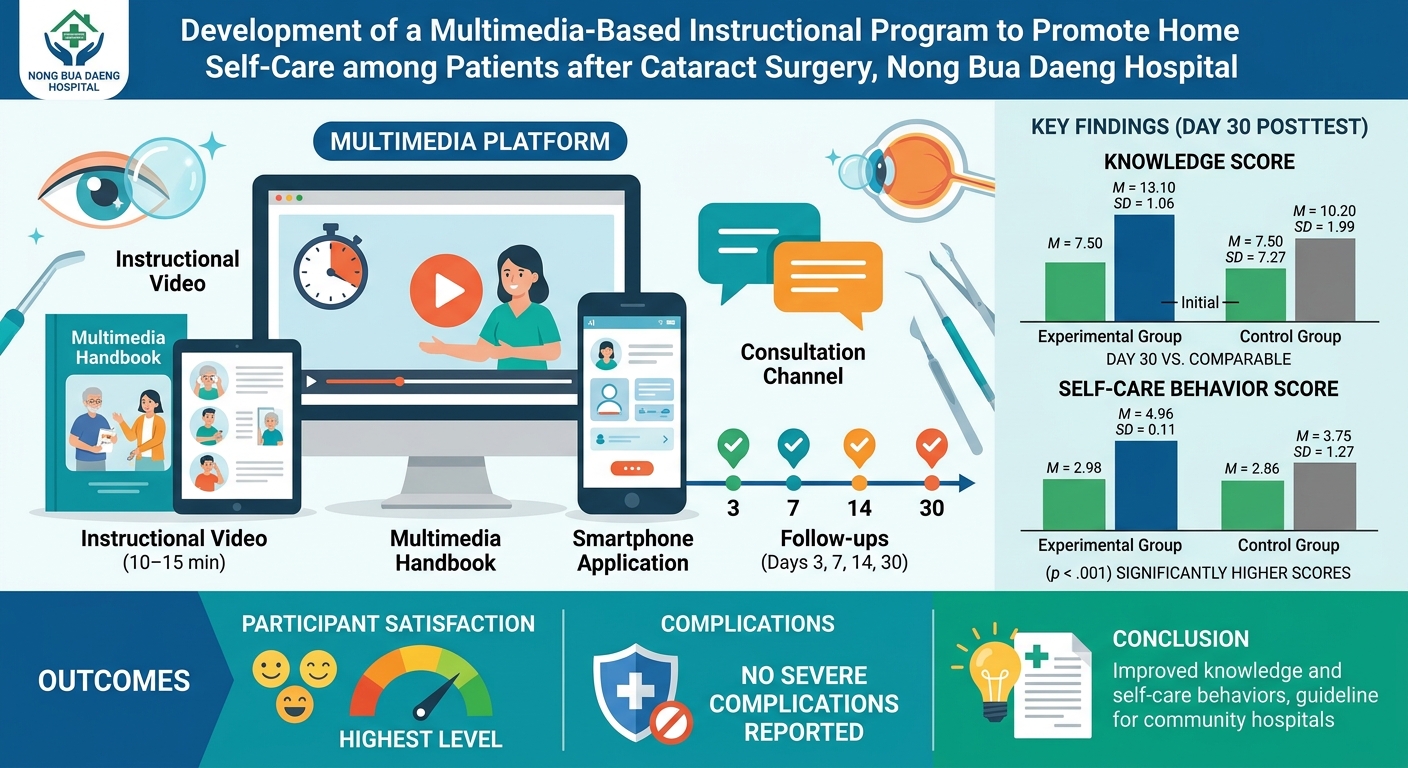
Results: The program included a 10–15 minute instructional video, a multimedia handbook, a smartphone application, a consultation channel, and follow-ups on postoperative days 3, 7, 14, and 30. Initially, the knowledge scores (M = 7.50 vs. 7.27) and self-care behavior scores (M = 2.98 vs. 2.86) were comparable. By the posttest on day 30, the experimental group demonstrated significantly higher scores than the control group in both knowledge (M = 13.10, SD = 1.06 vs. M = 10.20, SD = 1.99) and self-care behaviors (M = 4.96, SD = 0.11 vs. M = 3.75, SD = 1.27) (p < .001). Participant satisfaction reached the highest level, and no severe complications were reported.
Conclusion: The multimedia-based instructional program improved knowledge and self-care behaviors, leading to high patient satisfaction following cataract surgery. This program may serve as a guideline for instructional practices in community hospitals.
References
World Health Organization. World report on vision. Geneva: World Health Organization; 2019.
Chaisiri P, Vincent JE, Jenchitr W, Yospaiboon Y. Prevalence of eye diseases of the elderly in university eye clinic. J Med Assoc Thai 2024;107:309-15.
Maharana PK, Chhablani JK, Das TP, Kumar A, Sharma N. All India Ophthalmological Society members survey results: Cataract surgery antibiotic prophylaxis current practice pattern 2017. Indian J Ophthalmol 2018;66:820-4. doi:10.4103/ijo.IJO_1336_17.
Garg P, Roy A, Sharma S. Endophthalmitis after cataract surgery: epidemiology, risk factors, and evidence on protection. Curr Opin Ophthalmol 2017;28:67-72.
Kim SJ, Schoenberger SD, Thorne JE, Ehlers JP, Yeh S, Bakri SJ. Topical nonsteroidal anti-inflammatory drugs and cataract surgery: a report by the American Academy of Ophthalmology. Ophthalmology 2015;122:2159-68. doi:10.1016/j.ophtha.2015.05.014.
Bandello F, Coassin M, Di Zazzo A, Rizzo S, Biagini I, Pozdeyeva N, et al. One week of levofloxacin plus dexamethasone eye drops for cataract surgery: an innovative and rational therapeutic strategy. Eye (Lond) 2020;34:2112-22. doi:10.1038/s41433-020-0869-1.
Farwana R, Sheriff A, Manzar H, Farwana M, Yusuf A, Sheriff I. Watch this space: a systematic review of the use of video-based media as a patient education tool in ophthalmology. Eye (Lond) 2020;34:1563-9. doi: 10.1038/s41433-020-0798-z.
Mayer RE. Multimedia learning. 3rd ed. Cambridge (UK): Cambridge University Press; 2020.
Ciciriello S, Johnston RV, Osborne RH, Wicks I, deKroo T, Clerehan R, et al. Multimedia educational interventions for consumers about prescribed and over-the-counter medications. Cochrane Database Syst Rev 2013;(4):CD008416. doi: 10.1002/14651858.CD008416.pub2
Orem DE, Taylor SG, Renpenning KM. Nursing concepts of practice. 6th ed. St. Louis: Mosby; 2001.
Cohen J. Statistical power analysis for the behavioral sciences. 2nd ed. Hillsdale (NJ): Lawrence Erlbaum Associates; 1988.
อรุณรัตน์ รอดเชื้อ. ผลของโปรแกรมส่งเสริมการดูแลตนเองต่อความรู้และการปฏิบัติตัวของผู้ป่วยผ่าตัดต้อกระจก โรงพยาบาลราชวิถี. วารสารวิทยาลัยพยาบาลบรมราชชนนี กรุงเทพ 2555;28:1-12.
พรทิพย์ บุญญานุพงศ์. ผลการให้ข้อมูลโดยใช้สื่อวีดีทัศน์เตรียมความพร้อมผ่าตัดต้อกระจกต่อความรู้และความพึงพอใจของผู้ป่วยที่เข้ารับการผ่าตัดต้อกระจก โรงพยาบาลทุ่งสง. มหาราชนครศรีธรรมราชเวชสาร. 2565;6:66-77.
Knowles MS, Holton EF III, Swanson RA, Robinson PA. The adult learner: the definitive classic in adult education and human resource development. 9th ed. Abingdon (UK); New York (NY): Routledge; 2020.
อังคณา อัศวบุญญาเดช, ดุจดาว ศุภจิตกุลชัย, วริศนันท์ ปุรณะวิทย์. ผลการสอนสุขศึกษาโดยใช้สื่อวีดิทัศน์เรื่องการปฏิบัติตัวหลังทำผ่าตัดต้อกระจกให้กับผู้ป่วยผ่าตัดต้อกระจก. บูรพาเวชสาร 2565;9:13-27
Bandura A. Self-efficacy: the exercise of control. New York: W.H. Freeman; 1997.
Lim ZW, Chee ML, Soh ZD, Cheung N, Dai W, Sahil T, et al. Association between visual impairment and decline in cognitive function in a multiethnic Asian population. JAMA Netw Open 2020;3:e203560. doi: 10.1001/jamanetworkopen.2020.3560.
American Academy of Ophthalmology. Cataract in the Adult Eye Preferred Practice Pattern®. San Francisco (CA): American Academy of Ophthalmology; 2021.
Downloads
Published
How to Cite
Issue
Section
License
Copyright (c) 2026 Boromarajonani College of Nursing Sunpasitthiprasong

This work is licensed under a Creative Commons Attribution-NonCommercial-NoDerivatives 4.0 International License.
บทความที่ได้รับการตีพิมพ์เป็นลิขสิทธิ์ของวารสารวิทยาศาสตร์สุขภาพ วิทยาลัยพยาบาลบรมราชชนนี สรรพสิทธิประสงค์ ข้อความที่ปรากฏในบทความแต่ละเรื่องเป็นความคิดเห็นส่วนตัวของผู้เขียนแต่ละท่านไม่เกี่ยวข้องกับวิทยาลัยพยาบาลบรมราชชนนี สรรพสิทธิประสงค์ และคณาจารย์ท่านอื่นๆ ในวิทยาลัยพยาบาลฯ ความรับผิดชอบเกี่ยวกับบทความแต่ละเรื่องผู้เขียนจะรับผิดชอบของตนเอง