
The Effect of Using Aroma Hug Innovation in Reducing Pain: Case study of muscle pain in Students and Working Adults
Keywords:
muscle pain, hot compress, Thai herbs, office syndrome, aroma hug hot compress bagAbstract
Background: Myofascial pain syndrome is a common health issue among school-age and working-age populations. A hot compress combined with herbal therapy is an alternative approach for pain relief. This quasi-experimental study aimed to compare back muscle pain caused by office syndrome in school-age and working-age groups before and after using the Aroma Hug hot compress bag and to examine satisfaction with the Aroma Hug.
Methods: A one-group pretest-posttest quasi-experimental design was employed. The sample consisted of 31 participants recruited through purposive sampling from students and staff at Boromarajonani College of Nursing, Sanpasitthiprasong, based on the inclusion criteria. Research instruments included the Aroma Hug hot compress bag, a Numerical Rating Scale for pain assessment, and a satisfaction questionnaire. Data were analyzed using descriptive statistics. Pain scores across time points were compared using one-way repeated measures ANOVA with Bonferroni post-hoc analysis.
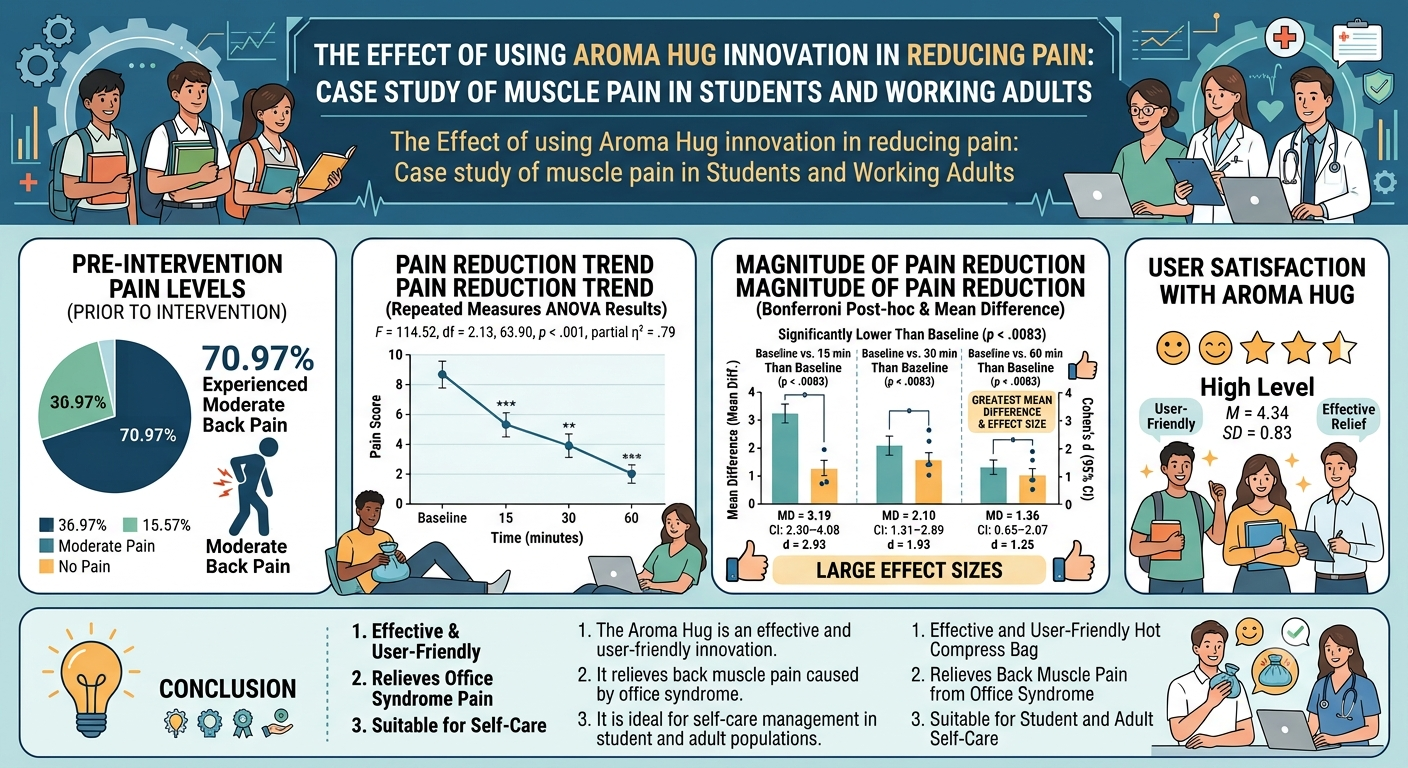
Results: Prior to the intervention, the majority of participants experienced moderate back pain (70.97%). A repeated measures ANOVA with Greenhouse-Geisser correction revealed statistically significant differences in pain scores across time points (F = 114.52, df = 2.13, 63.90, p < .001, partial η² = .79). Bonferroni post-hoc analysis demonstrated that pain scores at 15, 30, and 60 minutes post-intervention were significantly lower than baseline (p < .0083 for all comparisons). The greatest mean difference was observed at 60 minutes (Mean Difference = 3.19, 95% CI: 2.30–4.08, Cohen's d = 2.93), followed by 30 minutes (Mean Difference = 2.10, 95% CI: 1.31–2.89, Cohen's d = 1.93) and 15 minutes (Mean Difference = 1.36, 95% CI: 0.65–2.07, Cohen's d = 1.25), respectively. Overall satisfaction with the Aroma Hug was at a high level (M = 4.34, SD = 0.83).
Conclusion: The Aroma Hug hot compress bag is an effective and user-friendly innovation for relieving back muscle pain caused by office syndrome, making it suitable for self-care management among school-age and working-age populations.
References
Duenas M, Ojeda B, Salazar A, Mico JA, Failde I. A review of chronic pain impact on patients, their social environment and the health care system. J Pain Res 2016;9:457–67.
กรมอนามัย กระทรวงสาธารณสุข. Office Syndrome [อินเทอร์เน็ต]. 2568 [เข้าถึงเมื่อ 20 มิ.ย. 2569]. เข้าถึงได้จาก: https://ddc.moph.go.th/uploads/ckeditor2//files/Office%20Syndrome.pdf
กรมการแพทย์ กระทรวงสาธารณสุข. พิชิตออฟฟิศซินโดรม ทางออกสำหรับคนวัยทำงานยุคดิจิทัล [อินเทอร์เน็ต]. 2568 [เข้าถึงเมื่อ 31 มี.ค. 2569]. เข้าถึงได้จาก: https://pr.moph.go.th/online/index/news/321318
ไทยพีบีเอส (Thai PBS). โรคออฟฟิศซินโดรม ปีเดียว 4.8 แสนคน เช็กสัญญาณเตือน [อินเทอร์เน็ต]. 2568 [เข้าถึงเมื่อ 20 มิ.ย. 2569]. เข้าถึงได้จาก: https://www.thaipbs.or.th/news/content/348477
ชลลดา โต๊ะสิงห์, ชนิกานต์ จันทรเก, ชมพูนุช เทียนคำ, ชลดา ปะนาโท, ชลธิชา พงพันนา, ชลธี วัฒนะพล, และคณะ. การศึกษาปัจจัยที่เกี่ยวข้องที่ส่งผลต่อการเกิดการปวดหลังส่วนล่าง บ่าไหล่และคอของนักศึกษาพยาบาลชั้นปีที่ 2 รุ่นที่ 39 วิทยาลัยพยาบาลศรีมหาสารคาม. วารสารวิจัยนวัตกรรมและหลักฐานเชิงประจักษ์ทางสุขภาพ 2566;2:23-34.
กชมน อินทร์บัว. การเปรียบเทียบประสิทธิผลของการตอกเส้นและการเช็ดแหกเพื่อบรรเทาอาการของโรคออฟฟิศซินโดรม [อินเทอร์เน็ต]. 2565 [เข้าถึงเมื่อ 20 มี.ค. 2569]. เข้าถึงได้จาก: https://share.google/dcHRdoVWxluYRTzw9
วิศิษฎ์ เนติโรจนกุล. ผลของโปรแกรมปรับเปลี่ยนพฤติกรรม (เปลี่ยนน้อยนิดพิชิตออฟฟิศซินโดรม) ต่ออาการปวดกล้ามเนื้อบริเวณคอบ่าไหล่และหลังส่วนล่างของบุคลากรที่ทำงานในสำนักงาน โรงพยาบาลนครปฐม. วารสารแพทย์ เขต 4-5 2565;41:1-14.
ภควัต ไชยชิต. การศึกษาผลของการนวดไทยแบบราชสำนักต่อองศาการเคลื่อนไหวคอในผู้ป่วยออฟฟิศซินโดรมโรงพยาบาลขอนแก่น [วิทยาศาสตรมหาบัณฑิต สาขาวิทยาศาสตร์สุขภาพ]. ขอนแก่น: มหาวิทยาลัยขอนแก่น; 2564.
พรรณกาญจน์ พรมตัน, วานีตา ยีมะยี, อารยา ข้อค้า. ผลการประคบร้อนด้วยถุงถั่วเขียวสมุนไพรในกลุ่มบุคคล ที่มีอาการปวดเมื่อย. วารสารก้าวทันโลกวิทยาศาสตร์ 2563;20:90-100.
สายสุนีย์ คนสนิท, พัชรินทร์ พรหมเผ่า, จักรพันธ์ ฮ่องลึก, ธนวัฒน์ ยอดถี, อรุณรัตน์ ศรีทะวงษ์.ผลของเจลประคบร้อน (UP Gel pack) ต่ออาการปวดและความยืดหยุ่นบริเวณจุดกดเจ็บชนิดแฝงเร้นของกล้ามเนื้อบ่า. วารสารการแพทย์และสาธารณสุขเขต 4 2566;13:86-94.
คณะเภสัชศาสตร์ มหาวิทยาลัยอุบลราชธานี. ฐานข้อมูลสมุนไพร [อินเทอร์เน็ต]. 2567 [เข้าถึงเมื่อ 21 มิ.ย. 2569]. เข้าถึงได้จาก: https://phar.ubu.ac.th/herb-DetailThaicrudedrug/60
Nassr GNM, Vitzel KF, Poblete NJ, Leon PF, Sanchez PB. Heat transfer by three types of Hot pack disapplication on the flexibility of the lower back: a randomized Controlled trial. Fisioter Pesqui 2016; 23:201-9.
ประภัสสร ชาติประสพ, จุฑาภรณ์ เนตรโพธิ์แก้ว. การเปรียบเทียบประสิทธิผลการรักษาระหว่างการประคบด้วยแผ่นร้อนและแผ่นเย็น หลังการบำบัดด้วยคลื่นช็อคชนิดเรเดียลในผู้ป่วยที่มีกลุ่มอาการปวดกล้ามเนื้อ และพังพืดของกล้ามเนื้อทราพิเซียส. วารสาร Mahidol R2R e-Journal 2564;8:98-108. doi: 10.14456/jmu.2021.38
Michlovitz SL, Behrens BJ. Physical agents: theory and practice. 3rd ed. Philadelphia: F.A. Davis; 2014.
Vickers A. Massage and Aromatherapy: A Guide for Health Professionals. London: Chapman&Hall; 1996.
ณิชาภา พาราศิลป์, ศิรินทิพย์ คําฟู, อรรจน์มน ธรรมไชย. การเปรียบเทียบผลของแผ่นประคบร้อนสมุนไพรไทยและแผ่นประคบร้อนในการรักษาผู้ที่มีอาการปวดหลังส่วนล่าง: การทดลองแบบสุ่มและมีกลุ่มควบคุม. ศรีนครินทร์เวชสาร 2560;32;372–8.
ชลธิชา เทศนอก, ฐานิกา วารีย์, ฐานิดา สิทธิคํา, ฐิติยา คําพันธ์, ณัฐฐิชา คําเชียง, ณัฐธยาน์ ยศทะศรี, และคณะ. ประสิทธิผลของเข็มขัดสมุนไพรประคบร้อนเพื่อลดอาการปวดหลังส่วนล่างของเจ้าหน้าที่สายสนับสนุนวิทยาลัยพยาบาลบรมราชชนนีอุดรธานี. วารสารวิจัยนวัตกรรมและหลักฐานเชิงประจักษ์ทางสุขภาพ 2567;4:1-12.
พรรณกาญจน์ พรมตัน, วานีตา ยีมะยี, อารยา ข้อค้า. ผลการประคบร้อนด้วยถุงถั่วเขียวสมุนไพรในกลุ่มบุคคล ที่มีอาการปวดเมื่อย. วารสารก้าวทันโลกวิทยาศาสตร์ 2563;20:90-100.
Downloads
Published
How to Cite
Issue
Section
License
Copyright (c) 2026 Boromarajonani College of Nursing Sunpasitthiprasong

This work is licensed under a Creative Commons Attribution-NonCommercial-NoDerivatives 4.0 International License.
บทความที่ได้รับการตีพิมพ์เป็นลิขสิทธิ์ของวารสารวิทยาศาสตร์สุขภาพ วิทยาลัยพยาบาลบรมราชชนนี สรรพสิทธิประสงค์ ข้อความที่ปรากฏในบทความแต่ละเรื่องเป็นความคิดเห็นส่วนตัวของผู้เขียนแต่ละท่านไม่เกี่ยวข้องกับวิทยาลัยพยาบาลบรมราชชนนี สรรพสิทธิประสงค์ และคณาจารย์ท่านอื่นๆ ในวิทยาลัยพยาบาลฯ ความรับผิดชอบเกี่ยวกับบทความแต่ละเรื่องผู้เขียนจะรับผิดชอบของตนเอง