
Management of Chronic Post-Surgical Pain (CPSP): The Challenging Role of Nurses in Transitioning Pain Care from Acute to Chronic Pain
Keywords:
pain management, chronic post-surgical pain, transitioning from acute to chronic post-surgical pain, nursing roleAbstract
Introduction: Chronic postsurgical pain is a significant complication with lasting effects on patients. Poor management of this condition can negatively affect patients' quality of life and rehabilitation processes. This academic article aims to explain the pathophysiological mechanisms and risk factors that contribute to the transition from acute to chronic postsurgical pain throughout all phases of care. Additionally, it highlights the importance of nurses in conducting risk screening and implementing integrated pain management strategies to reduce the incidence of chronic postsurgical pain.
Methods: A literature review has identified that the mechanisms underlying chronic postsurgical pain are complex and multifactorial. Risk factors span various phases: preoperative (including psychosocial aspects and negative attitudes toward pain), intraoperative (encompassing the type of surgery, nerve injury, and methods of analgesic administration), and postoperative (notably the severity of pain within the first 72 hours). Effective management should begin with an assessment of the risk for developing chronic postsurgical pain, incorporate multimodal pain management strategies, and provide comprehensive holistic care across all dimensions.
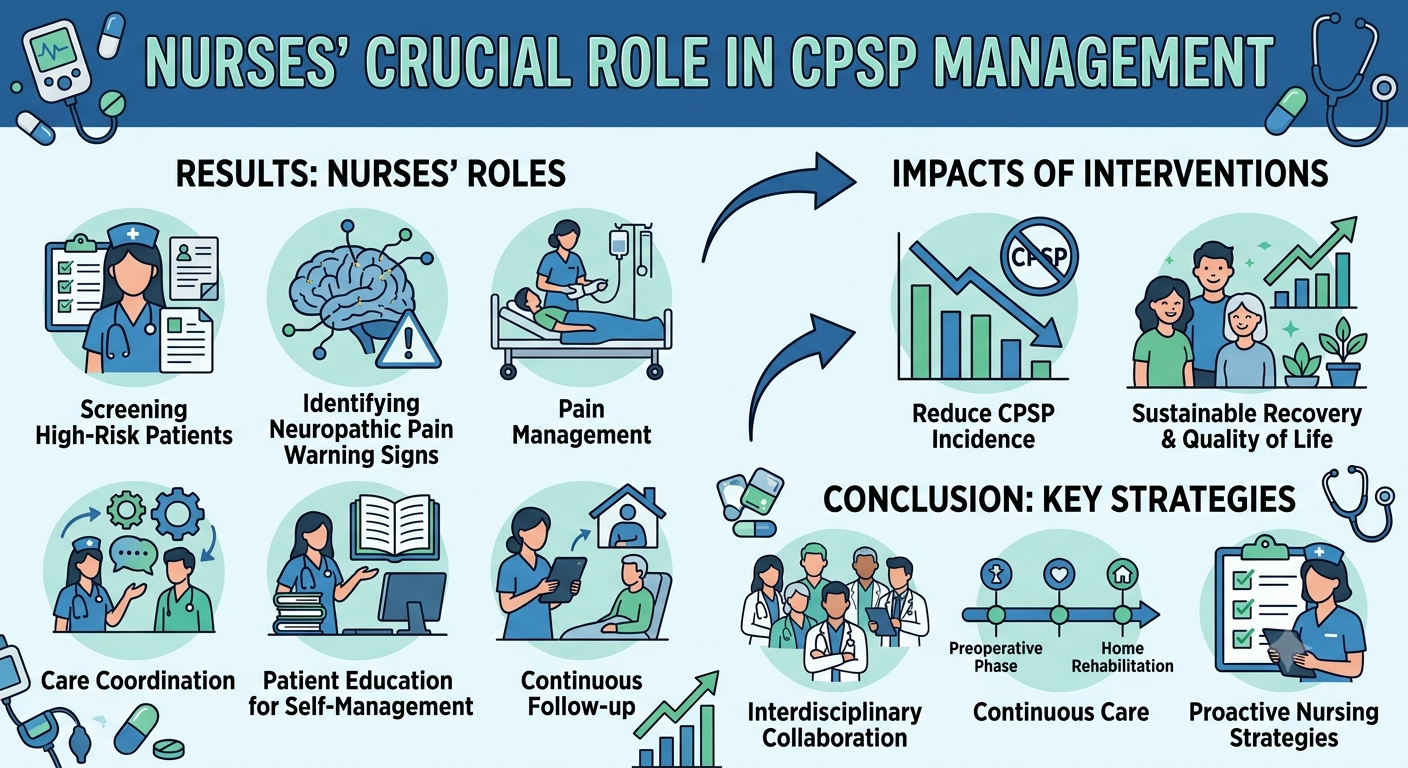
Results: Nurses play a crucial and demanding role in screening high-risk patients, identifying neuropathic pain warning signs during the transition phase, managing pain, coordinating care, educating patients for self-management, and maintaining continuous follow-up. These interventions help reduce the incidence of chronic postsurgical pain and support sustainable recovery and quality of life for patients.
Conclusion: Effective management of chronic postsurgical pain requires interdisciplinary collaboration and continuous care, beginning in the preoperative phase and extending through home rehabilitation. Nurses play a crucial role in this process by systematically implementing proactive nursing strategies that reduce the incidence of chronic postsurgical pain and consistently improve patients' quality of life.
References
Moka E, Aguirre JA, Sauter AR, Lavand’homme P. Chronic postsurgical pain and transitional pain services: a narrative review highlighting European perspectives. Reg Anesth Pain Med 2025;50:205-12.
Schug SA, Lavand'homme P, Barke A, Korwisi B, Rief W, Treede RD. The IASP classification of chronic pain for ICD-11: chronic postsurgical or posttraumatic pain. Pain 2019;160:45-52.
Rosenberger DC, Pogatzki-Zahn EM. Chronic post-surgical pain–update on incidence, risk factors and preventive treatment options. BJA Educ. 2022;22(5):190-6.
สิรลักษณ์ ทองหุ้ย. ความปวดเรื้อรังหลังผ่าตัดทรวงอก ปัจจัยที่เกี่ยวข้อง และการจัดการความปวดของผู้ป่วยหลังจำหน่าย: การศึกษาภาคตัดขวาง [วิทยานิพนธ์ปริญญาพยาบาลศาสตรมหาบัณฑิต]. สงขลา: มหาวิทยาลัยสงขลานครินทร์; 2566.
Yuan Y, Schreiber K, Flowers KM, Edwards R, Azizoddin D, Ashcraft L, et al. The relationship between emotion regulation and pain catastrophizing in patients with chronic pain. Pain Med 2024;25:468-77.
Kar P, Sudheshna KD, Padmaja D, Pathy A, Gopinath R. Chronic pain following thoracotomy for lung surgeries: It's risk factors, prevalence, and impact on quality of life-A retrospective study. Indian J Anaesth 2019;63:368-74.
พิมพ์พร พันธุ์คงทรัพย์. ความปวดเรื้อรังหลังการผ่าตัด: การทบทวนวรรณกรรม. วารสารวิชาการราชวิทยาลัยจุฬาภรณ์ 2564;3:60-70.
Karcz M, Abd-Elsayed A, Chakravarthy K, Aman MM, Strand N, Malinowski MN, et al. Pathophysiology of pain and mechanisms of neuromodulation: a narrative review (a neuron project). J Pain Res 2024;17:3757-90.
Fiorelli S, Cioffi L, Menna C, Ibrahim M, De Blasi RA, Rendina EA, et al. Chronic pain after lung resection: risk factors, neuropathic pain, and quality of life. J Pain Symptom Manage 2020;60:326-35.
Katz J, Weinrib AZ, Clarke H. Chronic postsurgical pain: from risk factor identification to multidisciplinary management at the Toronto General Hospital Transitional Pain Service. Can J Pain 2019;3:49-58.
Fregoso G, Wang A, Tseng K, Wang J. Transition from acute to chronic pain: evaluating risk for chronic postsurgical pain. Pain Physician 2019;22:479-88.
McCowat M, Fleming L, Vibholm J, Dixon D. The psychological predictors of acute and chronic pain in women following breast cancer surgery: a systematic review. Clin J Pain 2019;35:261-71.
Kim BR, Yoon SH, Lee HJ. Practical strategies for the prevention and management of chronic postsurgical pain. Korean J Pain 2023;36:149-62.
Ye Y, Gabriel RA, Mariano ER. The expanding role of chronic pain interventions in multimodal perioperative pain management: a narrative review. Postgrad Med. 2022;134:449-57.
Cohen SP, Vase L, Hooten WM. Chronic pain: an update on burden, best practices, and new advances. Lancet 2021;397:2082-97.
ศศิกานต์ นิมมานรัชต์. การป้องกันความปวดเรื้อรังหลังผ่าตัด สมาคมการศึกษาเรื่องความปวดแห่งประเทศไทย [อินเทอร์เน็ต]. 2563 [เข้าถึงเมื่อ 7 มิ.ย. 2569]. เข้าถึงได้จาก: http://www.tasp.or.th/factsheet/factsheet_thai.php
Akhtaruzzaman AKM. Multimodal approach to prevent chronic pain development. Bangladesh J Pain 2024;4:1-3.
Afenigus AD. Evaluating pain in non-verbal critical care patients: a narrative review of the critical care pain observation tool and its clinical applications. Front Pain Res (Lausanne) 2024;5:1481085.
Sahni S, Patel R, Wang L, Miles S, Dana E, Khan JS. Characteristics and perioperative risk factors for persistent pain after breast cancer surgery: a prospective cohort study. Surgeries 2023;4:301-16.
สิรลักษณ์ ทองหุ้ย, ลัพณา กิจรุ่งโรจน์, วรวิทย์ จิตติถาวร. ประสบการณ์ความปวดเรื้อรังหลังผ่าตัดทรวงอกและการจัดการความปวดของผู้ป่วยหลังจำหน่าย: การศึกษาภาคตัดขวาง. วารสารพยาบาลโรคหัวใจและทรวงอก 2566;34:18-30.
Downloads
Published
How to Cite
Issue
Section
License
Copyright (c) 2026 Boromarajonani College of Nursing Sunpasitthiprasong

This work is licensed under a Creative Commons Attribution-NonCommercial-NoDerivatives 4.0 International License.
บทความที่ได้รับการตีพิมพ์เป็นลิขสิทธิ์ของวารสารวิทยาศาสตร์สุขภาพ วิทยาลัยพยาบาลบรมราชชนนี สรรพสิทธิประสงค์ ข้อความที่ปรากฏในบทความแต่ละเรื่องเป็นความคิดเห็นส่วนตัวของผู้เขียนแต่ละท่านไม่เกี่ยวข้องกับวิทยาลัยพยาบาลบรมราชชนนี สรรพสิทธิประสงค์ และคณาจารย์ท่านอื่นๆ ในวิทยาลัยพยาบาลฯ ความรับผิดชอบเกี่ยวกับบทความแต่ละเรื่องผู้เขียนจะรับผิดชอบของตนเอง