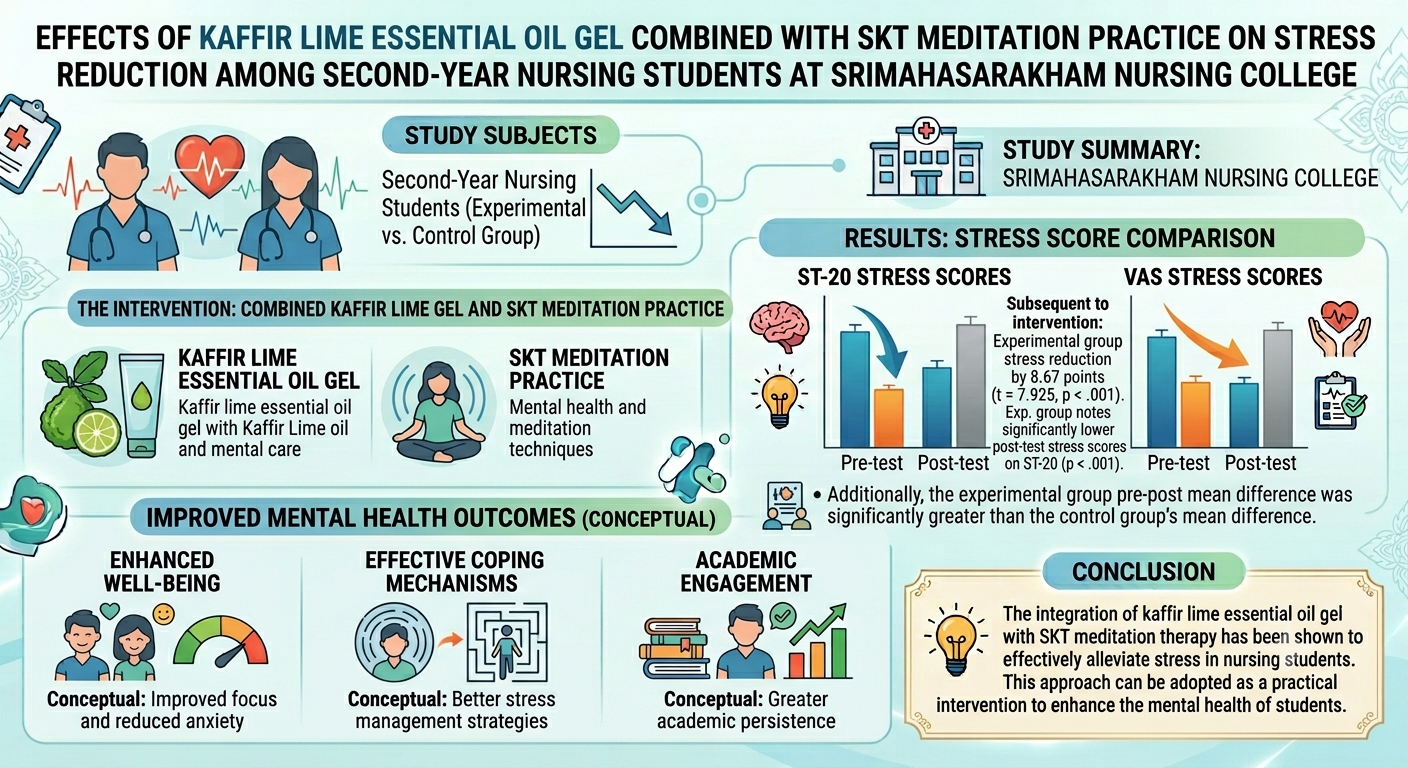
Effects of Kaffir Lime Essential Oil Gel Combined with SKT Meditation Practice on Stress Reduction among Second-Year Nursing Students at Srimahasarakham Nursing College
Keywords:
kaffir lime essential oil gel, stress, nursing students, SKT meditationAbstract
Background: Globally, one-fourth of people experience stress, anxiety, or depression, marking a 30 percent increase among youth and working-age individuals uncertain about the future. Nursing students face stressors from coursework, laboratory sessions, and clinical practica in hospitals, affecting mental health. This study compares nursing student stress with kaffir lime essential oil gel plus SKT meditation practice versus placebo gel plus SKT meditation practice.
Methods: Quasi-experimental study involved 60 second-year nursing students from Srimahasarakham Nursing College, allocated to experimental (n = 30) and control (n = 30) groups. Instruments comprised two categories: 1) Experimental instruments, including kaffir lime essential oil gel and SKT meditation activities, and 2) Data collection tools, comprising demographic questionnaire, ST-5 and ST-20 stress assessment scales, and Visual Analogue Scale (VAS), with Cronbach’s alpha values of .79, .75, and .70, respectively. Data analysis used frequency, percentage, mean, and standard deviation. Inferential statistics used independent samples t-test between groups and paired samples t-test within groups before and after the intervention. Significance was set at p < .05.
Results: The experimental group had a post-intervention stress score reduced by 8.67 points, with a statistically significant difference at the 0.001 level (t = 7.925, p < .001). When compared with the control group, the experimental group had a significantly lower post-intervention stress score at the .001 level according to both the ST-20 assessment (p < .001) and the VAS (p < .001). The experimental group also showed a significantly greater pre-post difference in stress scores than the control group.
Conclusion: The combination of bergamot essential oil gel and SKT mindfulness-based therapy activities can effectively reduce stress in nursing students.
References
World Health Organization (WHO). International Health Regulation [Internet]. 2025 [cited 2025 Dec 7]. Available from: https://www.who.int/health-topics/international-health-regulations#tab=tab_1
เทอดศักดิ์ เดชคง, บรรณาธิการ. สนทนาสร้างแรงจูงใจเพื่อปรับเปลี่ยนพฤติกรรมสุขภาพสำหรับผู้ป่วย NCDs. กรุงเทพฯ: บียอนด์ พับลิสซิ่ง; 2560.
ชฎาพร คงเพ็ชร์, อารีย์ ยมกกุล, นภาพร เพชรศร, นันชพัฒน์ แก้วทอง, กรปภา วงษ์จันทรา. ความเครียดและการจัดการความเครียดของนักศึกษาพยาบาลในสถานการณ์การแพร่ระบาดโควิด 19. วารสารวิจัยเพื่อการส่งเสริมสุขภาพและคุณภาพชีวิต 2566;3:37-46.
Kamollimsakul S, von Bormann SM, Triamchaisri SK. Immediate mood changes and practice adherence during a self-directed SKT1 meditation program in university students: an intensive longitudinal study. PLoS One 2026;21:e0350556. doi: 10.1371/journal.pone.0350556.
ปฐมพร โพธิ์ถาวร, สาวิตรี วงคประดิษฐ์. ผลการปฏิบัติสมาธิด้วยการหายใจต่อการลดความเครียดขณะสอบปลายภาควิชาการพยาบาลมารดาทารกและการผดุงครรภ์1 ของนักศึกษาพยาบาล. วารสารพยาบาลศาสตร์และสุขภาพ 2559;39:67-74.
สืบตระกูล ตันตลานุกุล, ปราโมทธ์ วงศ์สวัสดิ์. ความเครียดและการจัดการความเครียดของนักศึกษาพยาบาล. วารสารวิทยาลัยพยาบาลบรมราชชนนี อุตรดิตถ์ 2560;9:81-92.
อันธิฌา สายบุญศรี, ศิริพร นันทเสนีย์ , อริยา ดีประเสริฐ. ผลของโปรแกรมกลุ่มบำบัดตามแนวคิดการปรับความคิดและพฤติกรรม ร่วมกับการฝึกสมาธิบำบัดต่อความเครียดในนักศึกษาพยาบาลชั้นปีที่ 3 ที่เรียนวิชาการสร้างเสริมสุขภาพจิตและการพยาบาลจิตเวช คณะพยาบาลศาสตร์ มหาวิทยาลัยสวนดุสิต. วารสารวิจัยสุขภาพและการพยาบาล (วารสารวิทยาลัยพยาบาลบรมราชชนนี กรุงเทพ) 2565;38:281-92.
รุจิรา มะธิปิไข, สุภลักษณ์ โคตรชัย, กันย์ชิสา นาคเสน. การศึกษาผลของการสูดดมกลิ่นน้ำมันหอมระเหยต่อการทำงานของระบบประสาทอัตโนมัติและอารมณ์ความรู้สึก. วารสารวิทยาศาสตร์ เทคโนโลยีและนวัตกรรม มหาวิทยาลัยกาฬสินธุ์ 2568;4:26-40.
ญาดา เรียมริมมะตัน, อรชุมา หนูน้อย, โปรดปราน ทาศิริ, อัษฎางค์ พลนอก, พงษ์ณุวัฒน์ สมบัติภูธร. ประสิทธิผลของเจลน้ำมันสมุนไพรต่อความเครียดและการผ่อนคลายในผู้สูงอายุ. วารสารวิจัยการพยาบาลและสุขภาพ 2565;23:110-122.
Cohen J. Statistical power analysis for the behavioral sciences. 2nd ed. Hillsdale (NJ): Lawrence Erlbaum Associates; 1988.
Dutheil F, Pereira B, Moustafa F, Naughton G, Lesage FX, Lambert C. At-risk and intervention thresholds of occupational stress using a visual analogue scale. PLoS One. 2017;12:e0178948. doi: 10.1371/journal.pone.0178948.
Lesage FX, Berjot S. Validity of occupational stress assessment using a visual analogue scale. Occup Med (Lond). 2011;61:434-6. doi: 10.1093/occmed/kqr037.
จำเนียร คงประพันธ์, พัชรพรรณ เหมืองหม้อ, ขจรศรี ซ้อนมณี. ผลของสมาธิบำบัดแบบ SKT 1, 8 ต่อระดับความเจ็บปวดหลังผ่าตัดมดลูก/รังไข่ หอผู้ป่วยนรีเวชกรรม โรงพยาบาลแพร่. วารสารโรงพยาบาลแพร่ 2566;31:86-98.
González-Mas MC, Rambla JL, López-Gresa MP, Blázquez MA, Granell A. Volatile compounds in Citrus essential oils: a comprehensive review. Front Plant Sci. 2019;10:1-18. doi: 10.3389/fpls.2019.00012.
McEwen BS. Physiology and neurobiology of stress and adaptation: central role of the brain. Physiol Rev. 2007;87:873‑904. doi: 10.1152/physrev.00041.2006.
อ้อมบุญ วัลลิสุต. อโรมาเธอราพี [อินเทอร์เน็ต]. 2557 [เข้าถึงเมื่อ 9 ม.ค. 2569]. เข้าถึงได้จาก: https://pharmacy.mahidol.ac.th/th/knowledge/article/225
Downloads
Published
How to Cite
Issue
Section
License
Copyright (c) 2026 Boromarajonani College of Nursing Sunpasitthiprasong

This work is licensed under a Creative Commons Attribution-NonCommercial-NoDerivatives 4.0 International License.
บทความที่ได้รับการตีพิมพ์เป็นลิขสิทธิ์ของวารสารวิทยาศาสตร์สุขภาพ วิทยาลัยพยาบาลบรมราชชนนี สรรพสิทธิประสงค์ ข้อความที่ปรากฏในบทความแต่ละเรื่องเป็นความคิดเห็นส่วนตัวของผู้เขียนแต่ละท่านไม่เกี่ยวข้องกับวิทยาลัยพยาบาลบรมราชชนนี สรรพสิทธิประสงค์ และคณาจารย์ท่านอื่นๆ ในวิทยาลัยพยาบาลฯ ความรับผิดชอบเกี่ยวกับบทความแต่ละเรื่องผู้เขียนจะรับผิดชอบของตนเอง