Predictors of Iodine Deficiency Preventive Behaviors in Pregnant Women
Keywords:
Iodine deficiency preventive behaviors, predictors, pregnant womenAbstract
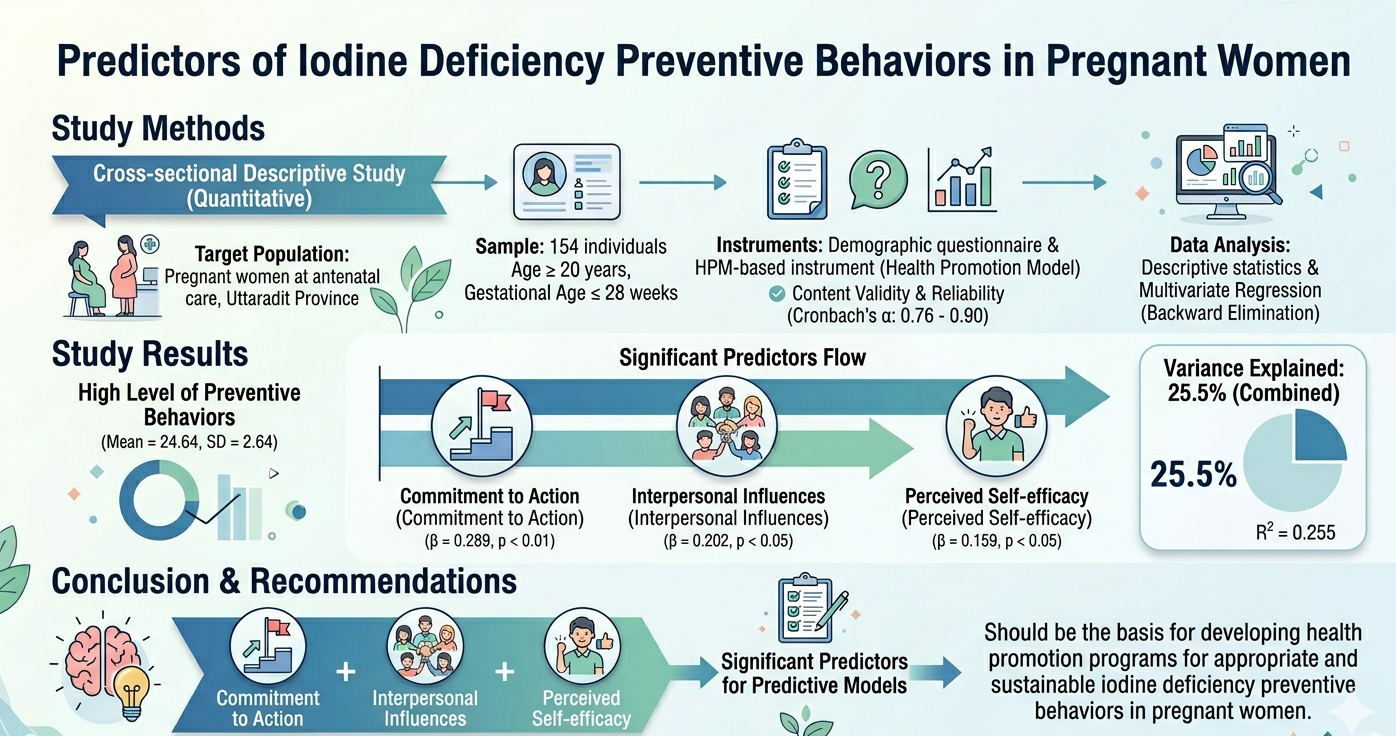
Background: Iodine deficiency remains a significant public health concern, particularly for pregnant women who require increased iodine intake. Despite Thailand's national supplementation and monitoring efforts, certain areas, such as Uttaradit Province, continue to report urinary iodine levels below World Health Organization standards. Consequently, promoting preventive behaviors during pregnancy is essential. This study seeks to explore iodine deficiency preventive behaviors and identify predictive factors among pregnant women.
Methods: A cross-sectional descriptive study was conducted with pregnant women attending antenatal care in Uttaradit Province. The sample included 154 pregnant women aged 20 years or older, with a gestational age of 28 weeks or less. Data were collected using a demographic questionnaire and an instrument based on the Health Promotion Model, both of which demonstrated established content validity and Cronbach’s alpha coefficients ranging from .76 to .90. The data were analyzed using descriptive statistics and multiple regression with the backward elimination method.
Results: Preventive behaviors against iodine deficiency were notably high (M = 24.64, SD = 2.64). Key predictors of these behaviors included commitment to action (β = .289, p < .01), interpersonal influences (β = .202, p < .05), and perceived self-efficacy (β = .159, p < .05). Together, these factors explained 25.5% of the variance (R² = .255).
Conclusion: Commitment to action, interpersonal influences, and self-efficacy emerged as significant predictors of preventive behaviors against iodine deficiency among pregnant women. Consequently, these factors should serve as the foundation for developing health promotion programs aimed at fostering appropriate and sustained preventive behaviors for iodine deficiency.
References
World Health Organization. Iodine status worldwide: WHO global database on iodine deficiency. Geneva: World Health Organization; 2020.
Iodine Global Network. Annual report 2021: leading global action to eliminate brain damage due to iodine deficiency [Internet]. 2021 [cited 2026 Feb 20]. Available from: https://ign.org/app/uploads/2023/05/11560-IGN-Annual-Report-2021.pdf
Patriota ES, Lima IC, Nilson EA, Franceschini SC, Goncalves VS, Pizato N. Prevalence of insufficient iodine intake in pregnancy worldwide: a systematic review and meta-analysis. Eur J Clin Nutr 2022;76:703–15.
Bath SC. The effect of iodine deficiency during pregnancy on child development. Proc Nutr Soc 2019;78:150–60.
World Health Organization. Assessment of iodine deficiency disorders and monitoring their elimination: a guide for programme managers. 3rd ed. Geneva: World Health Organization; 2007.
Fan L, Bu Y, Chen S, Wang S, Zhang W, He Y, Sun D. Iodine nutritional status and its associations with thyroid function of pregnant women and neonatal TSH. Front Endocrinol (Lausanne) 2024;15:1394306.
กรมอนามัย กระทรวงสาธารณสุข. รายงานการดำเนินงานโครงการควบคุมและป้องกันโรคขาดสารไอโอดีน (กรกฎาคม พ.ศ. 2563 – กุมภาพันธ์ พ.ศ. 2565). กรุงเทพฯ: คิว แอดเวอร์ไทซิ่ง; 2565.
เปี่ยมนุกูล กระเสาร์, เพ็ญพรรณ ทองเงา, จารณี พึ่งโพธิ์สภ, วิยะดา เจริญศิริวัฒน์, หรรษา ไทยศรี, อาชวินทร์ โรจนวิวัฒน์. ภาวะพร่องไทรอยด์ฮอร์โมนแต่กำเนิดในทารกแรกเกิดใน 4 ภูมิภาคของประเทศไทย ช่วงปี พ.ศ. 2559 ถึง 2561. วารสารกรมวิทยาศาสตร์การแพทย์ 2564;63:259–74.
สุมาลี มีศิริพันธุ์. รูปแบบการป้องกันภาวะการขาดสารไอโอดีนของหญิงตั้งครรภ์ จังหวัดอุตรดิตถ์. วารสารสุขภาพและสิ่งแวดล้อมศึกษา 2563;5:161–71.
Pender NJ, Murdaugh CL, Parsons MA. Health promotion in nursing practice. 7th ed. Pearson; 2019.
กัลยา บัวบาน. ปัจจัยที่มีอิทธิพลต่อพฤติกรรมป้องกันการขาดสารไอโอดีนในหญิงตั้งครรภ์ที่มารับบริการฝากครรภ์ ณ โรงพยาบาลศูนย์แห่งหนึ่งในภาคตะวันออกเฉียงเหนือ [วิทยานิพนธ์พยาบาลศาสตรมหาบัณฑิต]. ชลบุรี: มหาวิทยาลัยบูรพา; 2561.
Thorndike RM. Correlational procedures for research. New York: Gardner Press; 1978.
Polit DF, Beck CT. Nursing research: generating and assessing evidence for nursing practice. 8th ed. Lippincott Williams & Wilkins; 2008.
รัตน์ศิริ ทาโต. การวิจัยทางพยาบาลศาสตร์: แนวคิดสู่การประยุกต์ใช้. กรุงเทพฯ: สำนักพิมพ์แห่งจุฬาลงกรณ์มหาวิทยาลัย; 2561.
Kiess HO, Green BA. Statistical concepts for the behavioral sciences. 4th ed. Boston: Allyn & Bacon; 2009.
สุพัตรา อินทรพาณิชย์, อัมพร มีศรี, นงลักษณ์ วงศ์สถิตย์. ความสัมพันธ์ระหว่างพฤติกรรมการบริโภคอาหารที่มีไอโอดีนกับระดับฮอร์โมนไทรอยด์ในหญิงตั้งครรภ์. วารสารพยาบาลศาสตร์ มหาวิทยาลัยเชียงใหม่ 2562;41:45–56.
รานนท์ หาญมนตรี. ปัจจัยที่มีความสัมพันธ์กับพฤติกรรมการบริโภคไอโอดีนของหญิงตั้งครรภ์ อำเภอกุดจับ จังหวัดอุดรธานี. วารสารการพยาบาลสุขภาพและการศึกษา 2562;2:16–25.
รัตนาภรณ์ ตามเที่ยงตรง, ศิริวรรณ แสงอินทร์, วรรณี เดียวอิศเรศ. ปัจจัยทำนายพฤติกรรมการส่งเสริมสุขภาพด้านโภชนาการของหญิงตั้งครรภ์วัยรุ่น. วารสารคณะพยาบาลศาสตร์ มหาวิทยาลัยบูรพา 2560;25:49–60.
อังสินี กันสุขเจริญ, ชณุตพร สมใจ. ปัจจัยที่มีอิทธิพลต่อพฤติกรรมส่งเสริมสุขภาพของหญิงตั้งครรภ์ในจังหวัดสงขลา. วารสารพยาบาลกระทรวงสาธารณสุข 2566;33:112–25.
Downloads
Published
How to Cite
Issue
Section
License
Copyright (c) 2026 Boromarajonani College of Nursing Sunpasitthiprasong

This work is licensed under a Creative Commons Attribution-NonCommercial-NoDerivatives 4.0 International License.
บทความที่ได้รับการตีพิมพ์เป็นลิขสิทธิ์ของวารสารวิทยาศาสตร์สุขภาพ วิทยาลัยพยาบาลบรมราชชนนี สรรพสิทธิประสงค์ ข้อความที่ปรากฏในบทความแต่ละเรื่องเป็นความคิดเห็นส่วนตัวของผู้เขียนแต่ละท่านไม่เกี่ยวข้องกับวิทยาลัยพยาบาลบรมราชชนนี สรรพสิทธิประสงค์ และคณาจารย์ท่านอื่นๆ ในวิทยาลัยพยาบาลฯ ความรับผิดชอบเกี่ยวกับบทความแต่ละเรื่องผู้เขียนจะรับผิดชอบของตนเอง