
Factors Associated with Reasons for Missed Dental Appointments among Dental Service Recipients at a Community Hospital, Phatthalung Province
Keywords:
missed dental appointments, health insurance scheme, universal coverage scheme, appointment managementAbstract
Background: Missed dental appointments represent a significant challenge that compromises the efficiency of healthcare services by wasting personnel resources, time, and operational costs, while also disrupting the continuity of care. Understanding the characteristics and factors associated with missed appointments is essential for enhancing appointment management systems. This study aimed to examine the characteristics and reasons for missed dental appointments and to analyze the factors associated with these reasons among dental service recipients at a community hospital in Phatthalung Province.
Methods: This retrospective descriptive study analyzed data from the outpatient dental records of 229 individuals who received dental services and had a history of missed appointments between July 2022 and March 2023. Descriptive statistics, such as frequency, percentage, mean, standard deviation, minimum, and maximum, were used for data analysis. The chi-square test was applied to evaluate associations between variables, with the significance level established at .05.
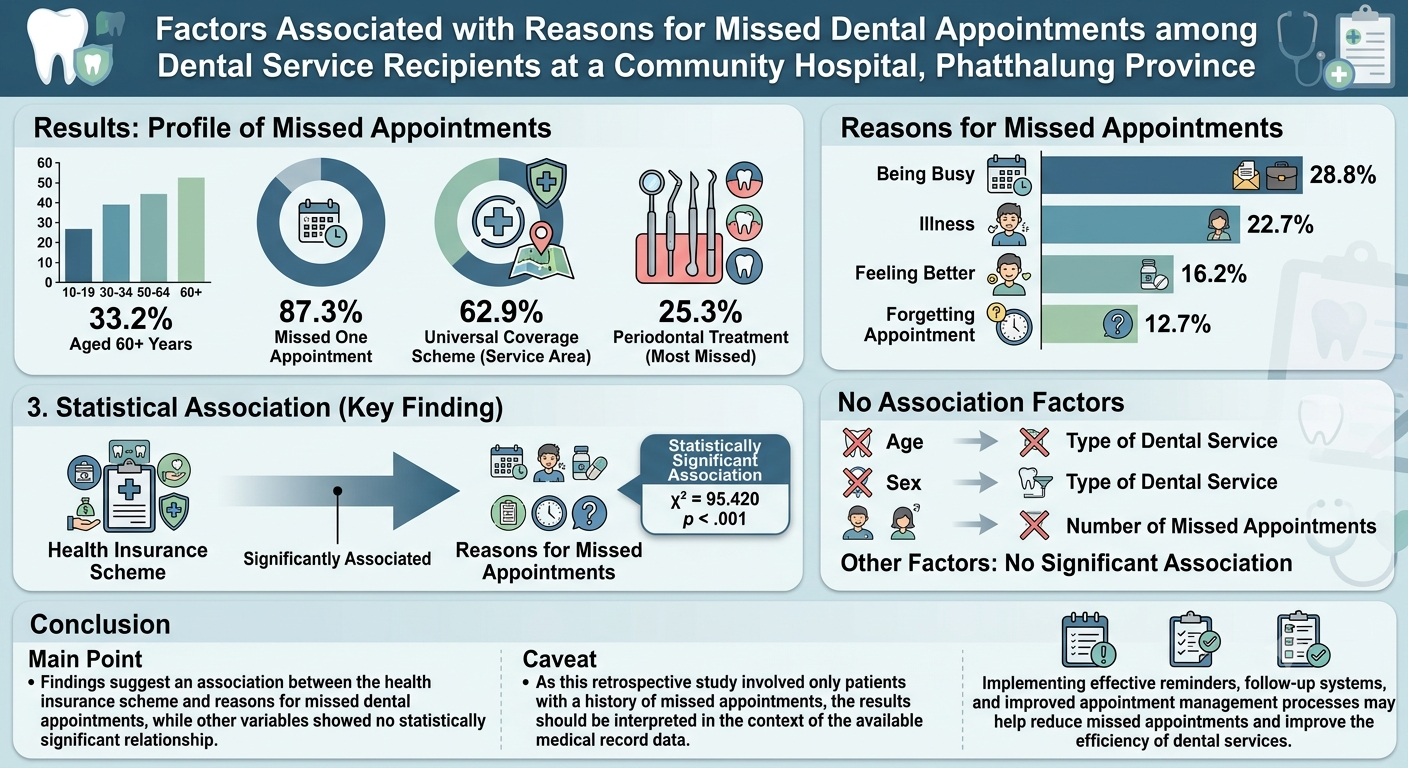
Results: Among the participants, 33.2% were aged 60 years or older, and 87.3% had missed one appointment. A majority, 62.9%, were enrolled in the Universal Coverage Scheme within the service area. Periodontal treatment was the most frequently missed service, representing 25.3% of cases. The primary reason for missed appointments was being busy (28.8%), followed by illness (22.7%), feeling better (16.2%), and forgetting the appointment date (12.7%). A statistically significant association was found between the health insurance scheme and the reasons for missed appointments (χ² = 95.420, p < .001). Other factors, such as age, sex, type of dental service, and the number of missed appointments, did not show a statistically significant association with the reasons for missed appointments.
Conclusion: The findings indicate an association between the health insurance scheme and the reasons for missed dental appointments, whereas other variables did not demonstrate a statistically significant relationship. Given that this retrospective study included only patients with a history of missed appointments, the results should be interpreted within the context of the available medical record data. The implementation of effective reminder systems, follow-up procedures, and enhanced appointment management processes may contribute to a reduction in missed appointments and an improvement in the efficiency of dental services.
References
Peres MA, Macpherson LMD, Weyant RJ, Daly B, Venturelli R, Mathur MR, et al. Oral diseases: a global public health challenge. Lancet 2019;394:249-60. doi: 10.1016/S0140-6736(19)31146-8.
Awartani F. Broken appointment behavior in a dental school environment. J Contemp Dent Pract 2003;4:100-7.
Helal O, Göstemeyer G, Krois J, Fawzy El Sayed K, Graetz C, Schwendicke F. Predictors for tooth loss in periodontitis patients: Systematic review and meta-analysis. J Clin Periodontol 2019;46:699-712. doi: 10.1111/jcpe.13118.
Tandon S, Duhan R, Sharma M, Vasudeva S. Between the Cup and the Lip: Missed Dental Appointments. J Clin Diagn Res 2016;10:ZC122-4. doi: 10.7860/JCDR/2016/17400.7842.
Khairuddeen NFI, Ahmad Nazari NHN, Ali Al-Kadhim AH, Samsudin AD, Amran N, Abdul Hamid NF, et al. Prevalence and reasons for missed dental appointments among patients treated by undergraduate dental students of Universiti Sains Islam Malaysia. IIUM J Orofacial Health Sci 2022;3:95-101. doi: 10.31436/ijohs.v3i1.106.
Gurol-Urganci I, de Jongh T, Vodopivec-Jamsek V, Atun R, Car J. Mobile phone messaging reminders for attendance at healthcare appointments. Cochrane Database Syst Rev 2012;2013:CD007458. doi: 10.1002/14651858.CD007458.pub3.
George A, Rubin G. Non-attendance in general practice: a systematic review and its implications for access to primary health care. Fam Pract 2003;20:178-84. doi: 10.1093/fampra/20.2.178.
Aldadi A, Robb KA, Williamson A. Factors influencing multiple non-utilised healthcare appointments from patients' and healthcare providers' perspectives: a qualitative systematic review of the global literature. BJGP Open 2025;8:BJGPO.2024.0075. doi: 10.3399/BJGPO.2024.0075.
Khries AM, Salaymeh RJ. Identifying barriers to pediatric dental appointments: insights from a study at Prince Faisal bin Al-Hussein Hospital. J Med Life 2024;17:812-8. doi: 10.25122/jml-2024-0178.
Kim J, Roy I, Martinez-Mier EA, Shukla A, Weir P. Impact of lack of transportation on access to dental care. Heliyon 2024;10:e40657. doi: 10.1016/j.heliyon.2024.e40657.
Borreani E, Wright D, Scambler S, Gallagher JE. Minimising barriers to dental care in older people. BMC Oral Health 2008;8:7. doi: 10.1186/1472-6831-8-7.
Shanahan D, O'Neill D. Barriers to dental attendance in older patients. Ir Med J 2017;110:548. PMID: 28665087.
Downloads
Published
How to Cite
Issue
Section
License
Copyright (c) 2026 Boromarajonani College of Nursing Sunpasitthiprasong

This work is licensed under a Creative Commons Attribution-NonCommercial-NoDerivatives 4.0 International License.
บทความที่ได้รับการตีพิมพ์เป็นลิขสิทธิ์ของวารสารวิทยาศาสตร์สุขภาพ วิทยาลัยพยาบาลบรมราชชนนี สรรพสิทธิประสงค์ ข้อความที่ปรากฏในบทความแต่ละเรื่องเป็นความคิดเห็นส่วนตัวของผู้เขียนแต่ละท่านไม่เกี่ยวข้องกับวิทยาลัยพยาบาลบรมราชชนนี สรรพสิทธิประสงค์ และคณาจารย์ท่านอื่นๆ ในวิทยาลัยพยาบาลฯ ความรับผิดชอบเกี่ยวกับบทความแต่ละเรื่องผู้เขียนจะรับผิดชอบของตนเอง