The Effectiveness of a Coaching Program on Preventing Behavioral Factors of Asthma Exacerbation and Improving Asthma Control in Patients with Uncontrolled Asthma at the Outpatient Department, Don Chedi Hospital, Suphanburi Province
Keywords:
coaching programs, exacerbation prevention behaviors, asthma control level, asthmaAbstract
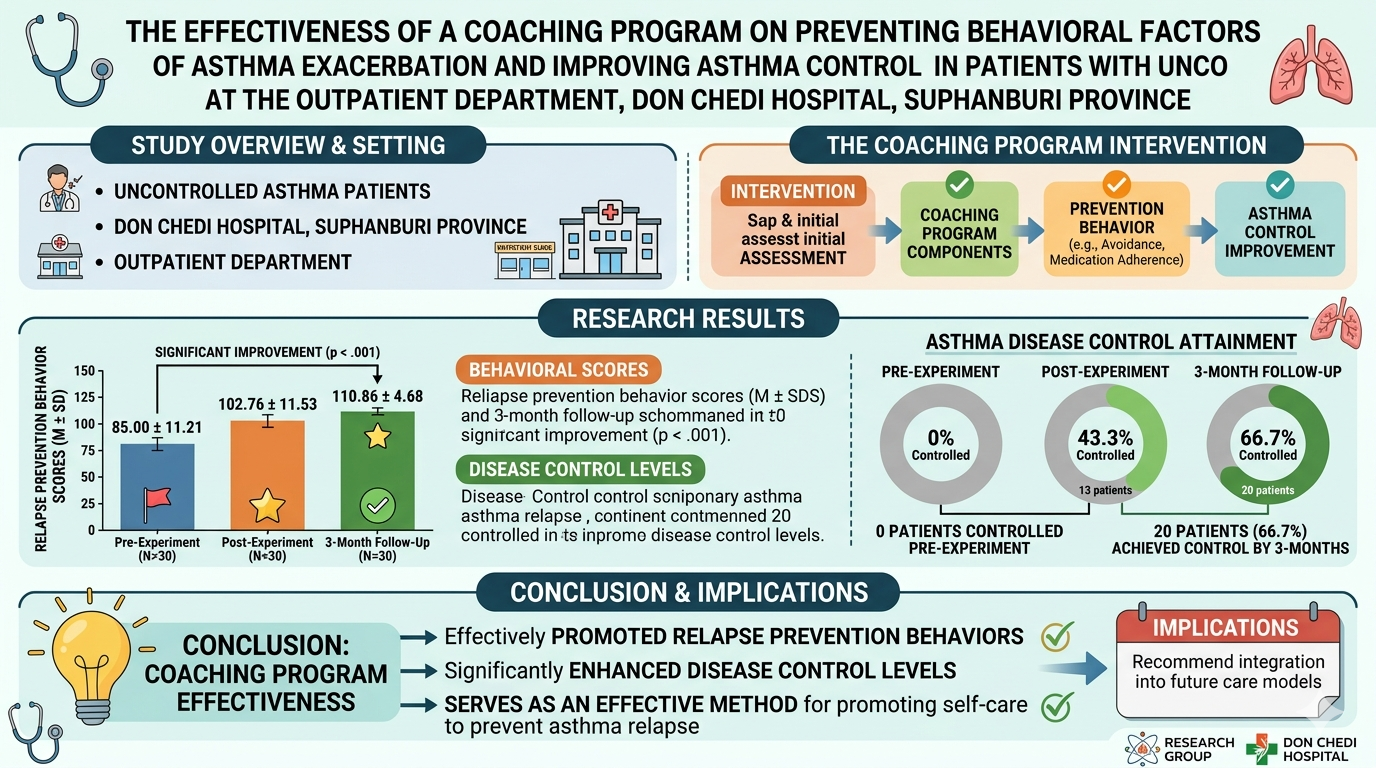
Background: Asthma represents a significant public health issue, as numerous patients fail to manage their symptoms effectively despite undergoing treatment and receiving education. This failure is often attributed to insufficient self-care skills. Consequently, this study aimed to investigate the impact of a coaching program on relapse prevention behaviors and the levels of disease control in individuals with asthma.
Methods: This study employed a quasi-experimental one-group repeated measures design, comprising 30 asthma patients from the asthma clinic in the outpatient department of Don Chedi Hospital, Suphan Buri Province. Participants were selected based on the following criteria: aged 40–60 years, diagnosed with asthma, experiencing uncontrolled disease in the preceding four weeks, and consenting to participate voluntarily. The research instruments utilized included a coaching program, a relapse prevention behavior questionnaire (IOC = .98, α = .71), and a disease control assessment (IOC = 1.00, α = .75). Data analysis was conducted using descriptive statistics, repeated measures ANOVA, and the Friedman test.
Results: Participants in the coaching program demonstrated a significant improvement in relapse prevention behavior scores, increasing from pre-experiment (M = 85.00, SD = 11.21) to post-experiment (M = 102.76, SD = 11.53), with further increases observed at the 3-month follow-up (M = 110.86, SD = 4.68) (p < .001). In terms of disease control, no patients had achieved control prior to the experiment; however, post-experiment, 43.3% of patients attained disease control, and by the 3-month follow-up, 20 patients (66.7%) were able to manage the disease (p < .001).
Conclusion: The coaching program effectively promoted relapse prevention behaviors and significantly enhanced disease control levels among patients with asthma. Consequently, this program serves as an effective method for promoting self-care among asthma patients to prevent disease relapse.
References
Global Burden of Disease 2019 Diseases and Injuries Collaborators. Global burden of 369 diseases and injuries in 204 countries and territories, 1990–2019: a systematic analysis for the Global Burden of Disease Study 2019. Lancet 2020;396:1204–22.
กองระบาดวิทยา กรมควบคุมโรค กระทรวงสาธารณสุข. รายงานสถานการณ์โรคหอบหืดประเทศไทย ปี 2563. นนทบุรี: กระทรวงสาธารณสุข; 2563.
วัชรา บุญสวัสดิ์. โรคหอบหืดในผู้ใหญ่. กรุงเทพฯ: สำนักพิมพ์แห่งจุฬาลงกรณ์มหาวิทยาลัย; 2561.
อรพรรณ โพชนุกูล. โรคหอบหืดในเด็ก. กรุงเทพฯ: สำนักพิมพ์แห่งจุฬาลงกรณ์มหาวิทยาลัย; 2567.
พนารัตน์ เมืองเจริญ. การพยาบาลผู้ป่วยโรคหอบหืด. วารสารพยาบาลโรคทรวงอกและเวชบำบัดวิกฤต 2566;31:45-56.
พรรณี ปรรคลักษ์, นฤมล ธีระรังสิกุล, ศิริยุพา สนั่นเรืองศักดิ์. ปัจจัยที่มีความสัมพันธ์กับพฤติกรรมการป้องกันอาการกำเริบของโรคหอบหืดในผู้ป่วยโรคหอบหืด. วารสารพยาบาลโรคทรวงอกและเวชบำบัดวิกฤต 2560;28:45-58.
วิมลัก ธารางกูร. ปัจจัยที่มีความสัมพันธ์กับการควบคุมโรคหอบหืดของผู้ป่วยโรคหอบหืดในชุมชน. วารสารสาธารณสุขศาสตร์ 2567;54:112-24.
ศุภกานต์ บุญนำมา, ภานุวัฒน์ สร้อยทอง, ญาดา วิริยไกรกุล, ราม รังสินธุ์. ปัจจัยที่มีผลต่อการควบคุมโรคหอบหืดของผู้ป่วยโรคหอบหืดในโรงพยาบาลชุมชน. วารสารการพยาบาลและการดูแลสุขภาพ 2566;41:78-89.
ศุภานัน ทองทวีโภคิน. พฤติกรรมการดูแลตนเองของผู้ป่วยโรคหอบหืดในชุมชน. วารสารวิทยาศาสตร์สุขภาพ 2565;31:95-106.
รชยา ยิกุสังข์. การส่งเสริมความรู้และพฤติกรรมการควบคุมโรคหอบหืดของผู้ป่วยโรคหอบหืด. วารสารพยาบาลศาสตร์ 2565;40:67-79.
Haas SA. Coaching: Developing key players. J Nurs Adm1992;23:54-8.
สุกัญญา พินหอม, ศิริยุพา สนั่นเรืองศักดิ์, นฤมล ธีระรังสิกุล. ผลของโปรแกรมการโค้ชต่อพฤติกรรมการดูแลตนเองของผู้ป่วยโรคเรื้อรัง. วารสารพยาบาลศาสตร์ 2564;39:45-56.
วิมลรัตน์ แสงจันทร์, นฤมล ธีระรังสิกุล, พจนารถ สารพัด. ผลของโปรแกรมการโค้ชต่อพฤติกรรมสุขภาพของผู้ป่วยโรคเรื้อรัง. วารสารการพยาบาลและการดูแลสุขภาพ 2566;41:78-89.
Cohen J. Statistical power analysis for the behavioral sciences. 2nd ed. Hillsdale (NJ): Lawrence Erlbaum Associates; 1988.
ปิยาณี เรืองเดช. การกำหนดขนาดกลุ่มตัวอย่างและการวิเคราะห์อำนาจการทดสอบในการวิจัยทางการพยาบาล. วารสารพยาบาลศาสตร์ 2567;42:1-12.
สมาคมสภาองค์กรโรคหืดแห่งประเทศไทย. แนวทางการวินิจฉัยและรักษาโรคหืดในประเทศไทย สำหรับผู้ใหญ่และเด็ก พ.ศ. 2555. กรุงเทพฯ: ภาพพิมพ์; 2555.
วรางคณา บุตรศรี, รัตนา บุญพา, ชาญณรงค์ สิงห์บรรณ. ผลของโปรแกรมการให้ความรู้ต่อพฤติกรรมการดูแลตนเองและการควบคุมระดับน้ำตาลในเลือดของผู้ป่วยเบาหวานชนิดที่ 2 ที่ไม่สามารถควบคุมระดับน้ำตาลในเลือดได้. วารสารการพยาบาลและการดูแลสุขภาพ 2564;39:45-56.
สุนทรี มอญทวี, รัตน์ศิริ ทาโต. ผลของโปรแกรมการโค้ชมารดาต่อพฤติกรรมการดูแลทารกแรกเกิด. วารสารพยาบาลศาสตร์ 2558;33:25-36.
Chung S, Lee J, Park H. Effects of health coaching on self-management and health behaviors among patients with chronic disease. J Clin Nurs 2025;34:210-20.
Hwang Y, Kim S, Park J. Health coaching intervention and behavioral change in patients with chronic illness: A randomized controlled trial. Int J Nurs Stud 2025;142:104521.
Seng J, Brown R, Smith K. The impact of health coaching on self-efficacy and clinical outcomes in chronic disease management. Patient Educ Couns 2025;118:45-52.
Global Initiative for Asthma. Global strategy for asthma management and prevention Update 2023 [Internet]. 2023 [cited 2026 Jun 8]. Available from: https://ginasthma.org/wp-content/uploads/2023/05/GINA-2023-Full-Report-2023-WMS.pdf
Molina Y, Banderas JW, St John J, Zhao H, Casillas A, Rodriguez HP, et al. Trusted messenger virtual asthma coaching intervention for adults with uncontrolled asthma: a pilot study. J Allergy Clin Immunol Pract 2024;12:561-9.
Fagnano M, Halterman JS, Conn KM, Shone LP, Wodi AP, Bailey LC. A randomized controlled trial of a parental asthma coaching intervention to improve asthma outcomes in children. Arch Pediatr Adolesc Med 2012;166:520-26. doi: 10.1001/archpediatrics.2011.2380.
Downloads
Published
How to Cite
Issue
Section
License
Copyright (c) 2026 Boromarajonani College of Nursing Sunpasitthiprasong

This work is licensed under a Creative Commons Attribution-NonCommercial-NoDerivatives 4.0 International License.
บทความที่ได้รับการตีพิมพ์เป็นลิขสิทธิ์ของวารสารวิทยาศาสตร์สุขภาพ วิทยาลัยพยาบาลบรมราชชนนี สรรพสิทธิประสงค์ ข้อความที่ปรากฏในบทความแต่ละเรื่องเป็นความคิดเห็นส่วนตัวของผู้เขียนแต่ละท่านไม่เกี่ยวข้องกับวิทยาลัยพยาบาลบรมราชชนนี สรรพสิทธิประสงค์ และคณาจารย์ท่านอื่นๆ ในวิทยาลัยพยาบาลฯ ความรับผิดชอบเกี่ยวกับบทความแต่ละเรื่องผู้เขียนจะรับผิดชอบของตนเอง