
The Effect of an Emotion Regulation and Family Participation Program on Aggressive Behavior in Schizophrenic Patients
Keywords:
schizophrenia , aggressive behavior, emotion regulation, family participationAbstract
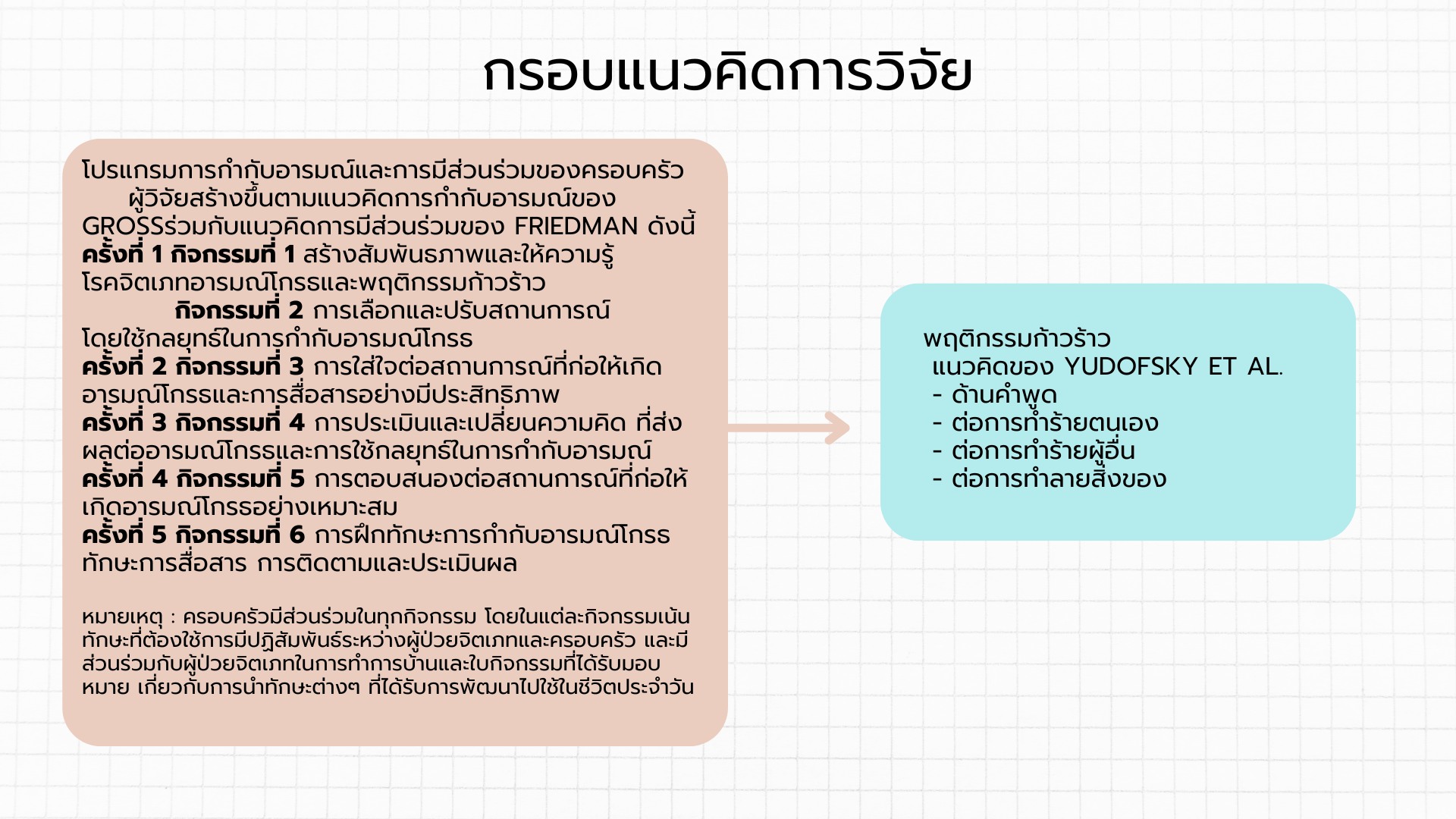
Aggressive behavior in patients with schizophrenia has numerous adverse consequences affecting both the patients themselves and others who may suffer injury or death, as well as causing property damage. This quasi-experimental study aimed to examine the effects of an emotion regulation program combined with family participation on aggressive behavior in patients with schizophrenia. The sample consisted of 42 patients diagnosed with schizophrenia according to ICD-10 diagnostic criteria at the inpatient department of Phrasri Mahabhodi Psychiatric Hospital. Participants were matched by characteristics, including gender and age, then randomly assigned to either the experimental group (n = 21) or control group (n = 21). The data collection instrument was an aggressive behavior assessment scale. The assessment’s reliability was established through a Cronbach's alpha coefficient of .81. Data were analyzed using descriptive statistics, chi-square tests, and t-tests.
Results: The findings revealed that the mean aggressive behavior scores of schizophrenia patients after receiving the emotion regulation and family participation program were significantly lower than before participating in the program (p < .05). Additionally, the mean aggressive behavior scores of the schizophrenia patients in the group that received the emotion regulation and family participation program were significantly lower than those in the group receiving routine nursing care (p < .05). The emotion regulation and family participation program resulted in improved emotional self-regulation among schizophrenia patients and reduced aggressive behavior. The study findings suggest that healthcare personnel should implement this program for schizophrenia patients, particularly those exhibiting aggressive behavior, to promote appropriate emotion regulation and reduce the occurrence of aggressive behavior.
References
World Health Organization. Schizophrenia [Internet]. 2022 [cited 2025 Jun 6]. Available from: https://www.who.int/news-room/fact-sheets/detail/schizophrenia
กรมสุขภาพจิต. จำนวนผู้ป่วยจิตเวชจำแนกตามกลุ่มโรค. ใน: รายงานประจำปี กรมสุขภาพจิตปีงบประมาณ 2565. นนทบุรี: กรมสุขภาพจิต; 2565.
โรงพยาบาลพระศรีมหาโพธิ์. รายงานจำนวนผู้ป่วยที่มารับบริการจำแนกตามโรคประจำปีงบประมาณ 2565-2567. อุบลราชธานี: โรงพยาบาลพระศรีมหาโพธิ์; 2567.
Li W, Yang Y, Hong L, An F-R, Ungvari GS, Ng CH, et al. Prevalence of aggression in patients with schizophrenia: A systematic review and meta-analysis of observational studies. Asian J Psychiatr 2020;47:101846.
Yudofsky SC, Silver JM, Jackson W, Endicott J, Williams D. The overt aggression scale for the objective rating of verbal and physical aggression. Am J Psychiatry 1986;143:35-39.
Weltens I, Bak M, Verhagen S, Vandenberk E, Domen P, van Amelsvoort T, et al. Aggression on the psychiatric ward: prevalence and risk factors. A systematic review of the literature. PLoS One 2021;16:e0258346.
Araya T, Ebnemelek E, Getachew R. Prevalence and associated factors of aggressive behavior among patients with schizophrenia at Ayder Comprehensive Specialized Hospital, Ethiopia. Biomed Res Int 2020;2020:1-8.
วุฒิชัย ชวนชนก, ภัทราภรณ์ ภัทรสกุล, สมบัติ สกุลพรรณ์. ปัจจัยที่เกี่ยวข้องกับพฤติกรรมก้าวร้าวของผู้ป่วยโรคจิตเภทในแผนกจิตเวชฉุกเฉิน. วารสารการพยาบาลจิตเวชและสุขภาพจิต. 2565;36:81-97.
Horan WP, Hajcak G, Wynn JK, Green MF. Impaired emotion regulation in schizophrenia: evidence from event-related potentials. Psychol Med 2013;43:2377-91.
Buyuksandalyaci Tunc E, Gul O. Difficulties in emotion regulation: are they the preventable cause of suicide, impulsivity, and aggression in schizophrenia and bipolar disorder. Psychiatr Danub 2023;35:38-46.
Caqueo-Urízar A, Fond G, Urzúa A, Boyer L, Williams DR. Violent behavior and aggression in schizophrenia: prevalence and risk factors. A multicentric study from three Latin-America countries. Schizophr Res 2016;178:23-28.
Wibawa IR, Hamid AYS, Daulima NHC. A phenomenological study: family experience in expressed emotion in providing care for client with risk of aggressive behavior. Walailak J Sci Technol 2020;17:450-9.
Buanasari A, Keliat BA, Susanti H. The application of acceptance commitment therapy (ACT) and family psychoeducation (FPE) to clients with schizophrenia and aggressive behavior. Nurse Media Journal of Nursing 2020;10:11-21. doi: 10.14710/nmjn.v10i1.22220
ทวีศักดิ์ กสิผล, พิจิตรา ชุณหฐิติธรรม, ชฎาภา ประเสริฐทรง, ชนิกา เจริญจิตต์กุล, ศิริยุพา นันสุนานนท์, อำพัน จารุทัสนางกูร. ประสบการณ์ของผู้ดูแลหลักในครอบครัวผู้ป่วยจิตเภท. วารสารสภากาชาดไทย 2563;13:102-15.
บูคอรี มะมิง, วินีกาญจน์ คงสุวรรณ. รูปแบบการจัดการพฤติกรรมก้าวร้าวในผู้ป่วยจิตเภท: การทบทวนวรรณกรรมอย่างเป็นระบบ. วารสารมหาวิทยาลัยนราธิวาสราชนครินทร์ 2566;15:62-97.
Tawfik A, Abd El SAEM, Harfush G, Ramadan E, Gemeay E. Effect of an emotion regulation training intervention on social functioning of patients with psychiatric disorders. Tanta Sci Nurs J 2021;21:122-41.
Ma C, Chan S, Chung Y, Ng S, Hui C, Suen Y, et al. The predictive power of expressed emotion and its components in relapse of schizophrenia: A meta-analysis and meta-regression. Psychol Med 2021;51:365-75.
Smithnaraseth A, Seeherunwong A, Panitrat R, Tipayamongkholgul M. Hospital and patient factors influencing the health status among patients with schizophrenia, thirty days after hospital discharge: Multi-level analysis. BMC Psychiatry 2020;20:1–13.
Gross JJ. Emotion regulation: Conceptual and empirical foundations. New York: Guilford; 2014.
Friedman M. Family nursing: Research, theory and practice. 5th ed. Norwalk (CT): Appleton & Lange; 2003.
กชพงศ์ สารการ. พฤติกรรมรุนแรงของผู้ป่วยจิตเวชและการจัดการของบุคลากรโรงพยาบาลพระศรีมหาโพธิ์ [วิทยานิพนธ์ปริญญามหาบัณฑิต] เชียงใหม่: มหาวิทยาลัยเชียงใหม่; 2542.
Gross JJ, John OP. Individual differences in two emotion regulation processes: Implications for affect, relationships, and well-being. J Pers Soc Psychol 2003;85:348-62.
ณัฏฐลิณ คุ้มรอด, รังสิมันต์ สุนทรไชยา. ผลของโปรแกรมการกำกับอารมณ์ต่ออาการซึมเศร้าในผู้ป่วยโรคซึมเศร้า. วารสารการพยาบาลจิตเวชและสุขภาพจิต 2560;31:136-51.
Peplau HE. Interpersonal relations in nursing: a conceptual frame of reference for psychodynamic nursing. New York: G.P. Putnam's Sons; 1952.
ฐิตินันท์ อ้วนล่ำ. บทบาทพยาบาลจิตเวชในการส่งเสริมการทำหน้าที่ของครอบครัวของผู้ป่วยจิตเภทในชุมชน. วารสารการพยาบาลจิตเวชและสุขภาพจิต 2563;34:1-12.
Daffern M, Simpson K, Ainslie H, Chu S. The impact of an intensive inpatient violent offender treatment program on intermediary treatment targets, violence risk and aggressive behavior in a sample of mentally disordered offenders. J Forensic Psychiatry Psychol 2018;29:163-88.
Peña-Sarrionandia A, Mikolajczak M, Gross JJ. Integrating emotion regulation and emotional intelligence traditions: A meta-analysis. Front Psychol 2015;6:160.
Berking M, Eichler E, Luhmann M, Diedrich A, Hiller W, Rief W. Affect regulation training reduces symptom severity in depression–a randomized controlled trial. PLoS One 2019;14:e0220436.
Yu BCL, Mak WWS, Chio FHN. Family involvement moderates the relationship between perceived recovery orientation of services and personal narratives among Chinese with schizophrenia in Hong Kong: A 1-year longitudinal investigation. Soc Psychiatry Psychiatr Epidemiol 2021;56:401-8.
Downloads
Published
How to Cite
Issue
Section
License
Copyright (c) 2025 Boromarajonani College of Nursing Sunpasitthiprasong

This work is licensed under a Creative Commons Attribution-NonCommercial-NoDerivatives 4.0 International License.
บทความที่ได้รับการตีพิมพ์เป็นลิขสิทธิ์ของวารสารวิทยาศาสตร์สุขภาพ วิทยาลัยพยาบาลบรมราชชนนี สรรพสิทธิประสงค์ ข้อความที่ปรากฏในบทความแต่ละเรื่องเป็นความคิดเห็นส่วนตัวของผู้เขียนแต่ละท่านไม่เกี่ยวข้องกับวิทยาลัยพยาบาลบรมราชชนนี สรรพสิทธิประสงค์ และคณาจารย์ท่านอื่นๆ ในวิทยาลัยพยาบาลฯ ความรับผิดชอบเกี่ยวกับบทความแต่ละเรื่องผู้เขียนจะรับผิดชอบของตนเอง