The Relationship Between a Health Promotion Planning Model and Sodium Consumption Behaviors among Hypertensive Patients
Keywords:
health promotion planning model, food consumption behavior, foods containing sodium, high blood pressureAbstract
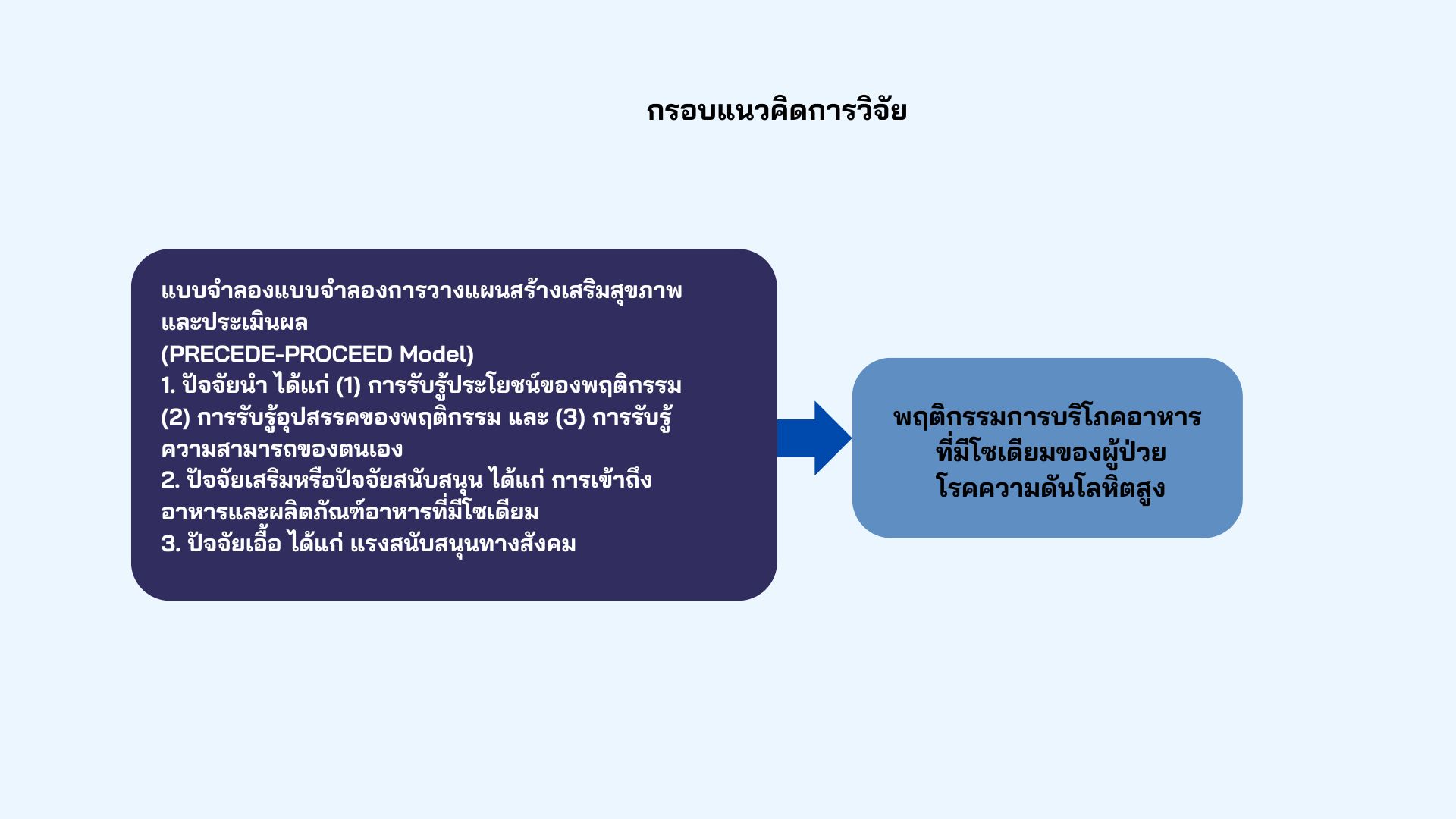
This cross-sectional survey study aimed to examine the relationship between a health promotion planning model and sodium consumption behavior among patients with hypertension. A sample of 420 participants was calculated for the study and data were collected through an online questionnaire having a Cronbach's alpha reliability coefficient of 0.81 and an item-objective congruence (IOC) index exceeding 0.67. Descriptive statistics and Spearman’s rank correlation coefficients were used for data analysis.
Results: The findings indicated the mean scores for perceived benefits (Mean = 3.74, S.D. = 0.51) and self-efficacy (Mean = 3.70, S.D. = 0.52) regarding sodium reduction behaviors were at the high level. Perceived barriers to engaging in these behaviors were moderate (Mean = 2.62, S.D. = 0.61), while enabling factors, such as access to sodium-rich foods and products, were also moderate (Mean = 2.85, S.D. = 0.75). Supportive factors, including social support for sodium consumption reduction, were moderate as well (Mean = 2.97, S.D. = 0.81). Sodium consumption behavior among participants was at a moderate level (Mean = 3.11, S.D. = 0.65). A positive moderate correlation was found between access to sodium-containing foods and self-efficacy (r = 0.571 and 0.459, respectively). Furthermore, positive but low correlations were identified for social support, perceived barriers, and perceived benefits (r = 0.325, 0.299, and 0.210, respectively), as well.
Based on these findings, healthcare service units should consider adopting the health promotion planning model to develop programs that target sodium consumption behaviors in patients with hypertension, as well as in other chronic diseases associated with dietary behaviors.
References
กรมควบคุมโรค. ยุทธศาสตร์ลดการบริโภคเกลือและโซเดียมในประเทศไทย ปี พ.ศ. 2559-2568.
กรุงเทพมหานคร; องค์การสงเคราะห์ทหารผ่านศึก; 2559.
กองโรคไม่ติดต่อ. แนวทางการดำเนินงานลดการบริโภคเกลือและโซเดียมระดับจังหวัด. นนทบุรี; กระทรวงสาธารณสุข; 2566.
Chailimpamontree W, Kantachuvesiri S, Aekplakorn W, Lappichetpaiboon R, Sripaiboonkij Thokanit N, Vathesatogkit P, et al. Estimated dietary sodium intake in Thailand: A nationwide population survey with 24-hour urine collections. J Clin Hypertens (Greenwich) 2021;23:744–54. doi: 10.1111/jch.14147.
Green L, & Kreuter M. Health program planning: An educational and ecological approach. 4th ed. New York: McGraw Hill; 2005.
ประทุม เมืองเป้, วุฒิชัย จริยา. ปัจจัยทำนายพฤติกรรมการบริโภคเกลือและโซเดียมของกลุ่มเสี่ยงโรคความดันโลหิตสูง อำเภอหนองไผ่ จังหวัดเพชรบูรณ์. วารสารวิชาการสาธารณสุข 2565;32:19–30.
จริญญา คมเสียบ. ความสัมพันธ์ระหว่างความรู้ การรับรู้อุปสรรค การรับรู้ประโยชน์ การสนับสนุนทางสังคม การรับรู้สมรรถนะแห่งตน กับพฤติกรรมการบริโภคเกลือโซเดียมของผู้ป่วยภาวะหัวใจล้มเหลว [วิทยานิพนธ์ปริญญาพยาบาลศาสตรมหาบัณฑิต]. กรุงเทพฯ: จุฬาลงกรณ์มหาวิทยาลัย; 2556.
พัชนี ถิระกุลพฤทธิ์. ปัจจัยที่มีผลต่อพฤติกรรมการบริโภคเกลือโซเดียมของครัวเรือน ในตำบลบางหมาก อำเภอกันตัง จังหวัดตรัง [วิทยานิพนธ์ปริญญาสาธารณสุขศาสตรมหาบัณฑิต]. ตรัง: วิทยาลัยการสาธารณสุขสิรินธร จังหวัดตรัง; 2559.
สำนักงานสาธารณสุขจังหวัดนครศรีธรรมราช. ระบบรายงานส่งข้อมูล 43 แฟ้ม [อินเทอร์เน็ต]. 2567 [เข้าถึงเมื่อ 8 ส.ค. 2567]. เข้าถึงได้จาก: https://nrt.hdc.moph.go.th/hdc/reports
ธานินทร์ ศิลป์จารุ. การวิจัยและวิเคราะห์ข้อมูลทางสถิติด้วย SPSS และ AMOS. พิมพ์ครั้งที่ 17. กรุงเทพฯ: บิสซิเนสอาร์แอนด์ดี; 2560
Best JW, Research in Education. 3rd ed. Englewood Cliffs, New Jersey: Prentice Hall; 1977.
Bartz AE. Basic Statistical Concepts. 4th ed. Englewood Cliffs, New Jersey: Prentice Hall; 1999.
Ukoha-Kalu BO, Isah A, Biambo AA, Samaila A, Abubakar MM, Kalu UA, & et al. Effectiveness of educational interventions on hypertensive patients’ self-management behaviours: An umbrella review protocol. BMJ Open 2023;13: e073682. doi: 10.1136/bmjopen-2023-073682.
Zhang Q, Shen Y, Yu M, Yang Z, Huang Z, Ding J, et al. Associations between estimation of salt intake and salt-restriction spoons and hypertension status in patients with poorly controlled hypertension: A community-based study from Huzhou City, Eastern China. Nutr J 2024;23:9. doi: 10.1186/s12937-024-00912-w.
Heindl B, Howard G, Clarkson S, Kamin Mukaz D, Lackland D, Muntner P, et al. Urban-rural differences in hypertension prevalence, blood pressure control, and systolic blood pressure levels. J Hum Hypertens 2023;37:1112–8. doi: 10.1038/s41371-023-00842-w.
Gupta DK, Lewis CE, Varady KA, Su YR, Madhur MS, Lackland DT, et al. Effect of dietary sodium on blood pressure: A crossover trial. JAMA 2023;330:2258–66. doi: 10.1001/jama.2023.23651.
อัมภากร หาญณรงค์, ชนัญชิดาดุษฎี ทูลศิริ, สมสมัย รัตนกรีฑากุล. ปัจจัยที่มีอิทธิพลต่อพฤติกรรมการบริโภคอาหารของผู้ป่วยโรคความดันโลหิตสูง. วารสารคณะพยาบาล มหาวิทยาลัยบูรพา 2560;25:52-65.
Downloads
Published
How to Cite
Issue
Section
License
Copyright (c) 2024 Boromarajonani College of Nursing Sunpasitthiprasong

This work is licensed under a Creative Commons Attribution-NonCommercial-NoDerivatives 4.0 International License.
บทความที่ได้รับการตีพิมพ์เป็นลิขสิทธิ์ของวารสารวิทยาศาสตร์สุขภาพ วิทยาลัยพยาบาลบรมราชชนนี สรรพสิทธิประสงค์ ข้อความที่ปรากฏในบทความแต่ละเรื่องเป็นความคิดเห็นส่วนตัวของผู้เขียนแต่ละท่านไม่เกี่ยวข้องกับวิทยาลัยพยาบาลบรมราชชนนี สรรพสิทธิประสงค์ และคณาจารย์ท่านอื่นๆ ในวิทยาลัยพยาบาลฯ ความรับผิดชอบเกี่ยวกับบทความแต่ละเรื่องผู้เขียนจะรับผิดชอบของตนเอง