
การพัฒนาและประเมินผลแนวปฏิบัติทางคลินิกสำหรับพยาบาลจิตเวช: การบำบัดทางสังคมจิตใจในผู้ป่วยโรคซึมเศร้า
คำสำคัญ:
โรคซึมเศร้า, แนวปฏิบัติทางคลินิกการบำบัดทางสังคมจิตใจ, ลดอาการซึมเศร้า, การหายทุเลา, การกลับเป็นซ้ำ, การกลับมารักษาซ้ำ, วันนอนในโรงพยาบาลบทคัดย่อ
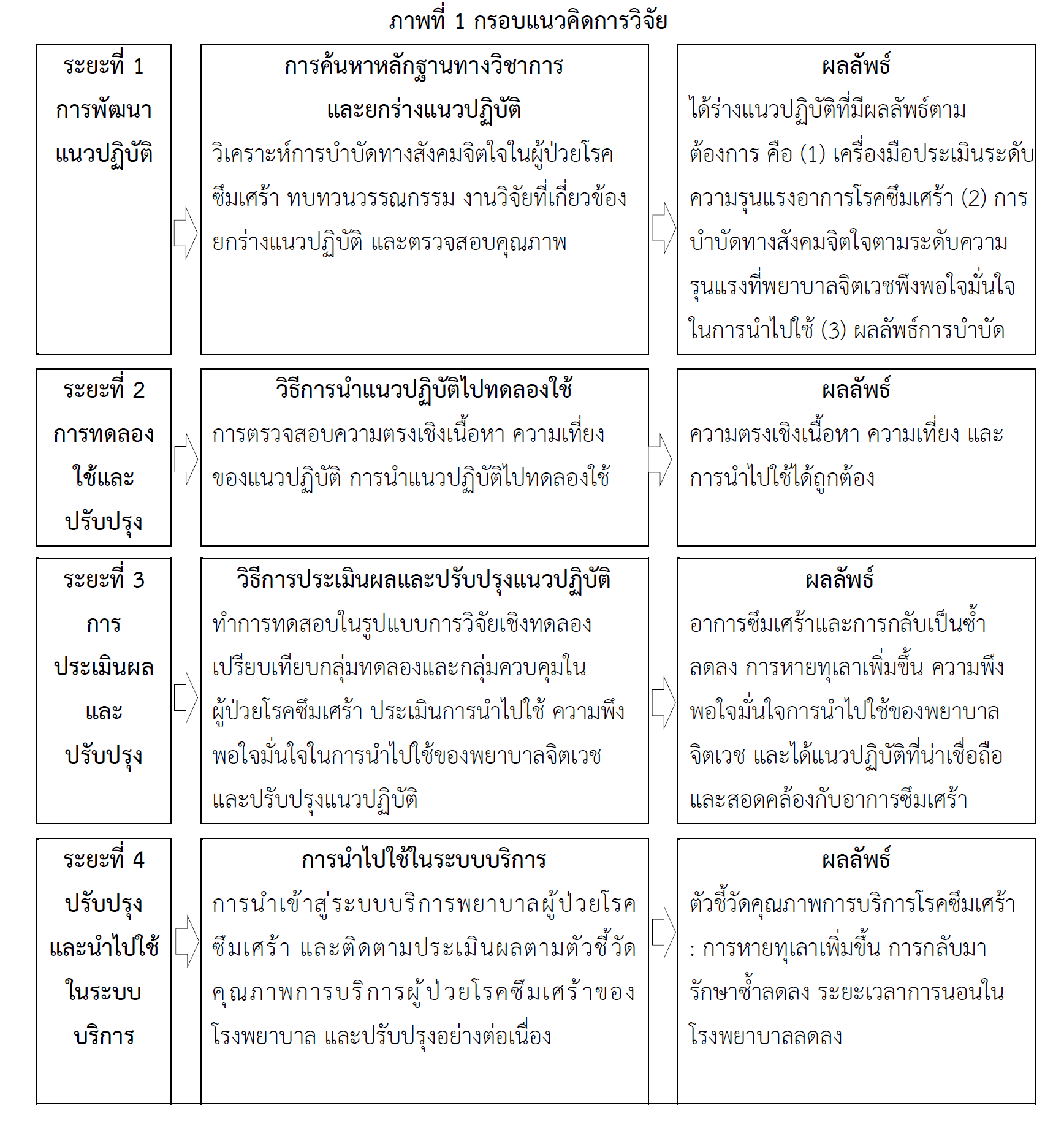
พยาบาลจิตเวชเป็นบุคลากรทางการแพทย์ที่มีความสำคัญในการดูแลผู้ป่วยโรคซึมเศร้า การวิจัยครั้งนี้ มีวัตถุประสงค์เพื่อพัฒนาและศึกษาผลแนวปฏิบัติทางคลินิกการบำบัดทางสังคมจิตใจในผู้ป่วยโรคซึมเศร้าสำหรับพยาบาลจิตเวช โดยวัดผลลัพธ์อาการซึมเศร้า การหายทุเลา วันนอนในโรงพยาบาล การกลับมารักษาซ้ำ พยาบาลจิตเวชมีความพึงพอใจและมั่นใจในการนำไปใช้ รูปแบบการวิจัยและพัฒนา 4 ระยะ คือ 1) การพัฒนาแนวปฏิบัติตามแนว GRADE 2) ทดลองใช้และปรับปรุง โดยทดลองใช้กับพยาบาลจิตเวช 5 คน และผู้ป่วยโรคซึมเศร้าที่รับไว้รักษาในโรงพยาบาลพระศรีมหาโพธิ์ที่มีอาการระดับเล็กน้อยขึ้นไป 15 คน ประเมินผลด้วยแบบประเมินอาการโรคซึมเศร้า 9 คำถาม (9Q) 3) ประเมินผลด้วยการวิจัยกึ่งทดลองกับผู้ป่วยโรคซึมเศร้า 44 คน และพยาบาลจิตเวช 10 คน ที่มีคุณสมบัติเดียวกันกับระยะที่ 2 แต่ไม่ซ้ำกลุ่มกัน ติดตามประเมินผลในระยะ 2 และ 6 เดือน และความพึงพอใจและมั่นใจในการนำไปใช้ของพยาบาลจิตเวช วิเคราะห์ข้อมูลด้วยความถี่ ร้อยละ การทดสอบไคสแควร์ และแมนวิทนีย์ยู และ 4) ปรับปรุงและนำไปใช้ ผลการศึกษาได้แนวปฏิบัติทางคลินิกตามระดับความรุนแรงของอาการ มีคำแนะนำเข้มแข็งและหลักฐานคุณภาพสูง การบำบัดทางสังคมจิตใจมีคำแนะนำเข้มแข็งและหลักฐานคุณภาพปานกลางสำหรับอาการเล็กน้อย ถึงปานกลางควรบำบัดด้วยโปรแกรมการออกกำลังกาย แก้ไขปัญหา จิตบำบัดประคับประคอง กระตุ้นพฤติกรรม หวนรำลึกความหลังที่เป็นสุข การเจริญสติตระหนักรู้ความคิด บำบัดความคิดและพฤติกรรม และจัดการตนเอง และอาการปานกลางควรบำบัดด้วยการดูแลแบบผสานความร่วมมือในการดูแลระหว่างวิชาชีพ บำบัดความคิดและพฤติกรรม และมีคำแนะนำเข้มแข็งและหลักฐานคุณภาพสูงสำหรับอาการปานกลางถึงรุนแรงควรบำบัดด้วยโปรแกรมความคิดและพฤติกรรม และเจริญสติตระหนักรู้ความคิด
ผลการศึกษา: หลังการนำแนวปฏิบัติฯ ไปทดลองใช้พบว่า กลุ่มทดลองมีค่าเฉลี่ยคะแนนอาการซึมเศร้าลดลง อัตราการหายทุเลาแตกต่างจากกลุ่มควบคุมอย่างมีนัยสำคัญสถิติ (p<. 05) และไม่กลับเป็นซ้ำในเวลา 2 และ 6 เดือน พยาบาลจิตเวชมีความพึงพอใจและมั่นใจในการนำไปใช้เพิ่มขึ้น การกลับมารักษาซ้ำ และวันนอนในโรงพยาบาลลดลง
เอกสารอ้างอิง
GBD 2019 Diseases and Injuries Collaborators. Global burden of 369 diseases and injuries in 204 countries and territories, 1990–2019: a systematic analysis for the Global Burden of Disease Study 2019. Lancet [Internet]. 2020 [cited 2020 Oct 23];396:1204–22. Available from: https://www.thelancet.com/action/showPdf?pii=S0140-6736%2820%2930925-9
National Clinical Practice Guideline. Depression in adults: the treatment and management [Internet]. 2018 [cited 2022 Oct 1]. Available from: https://www.nice.org.uk/guidance/gid-cgwave0725/documents/short-version-of-draft-guideline
National Institute for Health and Care Excellence. Vortioxetine for treating major depressive disorder. Issue Date [Internet]. 2014 [cited 2022 Nov 12]. Available from: https://www.nice.org.uk/guidance/ta367 /documents /major-depressive-disorder-vortioxetine-id583-final-scope.
Gutiérrez-Rojas, Porras-Segovia, Dunne, Andrade-González, Cervilla. Prevalence and correlates of major depressive disorder: a systematic review. Braz J Psychiatry 2020; 42:657-72. doi: 10.1590/1516-4446-2020-0650.
Punnapa Kittiratanapaiboon. Thai national Mental Health Survey 2013. 14th Annual International Mental Health Conference; National Survey Report, Miracle Grand Hall June 17th Miracle Grand Hotel, Bangkok; 2015.
Kongsuk T, Supanya S, Kenbubpha K, Phimtra S, Sukhawaha S, Leejongpermpoon J. Services for depression and suicide in Thailand. WHO South East Asia J Public Health. 2017;6:34-8. doi: 10.4103/2224-3151.206162. PMID: 28597857.
HDC – Dashboard กระทรวงสาธารณสุข [อินเตอร์เน็ต]. 2565 [เข้าถึงเมื่อ 12 ต.ค. 2565]. เข้าถึงได้จาก: https://hdcservice.moph.go.th/hdc/main/index_pk.php
กรมสุขภาพจิต. แนวปฏิบัติทางคลินิกการบำบัดทางสังคมจิตใจผู้ป่วยโรคซึมเศร้าสำหรับพยาบาลจิตเวชในสถานบริการระดับตติยภูมิ [อินเตอร์เน็ต]. 2554 [เข้าถึงเมื่อ 2 ต.ค. 2564]. เข้าถึงได้จาก: https://www.thaidepression.com/
จินตนา ลี้จงเพิ่มพูน, เกษราภรณ์ เคนบุปผา, สุพัตรา สุขาวห, สุภาภรณ์ ทองเบ็ญจมาศ, หทัยรัตน์ สายมาอินทร์. ผลการวิเคราะห์ความต้องการและปัญหาการจัดการโรคซึมเศร้าในโรงพยาบาลพระศรีมหาโพธิ์. โรงพยาบาลพระศรีมหาโพธิ์; 2564.
โรงพยาบาลพระศรีมหาโพธิ์. รายงานผลปฏิบัติงานประจำปีงบประมาณ 2564. โรงพยาบาลพระศรีมหาโพธิ์; 2564.
ธรณินทร์ กองสุข, ดาราวรรณ ต๊ะปินตา, สมบัติ สกุลพรรณ์, พันธ์ทิพย์ โกศัลวัฒน์, จินตนา ลี้จงเพิ่มพูน, หทัยรัตน์ ปฏิพัทธ์ภักดี, และคณะ. ประสิทธิผลของการบำบัดด้วยการปรับความคิดและพฤติกรรมต่ออาการซึมเศร้าในผู้ป่วยโรคซึมเศร้าคนไทย: การวิจัยแบบสุ่มและมีกลุ่มควบคุม [อินเตอร์เน็ต]. 2559 [เข้าถึงเมื่อ 26 ธ.ค. 2564]. เข้าถึงได้จาก: https://www.nrms.go.th/ข้อมูลข่าวสาร/เอกสารเผยแพร่
ธรณินทร์ กองสุข, อัจฉราพร สี่หิรัญวงศ์, หทัยรัตน์ ปฏิพัทธ์ภักดี, วรวิทย์ เจริญพร, เกรียงศักดิ์ หาญสิทธิพร, จินตนา ลี้จงเพิ่มพูน, และคณะ. รูปแบบการดูแลแบบผสานความร่วมมือในการดูแลระหว่างวิชาชีพที่มีต่ออาการซึมเศร้าและการควบคุมระดับน้ำตาลในเลือด สำหรับผู้ป่วยโรคเบาหวานที่มีโรคซึมเศร้าร่วมด้วย [อินเตอร์เน็ต]. 2559 [เข้าถึงเมื่อ 26 ธ.ค. 2564]. เข้าถึงได้จากhttps://www.nrms.go.th/ข้อมูลข่าวสาร/เอกสารเผยแพร่
ธรณินทร์ กองสุข, ดาราวรรณ ต๊ะปินตา, เชาวนี ล่องชูผล, จินตนา ลี้จงเพิ่มพูน, หทัยรัตน์ ปฏิพัทธ์ภักดี, สุภาภรณ์ ทองเบญจมาศ, และคณะ. การพัฒนาโปรแกรมการบำบัดด้วยจิตบำบัดประคับประคองสำหรับผู้ป่วยโรคซึมเศร้าในคนไทย [อินเตอร์เน็ต]. 2559 [เข้าถึงเมื่อ 26 ธ.ค. 2564]. เข้าถึงได้จาก: https://www.nrms.go.th/ข้อมูลข่าวสาร/เอกสารเผยแพร่
ธรณินทร์ กองสุข, ดาราวรรณ ต๊ะปินตา, เชาวนี ล่องชูผล, หทัยรัตน์ สายมาอินทร์, จินตนา ลี้จงเพิ่มพูน, พันธ์ทิพย์ โกศัลวัฒน์, และคณะ. การพัฒนาโปรแกรมการแก้ไขปัญหาสำหรับผู้ป่วยโรคซึมเศร้าในคนไทย [อินเตอร์เน็ต]. 2559 [เข้าถึงเมื่อ 26 ธ.ค. 2564]. เข้าถึงได้จาก: https://www.nrms.go.th/ข้อมูลข่าวสาร/เอกสารเผยแพร่
วาสนา เหล่าคงธรรม, สุปราณี พิมพ์ตรา, ธรณินทร์ กองสุข, สมพร รุ่งเรืองกลกิจ, จินตนา ลี้จงเพิ่มพูน. ผลของกลุ่มบำบัดแบบหวนรำลึกความหลังที่เป็นสุข ต่ออาการซึมเศร้าในผู้สูงอายุไทยที่เป็นโรคซึมเศร้า. วารสารการพยาบาลจิตเวชและสุขภาพจิต 2558;29:12-27.
ไพรัตน์ ชมภูบุตร, เกษราภรณ์ เคนบุปผา, สุพัตรา สุขาวห, จินตนา ลี้จงเพิ่มพูน, หทัยรัตน์ สายมาอินทร์. ผลการวิเคราะห์ความต้องการและปัญหาการจัดการโรคซึมเศร้าในโรงพยาบาลพระศรีมหาโพธิ์. โรงพยาบาลพระศรีมหาโพธิ์; 2563.
ละเอียด ปานนาค, สกาวรัตน์ พวงลัดดา, นารี เครือช้า, พัชรินทร์ ภักดีนวล. ผลของการใช้แนวปฏิบัติการพยาบาลเพื่อลดภาวะซึมเศร้าในผู้ป่วยโรคซึมเศร้า. วารสารวิชาการสาธารณสุข 2553;19:447-56.
สุวรีย์ เพชรแต่ง, คชารัตน์ ปรีชล. การพัฒนาและประเมินผลแนวปฏิบัติทางการพยาบาลเพื่อป้องกันการเกิดภาวะซึมเศร้าหลังคลอดในชุมชนตำบลหลักหก อำเภอเมือง จังหวัดปทุมธานี. วารสารพยาบาลสภากาชาดไทย 2564;14:207-20.
Soukup SM. The Center for Advanced Nursing Practice evidence-based practice model: promoting the scholarship of practice. The Nursing clinics of North America 2002;35:301–9.
ธรนินทร์ กองสุข, วิรัลพัชร กิตติธะระพันธุ์, สุนทรี ศรีโกไสย, จินตนา ลี้จงเพิ่มพูน. คู่มือการจัดทำแนวปฏิบัติทางจิตเวช. กรมสุขภาพจิต; 2558.
Schunemann HJ, Brennan S, Akl EA, Hultcrantz M, Alonso Coello P, Xia J, et al. The development methods of official GRADE articles and requirements for claiming the use of GRADE - a statement by the GRADE guidance group. J Clin Epidemiol 2023;159:79-84. doi: 10.1016/j.jclinepi.2023.05.010.
ธรณินทร์ กองสุข, สุวรรณา อรุณพงค์ไพศาล, ศุภชัย จันทร์ทอง, เบญจมาส พฤกษ์กานนท์, สุพัตรา สุขาวห, จินตนา ลี้จงเพิ่มพูน. ความเที่ยงตรงตามเกณฑ์การวินิจฉัยโรคซึมเศร้าของแบบประเมินอาการซึมเศร้า 9 คำถามฉบับปรับปรุงภาษากลาง. วารสารสมาคมจิตแพทย์แห่งประเทศไทย 2561;63:321-34.
กรมสุขภาพจิต กระทรวงสาธารณสุข. แนวปฏิบัติทางคลินิกเพื่อการบำบัดทางสังคมจิตใจผู้ป่วยโรคซึมเศร้าสำหรับพยาบาลจิตเวชในสถานบริการระดับตติยภูมิ (Clinical Practice Guideline of Psychosocial Intervention for Depressive Disorder for Psychiatric nurse in Tertiary Care) [อินเตอร์เน็ต]. 2560 [เข้าถึงเมื่อ 26 ธ.ค. 2565]. เข้าถึงได้จาก: https://www.thaidepression.com/www/58/cnpgtertiarycare.pdf
Xie Y, Wu Z, Sun L, Zhou L, Wang G, Xiao L, et al. The Effects and mechanisms of exercise on the treatment of depression. Front Psychiatry 2021;12:705559. doi: 10.3389/fpsyt.2021.705559.
ประภาส อุครานันท์, กมลทิพย์ สงวนรัมย์, สุพัตรา สุขาวห, สุภาภรณ์ ทองเบ็ญจมาศ. การทดสอบประสิทธิภาพเบื้องต้นของโปรแกรมการบำบัดด้วยการกระตุ้นพฤติกรรมในการลดอาการซึมเศร้าของผู้ป่วยโรคซึมเศร้า. การประชุมวิชาการสุขภาพจิตระดับชาติครั้งที่ 20 ประจำปี 2564 New Normal Mental health “สุขภาพจิตดีวิถีชีวิตใหม่”; 7-9 กรกฎาคม 2564; กรมสุขภาพจิต. นนทบุรี; 2564.
ไพรัตน์ ชมภูบุตร, เกษราภรณ์ เคนบุปผา, สุพัตรา สุขาวห, จินตนา ลี้จงเพิ่มพูน, หทัยรัตน์ สายมาอินทร์. การพัฒนาและผลของโปรแกรมการจัดการตนเองด้วยการเจริญสติตระหนักรู้ความคิดเพื่อป้องกันการกลับเป็นซ้ำของผู้ป่วยโรคซึมเศร้า. วารสารการพยาบาลจิตเวชและสุขภาพจิต 2565;36:117-40.
ไพรัตน์ ชมภูบุตร, จินตนา ลี้จงเพิ่มพูน, หทัยรัตน์ สายมาอินทร์, อัจฉริยาภรณ์ สุพิชญ์, สุดารัตน์ พุฒพิมพ์, สุทธยา แสงรุ่ง. โปรแกรมการจัดการตนเองเพื่อการหายทุเลาและป้องกันการกลับเป็นซ้ำสำหรับผู้ป่วยโรคซึมเศร้า. วารสารวิทยาศาสตร์สุขภาพ วิทยาลัยพยาบาลบรมราชชนนี สรรพสิทธิ ประสงค์ อุบลราชธานี 2565;6:30-48.
Polit DF, Beck CT. Nursing Research: Generating and Assessing Evidence for Nursing Practice. 9th ed. Lippincott, Williams & Wilkins: Philadelphia; 2012.
บุญใจ ศรีสถิตย์นรากูร. ระเบียบวิธีการวิจัยทางพยาบาลศาสตร์. กรุงเทพฯ: ยูแอนด์ไอ อินเตอร์ มีเดีย; 2553.
American Psychiatric Association. Diagnostic and statistical manual of mental disorders. 5th ed. Washington DC: American Psychiatric Association; 2013.
สถาบันเวชศาสตร์ผู้สูงอายุ. แบบทดสอบสภาพสมองเบื้องต้นฉบับภาษาไทย MMSE-Thai 2002 /คณะกรรมการจัดทำแบบทดสอบสภาพสมองเบื้องต้น ฉบับภาษาไทย พ.ศ.2542 สถาบันเวชศาสตร์ผู้สูงอายุ. นนทบุรี: กระทรวงสาธารณสุข; 2544.
อรุณ จิรวัฒน์กุล. สถิติทางวิทยาศาสตร์สุขภาพเพื่อการวิจัย. กรุงเทพฯ: วิทยพัฒน์; 2552. หน้า 116.
สุวรรณา อรุณพงค์ไพศาล, พูนศรี รังสีขจี, นิรมล พัจนสุนทร, สุรพล วีระศิริ, สุชาติ พหลภาคย์, ธวัชชัย กฤษณะประกรกิจ. การพัฒนาเครื่องมือคัดกรองภาวะซึมเศร้าชื่อ Khon Kaen University Depression Inventory (KKU-DI) สำหรับคนไทยในชุมชนภาคตะวันออกเฉียงเหนือ. วารสารสมาคมจิตแพทย์แห่งประเทศไทย 2549;51:330-48.
มาโนช หล่อตระกูล, ปราโมทย์ สุคนิชย์, จักรกฤษณ์ สุขยิ่ง. การพัฒนาแบบวัด Hamilton Rating Scale for Depression. วารสารสมาคมจิตแพทย์แห่งประเทศไทย 2539;41:235-46.
รณชัย คงสกนธ์, สมบัติ ศาสตร์รุ่งภัค, อวยชัย โรจนนิรันกิจ, อุไร บูรณเชฐ. การพัฒนาแบบประเมิน Montgomery Asberg Depression Rating Scale (MADRS) ฉบับภาษาไทย. วารสารสมาคมจิตแพทย์แห่งประเทศไทย 2546;48:211-9.
Train The Brain Forum Committee. Train the brain forum committee. Thai Geriatric Depression Scale-TDGS. Siriraj Hospital Gazette 1994;46:1-9.
Lotrakul M, Sumrithe S, Saipanish R. Reliability and validity of the Thai version of the PHQ-9. BMC Psychiatry 2008;8:46.
ธรณินทร์ กองสุข, ศุภชัย จันทร์ทอง, เกษราภรณ์ เคนบุปผา, สุพัตรา สุขาวห, จินตนา ลี้จงเพิ่มพูน, ศักดา ขำคม, และคณะ. ความน่าเชื่อถือและความเที่ยงตรงของแบบประเมินอาการโรคซึมเศร้าด้วย 9 คำถาม เปรียบเทียบกับแบบประเมิน Hamilton Rating Scale for Depression (HRS.D.-17). การประชุมวิชาการสุขภาพจิตนานาชาติ ครั้งที่ 9 ปี 2553; โรงแรมปริ้นซ์ พาเลซ มหานาค กรุงเทพมหานคร; 2553.
รังสิมันต์ สุนทรไชยา, ธรณินทร์ กองสุข, สุวรรณา อรุณพงค์ไพศาล, วาสินี วิเศษฤทธิ์, สุพัตรา สุขาวห, จินตนา ลี้จงเพิ่มพูน. วารสารการพยาบาลจิตเวชและสุขภาพจิต 2561;32:100-12.
American Psychiatric Association [APA]. Practice guideline for the treatment of patients with major depressive disorder (third edition) [Internet]. 2010 [cited 2022 Oct 1]. Available from: http://www.psychiatryonline.com/pracGuide/pracGuideTopic_7.aspx
อัจฉริยาภรณ์ สุพิชญ์, ไพรัตน์ ชมภูบุตร, จินตนา ลี้จงเพิ่มพูน, หทัยรัตน์ สายมาอินทร์, สุดารัตน์ พุฒพิมพ์, หทัยรัตน์ ดิษฐ์อั๊ง, และคณะ. ผลโปรแกรมการจัดการตนเองต่อการลดลงของความคิดอยากฆ่าตัวตายในผู้ป่วยโรคซึมเศร้า. โรงพยาบาลพระศรีมหาโพธิ์; 2565.
Adams EG. Treatment of depression in integrated care: Implementation of the nurse care manager. SAGE Open Nurs 2019;86:220-30. doi. 10.1177/2377960819861862.
Jiang L, Cheng L, Li X, Yan J. What should nurses do on post-stroke depression? A global systematic assessment of clinical practice guidelines. BMJ Open 2022;12:e064069. doi:10.1136/bmjopen-2022-064069.
Chantra R, Kunlaka S, Pumpith P. Effect of nursing interventions on depression treatment in depressive patients: A meta-analysis. International Journal of Public Health and Health Sciences 2019;1:11-7
Myles L, Merlo E. Elucidating the cognitive mechanisms underpinning behavioural activation. Int J Psychol Res (Medellin) 2022;15:126-32. doi: 10.21500/20112084.5400.
Farb N, Anderson A, Ravindran A, Hawley L, Irving J, Mancuso E, et al. Prevention of relapse/recurrence in major depressive disorder with either mindfulness-based cognitive therapy or cognitive therapy. J Consult Clin Psychol 2018;86:200-4. doi: 10.1037/ccp0000266.
ดาวน์โหลด
เผยแพร่แล้ว
รูปแบบการอ้างอิง
ฉบับ
ประเภทบทความ
สัญญาอนุญาต
ลิขสิทธิ์ (c) 2024 วิทยาลัยพยาบาลบรมราชชนนี สรรพสิทธิประสงค์

อนุญาตภายใต้เงื่อนไข Creative Commons Attribution-NonCommercial-NoDerivatives 4.0 International License.
บทความที่ได้รับการตีพิมพ์เป็นลิขสิทธิ์ของวารสารวิทยาศาสตร์สุขภาพ วิทยาลัยพยาบาลบรมราชชนนี สรรพสิทธิประสงค์ ข้อความที่ปรากฏในบทความแต่ละเรื่องเป็นความคิดเห็นส่วนตัวของผู้เขียนแต่ละท่านไม่เกี่ยวข้องกับวิทยาลัยพยาบาลบรมราชชนนี สรรพสิทธิประสงค์ และคณาจารย์ท่านอื่นๆ ในวิทยาลัยพยาบาลฯ ความรับผิดชอบเกี่ยวกับบทความแต่ละเรื่องผู้เขียนจะรับผิดชอบของตนเอง