
The Development of a Management Model for Palliative Care Patients
Keywords:
management, end of life, palliative careAbstract
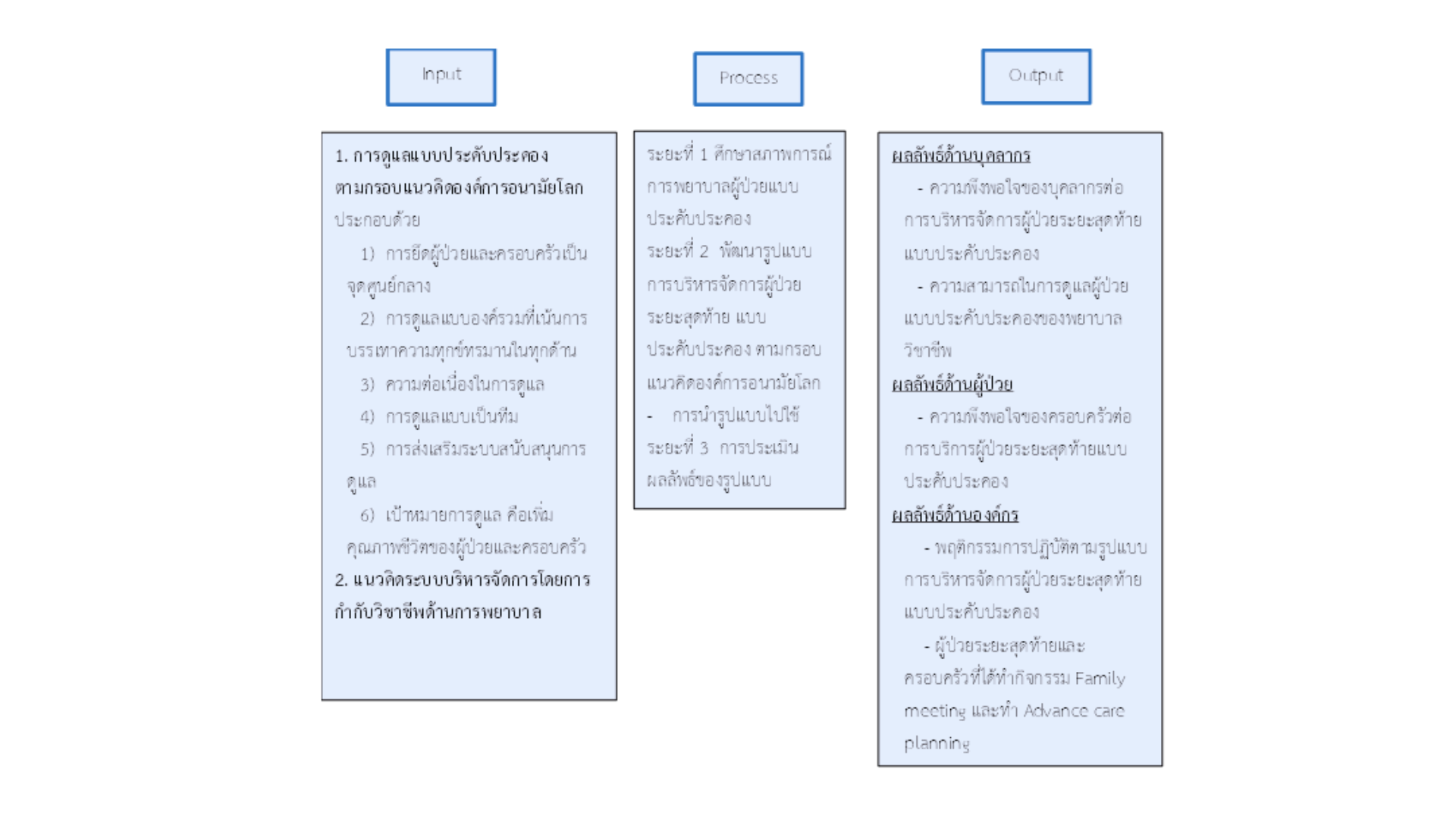
Palliative care is care that focuses on increasing the quality of life of patients and their families that reduces suffering by taking into account the needs and wishes of the patient and family. The objectives of this research were to 1) study palliative care management; 2) develop a palliative management model, and 3) study the results of the developed palliative management model for end-of-life patients. The study was conducted between 1 April 2022 - 31 October 2022. The sample consisted of 60 professional nurses and 30 end-of-life patients receiving palliative care at Yasothon Hospital. Research tools used to conduct the research included: 1) group discussion questions, 2) of the "YASO-PCN-CARE Mode!" management model for end-of-life palliative care patients. Assessment tools included: 1) the professional nurses practice evaluation form, 2) the Personnel satisfaction questionnaire, 3) the patient care nurse competence questionnaire, and 4) the family satisfaction with patient care questionnaire. The research assessment tools’ reliability were assessed using Cornbrash's Alpha Coefficient produced reliability values of 0.81, 0.79, 0.83 and 0.80, respectively. Descriptive statistics and Paired t tests statistics were used to analyze the data.
The results of the research found that the "YASO-PCN-CARE Model" palliative management model for end-of-life patient practice guidelines consisted of structuring, setting goals, holistic care, communication channels for continuous care, working as a team and building a clinical supervision network, having a care plan, sharing resources, and reviewing and evaluating the plan. The results of the assessment of the management model found that, (1) overall, personnel satisfaction was at a high level (Mean = 4.75, S.D. =0.45); (2) the ability to provide palliative care to end-of-life patients was very high (Mean =4.68, S.D. =0.14) and was statistically significantly higher than before implementation of the guidelines at the .05 level; (3) satisfaction of family on having model of care, the overall satisfaction was at a high level (Mean = 4.37, S.D. = 0.54): (4) compliance to the guidelines among the nurses was at a high level (Mean = 4.41, S.D. =.54); and (5) family meetings and advanced care planning was conducted in every case (100 %) after using the guidelines. Conclusion the palliative management model for end-of-life patient was easy to practice, personnel have ability to care for patients. Personnel and their families are satisfied with the model.
References
กระทรวงสาธารณสุข. การดูแลผู้ป่วยระยะท้ายแบบประคับประคอง [อินเตอร์เน็ต]. 2566 [เข้าถึงเมื่อ 25 พ.ค. 2566]. เข้าถึงได้จาก: https://hdcservice.moph.go.th/hdc/reports/report_kpi.php?flag_kpi_level=1&flag_kpi_year=2023&source=pformated/format1.php&id=a67ee74a4c0ff3c775b591be4ec80086
ชุติกาญจน์ หฤทัย, อัมราภัสร์ อรรถชัยวัจน์, โศภิษฐ์ สุวรรณเกศาวงษ์. ระบบบริการพยาบาลแบบประคับประคอง. นนทบุรี: สื่อตะวัน; 2559.
วินัย สวัสดิวร. เครือข่ายดูแลผู้ป่วยระยะสุดท้าย. วารสารก้าวใหม่หลักประกันสุขภาพ 2558;8:1-2.
World Health Organization. Planning and implementing palliative care services: A guide for program managers [Internet]. 2016 [cited 2022 May 25]. Available from: https://iris.who.int/bitstream/handle/10665/250584/9789241565417-eng.pdf?sequence=1
สำนักนโยบายและยุทธศาสตร์ กระทรวงสาธารณสุข. สถิติสาธารณสุข พ.ศ.2558. กรุงเทพฯ: สามเจริญ; 2559.
สำนักการพยาบาล กระทรวงสาธารณสุข. ระบบบริการพยาบาลแบบประคับประคอง. กรุงเทพฯ: สื่อตะวัน; 2559.
พิกุล นันทชัยพันธ์, ประทุม สร้อยวงค์. แนวปฏิบัติการพยาบาลทางคลินิก: การดูแลแบบประคับประคองในผู้ป่วยผู้ใหญ่. พิมพ์ครั้งที่ 2. นนทบุรี: สภาการพยาบาลและสมาคมพยาบาลแห่งประเทศไทยฯ; 2558.
Donabedian A. An Introduction to quality assurance in health care. New York: Oxford University Press; 2003.
ศศิวิมล ปานุราช, เยาวรัตน์ มัชฌิม, บวรลักษณ์ ทองทวี. ความรู้ในการดูแลแบบประคับประคองของพยาบาลในพื้นที่เครือข่ายสำนักงานหลักประกันสุขภาพ เขตบริการที่ 4 และปัจจัยที่เกี่ยวข้องในมหาวิทยาลัยศรีนครินทรวิโรฒ, การประชุมวิชาการระดับชาติ มศว วิจัยครั้งที่ 11. กรุงเทพฯ: มหาวิทยาลัยศรีนครินทรวิโรฒ; 2561. หน้า 1070-82.
ฝ่ายแผนงานและสารสนเทศโรงพยาบาลยโสธร. รายงานสถิติข้อมูลผู้ป่วยประจำปี. โรงพยาบาลยโสธร: ยโสธร; 2565.
สถาบันรับรองคุณภาพสถานพยาบาล. มาตรฐานโรงพยาบาลและบริการสุขภาพ ฉบับที่ 4. พิมพ์ครั้งที่ 2. นนทบุรี: สถาบันรับรองคุณภาพสถานพยาบาล; 2561.
สมจิตร ประภากร, ศิริพร สวยพริ้ง, อัญชลี สุขขัง, ศุภรักษ์ มั่นน้อย, วราภรณ์ พันธุ์อร่าม, สุจิรา ฟุ้งเฟื่อง. การพัฒนาระบบบริการพยาบาลแบบประคับประคองในผู้ป่วยมะเร็งที่เข้ารับการรักษาในสถาบันมะเร็งแห่งชาติ. วารสารกองการพยาบาล 2558;42:50-66.
Stewart K, Doody O, Bailey M, & Moran S. Improving the quality of nursing documentation in a palliative care setting: A quality improvement initiative. International Journal of Palliative Nursing 2017;23:577-85.
มัณฑนา, จิระกังวาน, ศิริรัตน์ จันตรี. การพัฒนาการดูแลแบบประคับประคองผู้ป่วยมะเร็งระยะท้ายแบบบูรณาการไร้รอยต่อ โรงพยาบาลศรีสะเกษ. วารสารการพยาบาล การสาธารณสุขและการศึกษาวิทยาลัยพยาบาลบรมราชชนนีพะเยา 2561;19:70-83.
จอนผะจง เพ็งจาด. บทบาทพยาบาลในการดูแลแบบประคับประคอง. วารสารวิทยาลัยพยาบาล บรมราชชนนี กรุงเทพ 2557;30:100-7.
ละเอียด แจ่มจันทร์, สายสมร เฉลยกิตติ. แนวโน้มการดูแลผู้ป่วยแบบประคับประคอง ในหลักสูตรพยาบาลศาสตรบัณฑิต. วารสารพยาบาลทหารบก 2560;8:22-8.
ศิริเพ็ญ ชั้นประเสริฐ, ทัศนีย์ เชื่อมทอง, สุปรานี ศรีพลาวงษ์. การพัฒนาระบบบริการพยาบาลแบบประคับประคองกลุ่มการพยาบาล โรงพยาบาลชลบุรี. วารสารศูนย์การศึกษาแพทยศาสตร์คลินิกโรงพยาบาลพระปกเกล้า 2559;33:326-39.
อัมภา ศรารัชต์. คุณภาพและการรับรองคุณภาพการพยาบาล. วารสารกองการพยาบาล 2557;41: 1-6.
Downloads
Published
How to Cite
Issue
Section
License
Copyright (c) 2024 Boromarajonani College of Nursing Sunpasitthiprasong

This work is licensed under a Creative Commons Attribution-NonCommercial-NoDerivatives 4.0 International License.
บทความที่ได้รับการตีพิมพ์เป็นลิขสิทธิ์ของวารสารวิทยาศาสตร์สุขภาพ วิทยาลัยพยาบาลบรมราชชนนี สรรพสิทธิประสงค์ ข้อความที่ปรากฏในบทความแต่ละเรื่องเป็นความคิดเห็นส่วนตัวของผู้เขียนแต่ละท่านไม่เกี่ยวข้องกับวิทยาลัยพยาบาลบรมราชชนนี สรรพสิทธิประสงค์ และคณาจารย์ท่านอื่นๆ ในวิทยาลัยพยาบาลฯ ความรับผิดชอบเกี่ยวกับบทความแต่ละเรื่องผู้เขียนจะรับผิดชอบของตนเอง