
Factors affecting medication adherence and quality of life of psychiatric patients receiving tele-mental health services In Mueang District, Lampang Province
Keywords:
medication adherence, quality of life, psychiatric patients, tele-mental healthAbstract
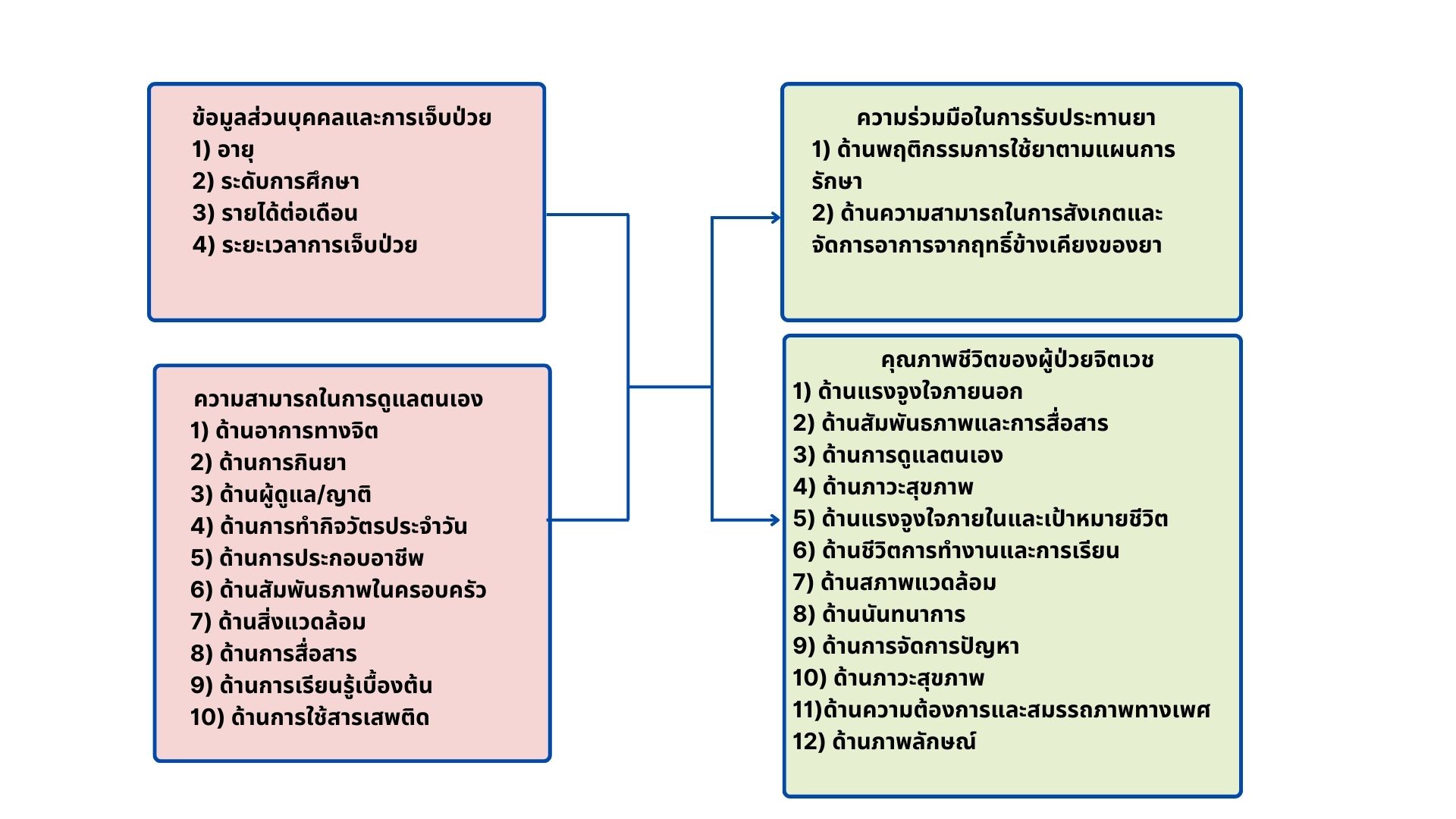
Psychiatric patients in the community tend to take medication nonadherence, causing symptoms to relapse and affecting the patient's quality of life of psychiatric patients receiving tele-mental health services. Telehealth services support continuous patient care and support access to health services. This predictive study aimed to study the level of medication adherence, the level of quality of life and factors affecting medication adherence and quality of life of psychiatric patients receiving tele-mental health services. The sample consisted of 275 psychiatric patients in Mueang District, Lampang Province, using stratified random sampling. Data were collected by a self-care ability assessment, a medication adherence assessment and quality of life assessment form for psychiatric patients. Data were analyzed by using descriptive statistics, binary logistic regression, and multiple regression analysis. The results revealed three main findings. Firstly, medication adherence was at a high level with a rate of 77.1%, and the quality of life of psychiatric patients was also at a high level (= 3.02, S.D. = 0.57). Secondly, four factors significantly affected medication adherence at the .05 level, including age, education level, duration of illness, and self-care ability. Lastly, three factors that significantly affected the quality of life (QoL) were age (Age), duration of illness (Time), and self-care ability (Self-care) at a level of 36.80% (R2 = 0.368). The forecasting equation was as follows: Y(QoL) = 5.122 - 0.442 (Age) - 0.762 (Time) +.824 (Self-care). Therefore, healthcare professionals responsible for remotely caring for mental health patients receiving telehealth services should incorporate factors such as age, duration of illness, and self-care abilities into the strategy to promote collaboration in medication adherence and the quality of life for mental health patients in the community.
References
กระทรวงสาธารณสุข. ฐานข้อมูล HDC [อินเตอร์เน็ต]. 2564 [เข้าถึงเมื่อ 2 พ.ย. 2565]. เข้าถึงได้จาก: https://hdcservice.moph.go.th/hdc/main/index.php.
Hamann J, Lipp ML, Christ-Zapp S, Spellmann I, Kissling W. Psychiatrist and patient responses to suspected medication nonadherence in schizophrenia spectrum disorders. Psychiatric Services 2014;65:7;881-87. doi: 10.1176/appi.ps.201300322
ศรินรัตน์ จันทพิมพ์ และขนิษฐา นันทบุตร. การดูแลผูป้่วยจิตเภทโดยชุมชน. วารสารการพยาบาลและการดูแลสุขภาพ 2561;36:2;68-76.
กองยุทธศาสตร์และแผนงาน สำนักงานปลัดกระทรวง. สถิติสาธารณสุข พ.ศ. 2564. นนทบุรี: กองยุทธศาสตร์และแผนงาน กระทรวงสาธารณสุข; 2557.
รุ่งทิวา วราพุฒ, รังสิมันต์ สุนทรไชยา, เอกอุมา อิ่มคำ. วารสารพยาบาลจิตเวชและสุขภาพจิต 2565; 36:33-48.
กาญจนา สุทธิเนียม และชลพร กองคำ. การพัฒนาแบบวัดคุณภาพชีวิตของผู้ป่วยจิตเวช สถาบันจิตเวชศาสตร์สมเด็จเจ้าพระยา. วารสารการพยาบาลจิตเวชและสุขภาพจิต 2555;26:28-40.
จีรศักดิ์ ห้วยทราย,สมชาย สุริยะไกร. ปัจจัยที่เกี่ยวข้องกับความร่วมมือในการใช้ยาของผู้ป่วยจิตเภท โรงพยาบาลดงหลวง. ศรีนครินทร์เวชสาร 2019;34:150-4.
สุชานาถ อินวรรณา, โสภิณ แสงอ่อน, พัชรินทร์ นินทจันทร์, มาลาตี รุ่งเรืองศิริพันธ์. ปัจจัยที่เกี่ยวข้องกับพฤติกรรมการไม่ร่วมมือรับประทานยาในผู้ป่วยโรคอารมณ์สองขั้ว.วารสารการพยาบาลจิตเวชและสุขภาพจิต 2020;34:33-56.
สุมิศา กุมลา, โสภิณ แสงอ่อน,พัชรินทร์ นินทจันทร์. ผลของโปรแกรมส่งเสริมความร่วมมือในการรับประทานยาในผู้ป่วยจิตเภท. วารสารการพยาบาลจิตเวชและสุขภาพจิต 2564;34:132-52.
ณัฐวรา เชื้อหมอ. ปัจจัยทำนายคุณภาพชีวิตของผู้ป่วยโรคอารมณ์แปรปรวนสองขั้ว [วิทยานิพนธ์ปริญญาพยาบาลศาสตรมหาบัณฑิต]. กรุงเทพฯ: จุฬาลงกรณ์มหาวิทยาลัย; 2560.
กิ่งกาญจน์ ไชยบุศย์,เพ็ญพักตร์ อุทิศ. ปัจจัยคัดสรรที่มีความสัมพันธ์กับคุณภาพชีวิตด้านสุขภาพของผู้ป่วยโรคจิตเภทและใช้สารเสพติดในชุมชนเขตภาคกลาง. วารสารการพยาบาลจิตเวชและสุขภาพจิต 2559; 30:137-51.
Bradford NK, Caffery LJ, Smith AC. Telehealth services in rural and remote Australia: a systematic review of models of care and factors influencing success and sustainability. Rural and remote health 2016;16:1-23.
กมนต์ภรณ์ สุวรรณทวีมีสุข, กิติิพล นาควิโรจน์, ธัญญรัตน์ โนมัยสินทวี. ผลลัพธ์ของการใช้ระบบแพทย์ทางไกลควบคู่กับการดูแลปกติเปรียบเทียบกับการดูแลแบบปกติในผู้ป่วยมะเร็งที่ได้รับการดูแลแบบประคับประคอง: การทดลองสุ่มแบบมีกลุ่มควบคุม. วารสารระบบบริการปฐมภูมิและเวชศาสตร์ครอบครัว 2566;6:133-43.
Uscher-Pines L, Arora N, Jones M, Lee A, Sousa JL, McCullough C M, Ober AJ. Experiences of Health Centers in Implementing Telehealth Visits for Underserved Patients During the COVID-19 Pandemic: Results from the Connected Care Accelerator Initiative. Rand Health Quarterly 2022.
Krzystanek M, Krysta K, Skalacka K. Treatment compliance in the long-term paranoid schizophrenia telemedicine study. J Technol Behav Sci 2017;2:84-7.
โรงพยาบาลลำปาง. เวชระเบียนผู้ป่วยนอก ปีงบประมาณ 2564. ลำปาง: โรงพยาบาลลำปาง; 2565.
Farragher B. Treatment compliance in the mental health service. Iris Medication Journal 1999;92:392-4.
รัชนี อุทัยพันธ์. ผลของการสัมภาษณ์เพื่อเสริมสร้างแรงจูงใจแบบกลุ่มต่อความร่วมมือในการรักษาด้วยยาของผู้ป่วยจิตเภทในชุมชน [วิทยานิพนธ์ปริญญาพยาบาลศาสตรมหาบัณฑิต]. กรุงเทพฯ: จุฬาลงกรณ์มหาวิทยาลัย; 2555.
กรมสุขภาพจิต กระทรวงสาธารณสุข. คู่มือระบบการดูแลผู้ป่วยจิตเวชที่มีความเสี่ยงสูงต่อการก่อความรุนแรงสำหรับสถาบัน/โรงพยาบาล สังกัดกรมสุขภาพจิต. กรุงเทพฯ: พรอสเพอรัสพลัส; 2563.
Acosta FJ, Hernández JL, Pereira J, Herrera J, Rodríguez CJ. Medication adherence in schizophrenia. World Journal Psychiatry 2012;2:74-82.
Hirakawa Y, Hilawe EH, Chiang C, Kawazoe N, Aoyama A. Comprehensive medication management services influence medication adherence among Japanese older people. Journal Rural Med 2015;10:79–83.
Kikkert M, Dekker J. Medication adherence decisions in patients with schizophrenia. Prim Care Companion CNS Disord. 2017;19:17n02182. doi: 10.4088/PCC.17n02182.
ศศิธร รุ่งสว่าง. ปัจจัยที่มีความสัมพันธ์ต่อความร่วมมือในการใช้ยาหลายขนานของผู้สูงอายุโรคเรื้อรัง. วารสารพยาบาลศาสตร์ มหาวิทยาลัยสยาม 2560;18:6-23.
Downloads
Published
How to Cite
Issue
Section
License
Copyright (c) 2023 Boromarajajonani College of Nursing Sunpasitthiprasong

This work is licensed under a Creative Commons Attribution-NonCommercial-NoDerivatives 4.0 International License.
บทความที่ได้รับการตีพิมพ์เป็นลิขสิทธิ์ของวารสารวิทยาศาสตร์สุขภาพ วิทยาลัยพยาบาลบรมราชชนนี สรรพสิทธิประสงค์ ข้อความที่ปรากฏในบทความแต่ละเรื่องเป็นความคิดเห็นส่วนตัวของผู้เขียนแต่ละท่านไม่เกี่ยวข้องกับวิทยาลัยพยาบาลบรมราชชนนี สรรพสิทธิประสงค์ และคณาจารย์ท่านอื่นๆ ในวิทยาลัยพยาบาลฯ ความรับผิดชอบเกี่ยวกับบทความแต่ละเรื่องผู้เขียนจะรับผิดชอบของตนเอง