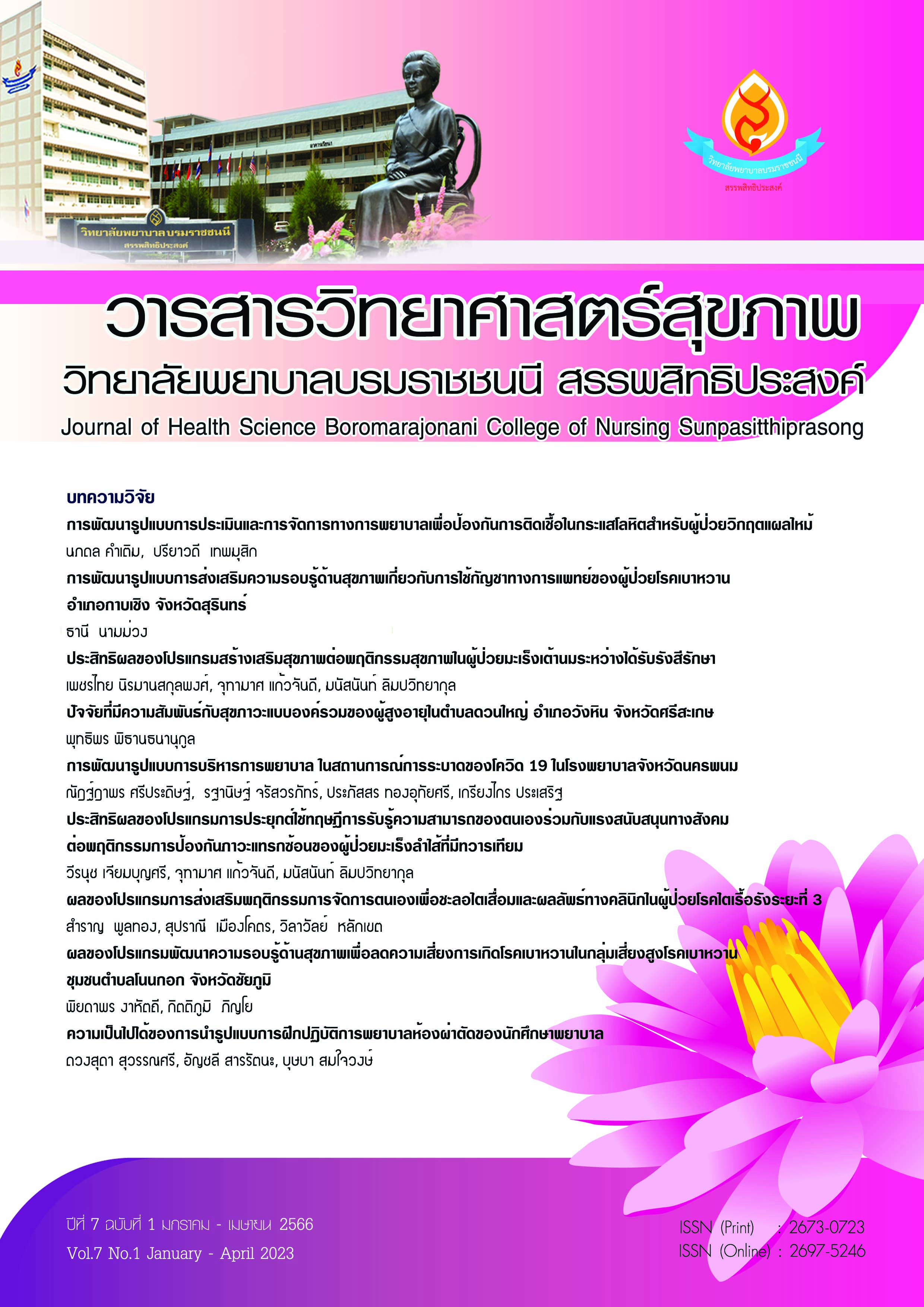
A Development of Assessment and Nursing Management Model to Preventing Sepsis in Critical Burned Patients
Keywords:
infection assessment, nursing management, critically burned patientsAbstract
Sepsis in critical burned patients is a vital problem leading to risk of severity and mortality. Assessment and nursing management are important factors to reduce the points and be suitable the situation. This research and development aimed to 1) study the situation on assessment and nursing management model to preventing sepsis in critical burned patients, 2) develop of assessment and nursing management model to preventing sepsis in critical burned patients, and 3) evaluate an assessment and nursing management model to preventing sepsis in critical burned patients. The samples consisted of 28 critical burned patients admitted to the Burn Unit, and 12 registered nurses. The instruments consisted of 1) a guideline to the assessment and nursing care management model to preventing sepsis in critical burned patients, 2) the patient record form, 3) the evaluating form the knowledge of nurse about the assessment and nursing care management to preventing sepsis in critical burned patients, 4) the evaluating form of difficulty and ability to implement the model, 5) the evaluating form for compliance with the assessment form of professional nurses, and 6) the evaluating form on the satisfaction of nurse. The data were analyzed by percentage, mean, standard deviation, Chi-square, and Wilcoxon test. The finding showed that previous pattern of assessment and nursing management at the burn unit was not unclear. Most of the nurses had insufficient assessment of burn wound infection and delayed the assessment. They also had a lack of nursing management in organizing units to each patient's problem condition. There was an incidence of septic shock, three cases (11.53 %), and one death (3.85%). After using the assessment and nursing management model to prevent sepsis in critical burned patients developed, there was only one sepsis, no septic shock and death. Median scores of knowledge of preventing sepsis in critical burned patients (11.81 to 17.08) and the practice score (from 16.16 to 22.70) were improved among registered nurses. Both of them were significantly different at the .05 level (p- value = .002). Most of the nurses had the highest level of satisfaction (58.34 %), the easier use (91.67 %), and utilitarianism (85.19 %).
References
Chen Z, Turxun N, Ning F. Meta – analysis of the diagnostic value of procalcitonin in adult burn sepsis. Adv Clin Exp Med. 2021;30:455-63. doi: 10.17219/acem/131755.
Cao Z, Zhang Y, Luo JH, Liao WQ, Cheng X, & Zhan JH. A bibliometric analysis on burn sepsis 2022. doi: 10.21203/rs.3.rs-1602059/v1
Boehm D, Menke H. Sepsis in Burns – Lessons Learnt from Developments in the Management of Septic Shock. Medicina 2022;58:26.
Torres MJM, Peterson JM, Wolf SE. Detection of infection and sepsis in burns. Surg Infect 2021;22:20-7.
Dvorak JE, Khandelwal A, Ladhani HA, Claridge JA. Review of sepsis in burn patients in 2020. Surg Infect 2021;22:37-43.
Zhang P, Zou B, Liou YC, Huang C. The pathogenesis and diagnosis of sepsis post burn injury. Burns Trauma 2021;9:tkaa047. doi: 10.1093/burnst/tkaa047.
Manning J. Sepsis in the burn patient. Critical Care Nursing Clinics. 2018;30:423-30.
Tiwari MN. Nursing responsibility for burns and infection control. J Pharm Negat Results 2022:4519-21.
Evans L, Rhodes A, Alhazzani W, Antonelli M, Coopersmith CM, French C, et al. Surviving sepsis campaign: international guidelines for management of sepsis and septic shock 2021. Intensive Care Med 2021;47:1181-247.
Greenhalgh DG. Sepsis in the burn patient: a different problem than sepsis in the general population. Burns Trauma 2017;5:23. doi: 10.1186/s41038-017-0089-5.
Evans L, Alhazzani W, Antonelli M, Craig M, Smith C, French C, et al. GUIDELINES Surviving sepsis campaign: international guidelines for management of sepsis and septic shock 2021. Intensive Care Med 2021;47:1181–247.
Yang Y, Zhang Y, Li S, Zheng X, Wong MH, Leung KS, et al. A robust and generalizable immune-related signature for sepsis diagnostics. IEEE/ACM Trans Comput Biol Bioinform 2021;19:3246-54.
Niggemann P, Rittirsch D, Buehler PK, Schweizer R, Giovanoli P, Reding T, et al. Incidence and time point of sepsis detection as related to different sepsis definitions in severely burned patients and their accompanying time course of pro-inflammatory biomarkers. J Pers Med 2021;11:701.
Khwannimit B, Bhurayanontachai R, Vattanavanit V. Comparison of the accuracy of three early warning scores with SOFA score for predicting mortality in adult sepsis and septic shock patients admitted to intensive care unit. Heart Lung 2019;48:240-4. doi: 10.1016/j.hrtlng.2019.02.005.
วิไลวรรณ เนื่อง ณ สุวรรณ, จิราพร น้อมกุศล, รัตนา ทองแจ่ม, ธนชัย พนาพุฒิ. การพัฒนาระบบการพยาบาลผู้ป่วยที่มีภาวะติดเชื้อในกระแสเลือดอย่างรุนแรง. วารสารการพยาบาลและการดูแลสุขภาพ 2557;32:25–36.
ภาพิมล โกมล, รัชนี นามจันทรา, วารินทร์ บินโฮเซ็น. คุณภาพการจัดการดูแลผู้มีกลุ่มอาการติดเชื้อในกระแสเลือดที่หน่วยงานอุบัติเหตุและฉุกเฉินโรงพยาบาลสิงห์บุรี [ปริญญานิพนธ์พยาบาลศาสตรมหาบัณฑิต]. มหาวิทยาลัยรังสิต: ปทุมธานี; 2560.
วิทยา บุตรสาระ, ยุพนา ลิงลม, สำเนียง คำมุข. การพัฒนาระบบการดูแลผู้ป่วยที่มีภาวะติดเชื้อในกระแสเลือด. วารสารมหาวิทยาลัยนครพนม ฉบับพิเศษการประชุมพยาบาล ครั้งที่ 25 2563;(พิเศษ):17-25.
ประไพพรรณ ฉายรัตน์, สุพัฒศิริ ทศพรพิทักษ์กุล. ประสิทธิผลของรูปแบบการพยาบาลผู้ป่วยที่มีภาวะติดเชื้อในกระแสโลหิต. วารสารการพยาบาลและการดูแลสุขภาพ 2560;35:224-31.
ชุมชนนักปฏิบัติการพยาบาลผู้ป่วยแผลไหม้แห่งประเทศไทย โครงการพัฒนาฐานข้อมูลผู้ป่วยแผลไหม้ multi-Center ด้วยระบบ UCHA. รายงานผู้ป่วยแผลไหม้ประจำปีงบประมาณ 2560. วารสารแผลไหม้และสมานแผลแห่งประเทศไทย 2560;11:10.
ชุมชนนักปฏิบัติการพยาบาลผู้ป่วยแผลไหม้แห่งประเทศไทย โครงการพัฒนาฐานข้อมูลผู้ป่วยแผลไหม้ Multi-Center ด้วยระบบ UCHA. รายงานผู้ป่วยแผลไหม้ประจำปีงบประมาณ 2561. วารสารแผลไหม้และสมานแผลแห่งประเทศไทย 2562;12:10.
ชุมชนนักปฏิบัติการพยาบาลผู้ป่วยแผลไหม้แห่งประเทศไทย โครงการพัฒนาฐานข้อมูลผู้ป่วยแผลไหม้ Multi-Center ด้วยระบบ UCHA. รายงานผู้ป่วยแผลไหม้ประจำปีงบประมาณ 2562. วารสารแผลไหม้และสมานแผลแห่งประเทศไทย 2563;13:10.
Donabedian A. An introduction to quality assurance in health care. New York: Oxford University Press; 2003.
Omar Nunez Lopez, Janos Cambiaso-Daniel, Ludwik K Branski, William B Norbury, David N Herndon. Predicting and managing sepsis in burn patients: current perspectives. Ther Clin Risk Manag 2017;13:1107-17. doi: 10.2147/TCRM.S119938
Tran NK, Albahra S, Pham TN, Holmes IV JH, Greenhalgh D, Palmieri TL, et al. Novel application of an automated-machine learning development tool for predicting burn sepsis: proof of concept. Scientific reports 2020;10:12354.
ยุวดี เทียมสุวรรณ, อรชร มาลาหอม, ธีรนุช ยินดีสุข, ประภัสสร ควาญช้าง, นุสรา ประเสริฐศรี. การพัฒนาระบบการดูแลผู้ป่วยหนักที่ติดเชื้อในกระแสเลือด โดยใช้การจัดการรายกรณี ในโรงพยาบาลสรรพสิทธิประสงค์ อุบลราชธานี. วารสารการพยาบาลและการดูแลสุขภาพ 2560;35:184-93.
พัชนีภรณ์ สุรนาทชยานันท,์ วนิดา เคนทองดี, สุพัตรา กมลรัตน์. การพัฒนาระบบการพยาบาลผู้ป่วยภาวะติดเชื้อในโรงพยาบาลเลย. วารสารการพยาบาลและการดูแลสุขภาพ 2561;36:207-15.
กรรณิกา อำพนธ์, ชัชญาภา บุญโยประการ, ชรินทร์ ศิลป์ กิจเจริญ. ผลลัพธ์ของการพัฒนาการดูแลผู้ป่วยติดเชื้อในกระแสเลือด โรงพยาบาลพระปกเกล้า. วารสารศูนย์การศึกษาแพทยศาสตร์คลินิก โรงพยาบาลพระปกเกล้า 2560;34:222-36.
ศุภา เพ็งเลา, กนกวรรณ สินลักษณทิพย์. การพัฒนาระบบบริการพยาบาลผู้ป่วยที่มีภาวะติดเชื้อในกระแสโลหิต โรงพยาบาลโพธาราม จังหวัดราชบุรี. วารสารเขต 4 – 5 2563;39:698-712.
สมใจ จันทะวัง. การพัฒนาแนวปฏิบัติการพยาบาลผู้ป่วยที่มีภาวะช็อกจากการติดเชื้อในกระแสเลือดในงานห้องผู้ป่วยหนัก 2 โรงพยาบาลลำพูน. วารสารโรงพยาบาลแพร่ 2560;26:35-46.
Downloads
Published
How to Cite
Issue
Section
License
Copyright (c) 2023 Boromarajajonani College of Nursing Sunpasitthiprasong

This work is licensed under a Creative Commons Attribution-NonCommercial-NoDerivatives 4.0 International License.
บทความที่ได้รับการตีพิมพ์เป็นลิขสิทธิ์ของวารสารวิทยาศาสตร์สุขภาพ วิทยาลัยพยาบาลบรมราชชนนี สรรพสิทธิประสงค์ ข้อความที่ปรากฏในบทความแต่ละเรื่องเป็นความคิดเห็นส่วนตัวของผู้เขียนแต่ละท่านไม่เกี่ยวข้องกับวิทยาลัยพยาบาลบรมราชชนนี สรรพสิทธิประสงค์ และคณาจารย์ท่านอื่นๆ ในวิทยาลัยพยาบาลฯ ความรับผิดชอบเกี่ยวกับบทความแต่ละเรื่องผู้เขียนจะรับผิดชอบของตนเอง