COVID-19 Related Health Literacy of Elderly in Primary Care Unit of Sunpasitthiprasong Hospital
Keywords:
health literacy, corona virus 2019, elderly, infodemicAbstract
There is limited information on infodemic and health literacy related coronavirus 2019 in the elderly. The aim of the descriptive cross-sectional study was to study infodemic and health literacy about Corona virus 2019 of elderly people. The sample consisted of 282 elderly people who came to receive services in the Primary Care Unit (PCU) area of Sunpasitthiprasong Hospital, purposive selection was conducted. The research instruments consisted of four parts: 1) General information questionnaire, 2) The Thai Mental State Examination (MMSE-I Thai 2002), 3) The Coronavirus Perception or Confusion Questionnaire, and 4) Health literacy of Corona virus 2019 Questionnaire. Data were analyzed by descriptive statistics. The results found that most of the samples were female (60%), average age 68.20 years (S.D. ± 6.75), primary education (45%), and underlying disease (88%). The samples had well perception of infodemic about the corona virus 2019 information mean score 3.56 (S.D. ± 0.62) and mean score coronavirus confusion was 2.66 (S.D. ± 0.53). The overall of Corona virus 2019 related health literacy mean score was 3.39 (S.D. ± 0.83). Considering each domain consisted of 1) access to data mean score 2.93 (S.D. ± 0.83), 2) data understanding mean score 3.57 (S.D. ± 0.46), 3) data evaluation mean score 3.58 (S.D. ± 0.59), and 4) the data use aspect for the prevention of coronavirus 2019, the mean score was 3.62 (S.D. = 0.50). The findings showed that the elderly’s COVID-19 related health literacy was at an adequate level in three aspects of understanding, evaluating, and implementing, except for data access being at the problematic level. Therefore, health team should be used methods that easily accessible for information in each context of the elderly.
References
Ciotti M, Ciccozzi M, Terrinoni A, Jiang W-C, Wang C-B, Bernardini S. The COVID-19 pandemic. Critical reviews in clinical laboratory sciences. 2020;57:365-88.
COVID-19 Situation in Thailand [Internet]. [cited 2022 Feb 21] Available from:. https://covid19.who.int/region/searo/country/th
Preskorn SH. The 5% of the population at high risk for severe COVID-19 infection is identifiable and needs to be taken into account when reopening the economy. J Psychiatr Pract. 2020;26:219-27. doi: 10.1097/PRA.0000000000000475.
Niu S, Tian S, Lou J, Kang X, Zhang L, Lian H, et al. Clinical characteristics of older patients infected with COVID-19: A descriptive study. A Arch Gerontol Geriatr 2020;89:104058. doi: 10.1016/j.archger.2020.104058.
Daoust J-F. Elderly people and responses to COVID-19 in 27 Countries. PloS one. 2020;15:e0235590. doi: https://doi.org/10.1371/journal.pone.0235590.
Gustavsson J, Beckman L. Compliance to recommendations and mental health consequences among elderly in Sweden during the initial phase of the COVID-19 pandemic—a cross sectional online survey. Int J Environ Res Public Health 2020;17:5380. doi: 10.3390/ijerph17155380.
Gautam V, S D, Rustagi N, Mittal A, Patel M, Shafi S, et al. Health literacy, preventive COVID 19 behaviour and adherence to chronic disease treatment during lockdown among patients registered at primary health facility in urban Jodhpur, Rajasthan. Diabetes Metab Syndr 2021;15:205-11. doi: 10.1016/j.dsx.2020.12.023.
Nutbeam D, Muscat DM. Health Promotion Glossary 2021. Health promotion international 2021;36:1811. doi: https://doi.org/10.1093/heapro/daab067.
Galvão J. COVID-19: the deadly threat of misinformation. Lancet Infect Dis 2021;21(5):e114. doi:10.1016/S1473-3099(20)30721-0.
World Health Organization. Coronavirus disease (COVID-19) advice for the public: Mythbusters[Internet]. 2022 [2022 Feb 21.]. Available from: https://www.who.int/emergencies/diseases/novel-coronavirus-2019/advice-for-public/myth-busters.
Zarocostas J. How to fight an infodemic. The lancet. 2020;395(10225):676.
Liu C, Wang D, Liu C, Jiang J, Wang X, Chen H, et al. What is the meaning of health literacy? A systematic review and qualitative synthesis. Family medicine and community health. 2020;8;e00351. doi: 10.1136/fmch-2020-000351.
Paakkari L, Okan O. COVID-19: health literacy is an underestimated problem. The Lancet Public Health. 2020;5:e249. doi:10.1016/S2468-2667(20)30086-4.
Levy H, Janke AT, Langa KM. Health literacy and the digital divide among older Americans. J Gen Intern Med 2015;30:284-9. doi: 10.1007/s11606-014-3069-5.
Beaunoyer E, Dupéré S, Guitton MJ. COVID-19 and digital inequalities: Reciprocal impacts and mitigation strategies. Comput Human Behav 2020;111:106424. doi: https://doi.org/10.1016/j.chb.2020.106424.
Eronen J, Paakkari L, Portegijs E, Rantanen T. Coronavirus-related health literacy and perceived restrictiveness of protective measures among community-dwelling older persons in Finland. Aging Clin Exp Res 2021;33:2345-53.
Boonkerd P, Assantachai P, Senanarong W. Clinical practice guideline for dementia (in Thai) Guideline for Dementia. Bangkok: Neuroscience Institute; 2003.
Okan O, Bollweg TM, Berens EM, Hurrelmann K, Bauer U, Schaeffer D. Coronavirus-related health literacy: A cross-sectional study in adults during the COVID-19 infodemic in Germany. Int J Environ Res Public Health 2020;17:5503. doi: 10.3390/ijerph17155503
Yabrude ATZ, Souza ACMd, Campos CWd, Bohn L, Tiboni M. Challenges caused by fake news among elderly population during the Covid-19 Infodemic: experience of medical students. Rev Bras Educ Med 2020;44 Suppl 1: e0140.
Pechrapa K, Yodmai K, Kittipichai W, Charupoonpol P, Suksatan W. Health literacy among older adults during COVID-19 pandemic: a cross-sectional study in an urban community in Thailand. Ann Geriatr Med Res 2021;25:309-17.
รัชชานันท์ ศรีสุภักดิ์, ปนัดดา งามเปรี่ยม, สุรัตนา เหล่าไชย, ประภากร ศรีสว่าวงศ์. ความสัมพันธ์ระหว่างความรอบรู้ทางสุขภาพกับการปฏิบัติตนในการป้องกันโรคโควิด-19 ของผู้สูงอายุ กรณีศึกษา: ตำบลแวงน่าง จังหวัดมหาสารคาม. วารสารวิจัยสาธารณสุขศาสตร์ มหาวิทยาลัยขอนแก่น 2564;14:104-14.
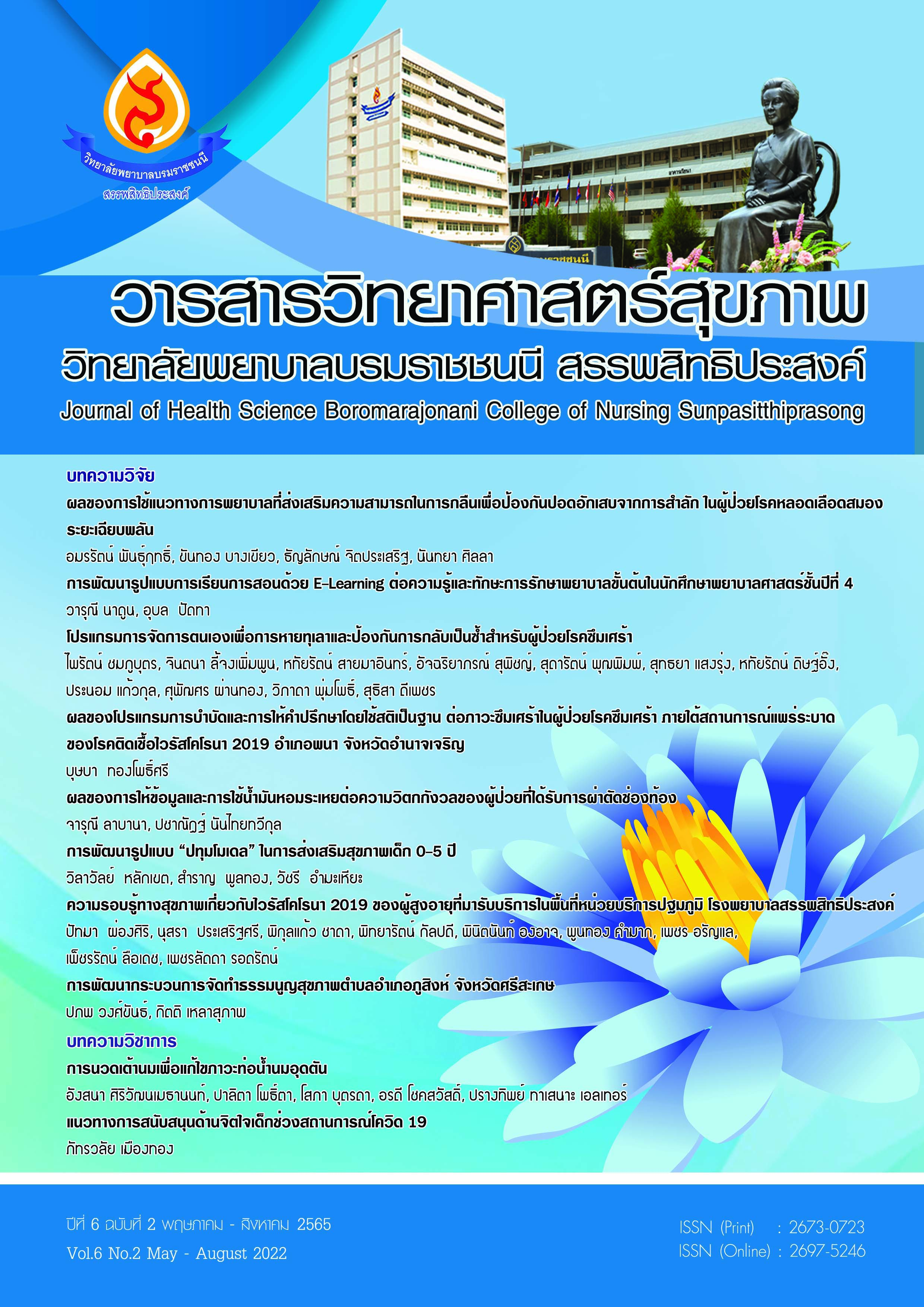
Downloads
Published
How to Cite
Issue
Section
License
Copyright (c) 2022 Boromarajajonani College of Nursing Sunpasitthiprasong

This work is licensed under a Creative Commons Attribution-NonCommercial-NoDerivatives 4.0 International License.
บทความที่ได้รับการตีพิมพ์เป็นลิขสิทธิ์ของวารสารวิทยาศาสตร์สุขภาพ วิทยาลัยพยาบาลบรมราชชนนี สรรพสิทธิประสงค์ ข้อความที่ปรากฏในบทความแต่ละเรื่องเป็นความคิดเห็นส่วนตัวของผู้เขียนแต่ละท่านไม่เกี่ยวข้องกับวิทยาลัยพยาบาลบรมราชชนนี สรรพสิทธิประสงค์ และคณาจารย์ท่านอื่นๆ ในวิทยาลัยพยาบาลฯ ความรับผิดชอบเกี่ยวกับบทความแต่ละเรื่องผู้เขียนจะรับผิดชอบของตนเอง