Guidelines for Pediatric Psychological Support During the COVID-19 Pandemic
Keywords:
pediatric care, psychological support, COVID-19, resilienceAbstract
The COVID-19 epidemic has a major effect on the economy, society, and the health of people of all ages. Due to these circumstances, people now tend to live different lifestyles, resulting in both short-term and long-term psychological and societal problems. Furthermore, children are primarily affected by these changes as they must deal with limited means for interaction with peers their own age and online classes. Over time, this imposes repercussions on the proper growth, stress, and anxiety among those young generations. Thus, psychological care and support are essential for safeguarding their potential for both physical and mental growth. Additionally, strong management strategies are also essential to prevent both short-term and long-term psychological problems and maintain a good mental health, which could be achieved under the IASC's practices of mental and societal reinforcement (Inter-Agency Standing Committee). By the aforesaid rationales and issues, the research aimed to promote awareness among medical professionals, families, and society concerning the need of mental health care for children and to promote mind encouragement leading to faster adaptability in returning to their normal life after confronting a pandemic crisis.
References
World Health Organization (WHO). Coronavirus (COVID-19) Dashboard [Internet]. 2022 [cited 2022 Mar 1]. Available from: https ://covid19.who.int/.
UNICEF. The State of the World's Children 2021 On My Mind: Promoting, protecting and caring for children’s mental health [Internet]. 2022 [cited 2022 Mar 1]. Available from: URL:https://www.unicef.org/reports/state-worlds-children-2021.
กรมสุขภาพจิต. คู่มือการปฏิบัติงานทีมช่วยเหลือเยียวยาจิตใจทุกระดับ : ผู้ประสบภาวะวิกฤตในกรณีการระบาดของโรคติดเชื้อไวรัสโคโรนา 2019 (Covid-19) [อินเทอร์เน็ต]. 2564 [เข้าถึงเมื่อ 11 มี.ค. 2565]. เข้าถึงได้จาก: https://www.dmh.go.th/covid19/pnews/files/MCATTupdate.pdf
Dupuy HJ. The general well-being schedule. In: Mcdowell & Clair Newell, editor. New Yok: Oxford university press; 1997.
Inter-Agency Standing Committee. IASC Guidance on Operational Consideration for Multispectral Mental Health and Psychosocial Support Programs during the COVID-19 Pandemic [Internet]. 2022 [cited 2022 Mar 1]. Available from: https://interagencystandingcommittee.org
อารียา สตารัตน์. การจัดสภาพแวดล้อมในสถานศึกษาของโรงเรียนสังกัดกรุงเทพมหานคร สำนักงานเขตราชเทวี [สารนิพนธ์ปริญญาการศึกษามหาบัณฑิต]. กรุงเทพฯ: มหาวิทยาลัยศรีนครินทรวิโรฒ; 2556.
ราชวิทยาลัยจิตแพทย์แห่งประเทศไทย. คำแนะนำในการดูแลจิตใจช่วงการระบาดของไวรัส Covid-19 [Mental care advice during the Covid-19 virus outbreak] [อินเทอร์เน็ต]. 2563 [เข้าถึงเมื่อ 15 ก.พ. 2565].เข้าถึงได้จาก:
https://www.rcpsycht.org/th/organization/laws-regulations.
ประเวช ตันติพิวัฒนสกุล. แนวทางการจัดกิจกรรมการเรียนรู้การสร้างความเข้มแข็งทางใจสำหรับนักเรียนชั้นมัธยมศึกษา. กรุงเทพฯ: โรงพิมพ์ชุมนุมสหกรณ์การเกษตรแห่งประเทศไทย จำกัด; 2551.
กรมสุขภาพจิต. เปลี่ยนร้ายกลายเป็นดี พลังสุขภาพจิต RQ. สำนักสุขภาพจิตสังคม กรมสุขภาพจิต กระทรวงสาธารณสุข; 2552.
อภิพร เป็งปิง, ศศิลักษณ์ ขยันกิจ.การนำเสนอกรอบแนวคิดบทบาทครูในการส่งเสริมความเข้มแข็งทางจิตใจของเด็กวัยอนุบาล. วารสารอิเล็กทรอนิกส์ทางการศึกษา (OJED) [อินเตอร์เน็ต]. 2562 [เข้าถึงเมื่อ 11 พ.ย. 2564].เข้าถึงได้จาก: https://www.tci-thaijo.org/index.php/OJED/article/view/184416/144214.
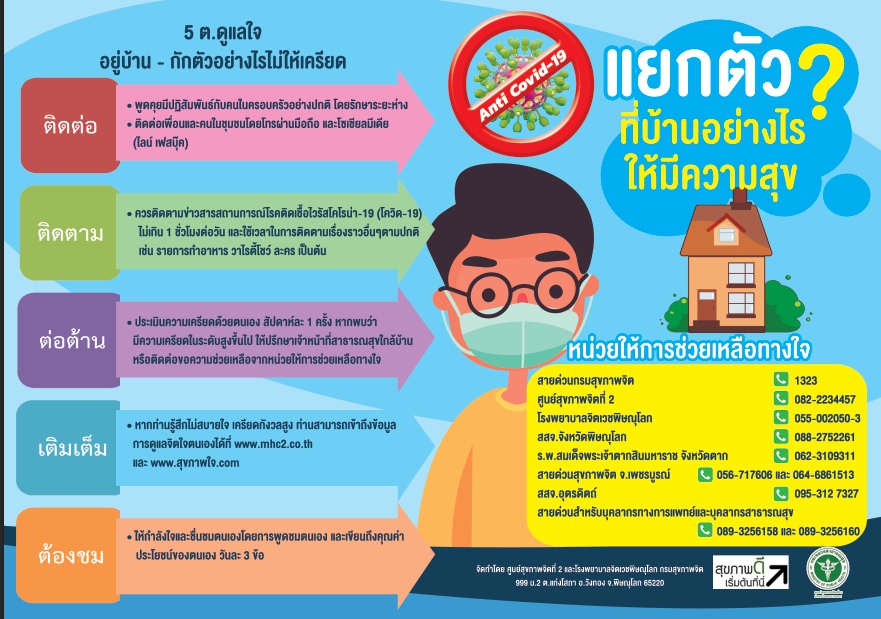
ศูนย์สุขภาพจิตที่ 2 และโรงพยาบาลจิตเวช พิษณุโลก. แยกตัวที่บ้านอย่างไรให้มีความสุข. [อินเตอร์เน็ต]. 2564 [เข้าถึงเมื่อ 9 มิ.ย. 2565].เข้าถึงได้จาก https://www.mhc2.go.th/newweb/files/img/160214646502-2.1.jpg.
Downloads
Published
How to Cite
Issue
Section
License
Copyright (c) 2022 Boromarajajonani College of Nursing Sunpasitthiprasong

This work is licensed under a Creative Commons Attribution-NonCommercial-NoDerivatives 4.0 International License.
บทความที่ได้รับการตีพิมพ์เป็นลิขสิทธิ์ของวารสารวิทยาศาสตร์สุขภาพ วิทยาลัยพยาบาลบรมราชชนนี สรรพสิทธิประสงค์ ข้อความที่ปรากฏในบทความแต่ละเรื่องเป็นความคิดเห็นส่วนตัวของผู้เขียนแต่ละท่านไม่เกี่ยวข้องกับวิทยาลัยพยาบาลบรมราชชนนี สรรพสิทธิประสงค์ และคณาจารย์ท่านอื่นๆ ในวิทยาลัยพยาบาลฯ ความรับผิดชอบเกี่ยวกับบทความแต่ละเรื่องผู้เขียนจะรับผิดชอบของตนเอง