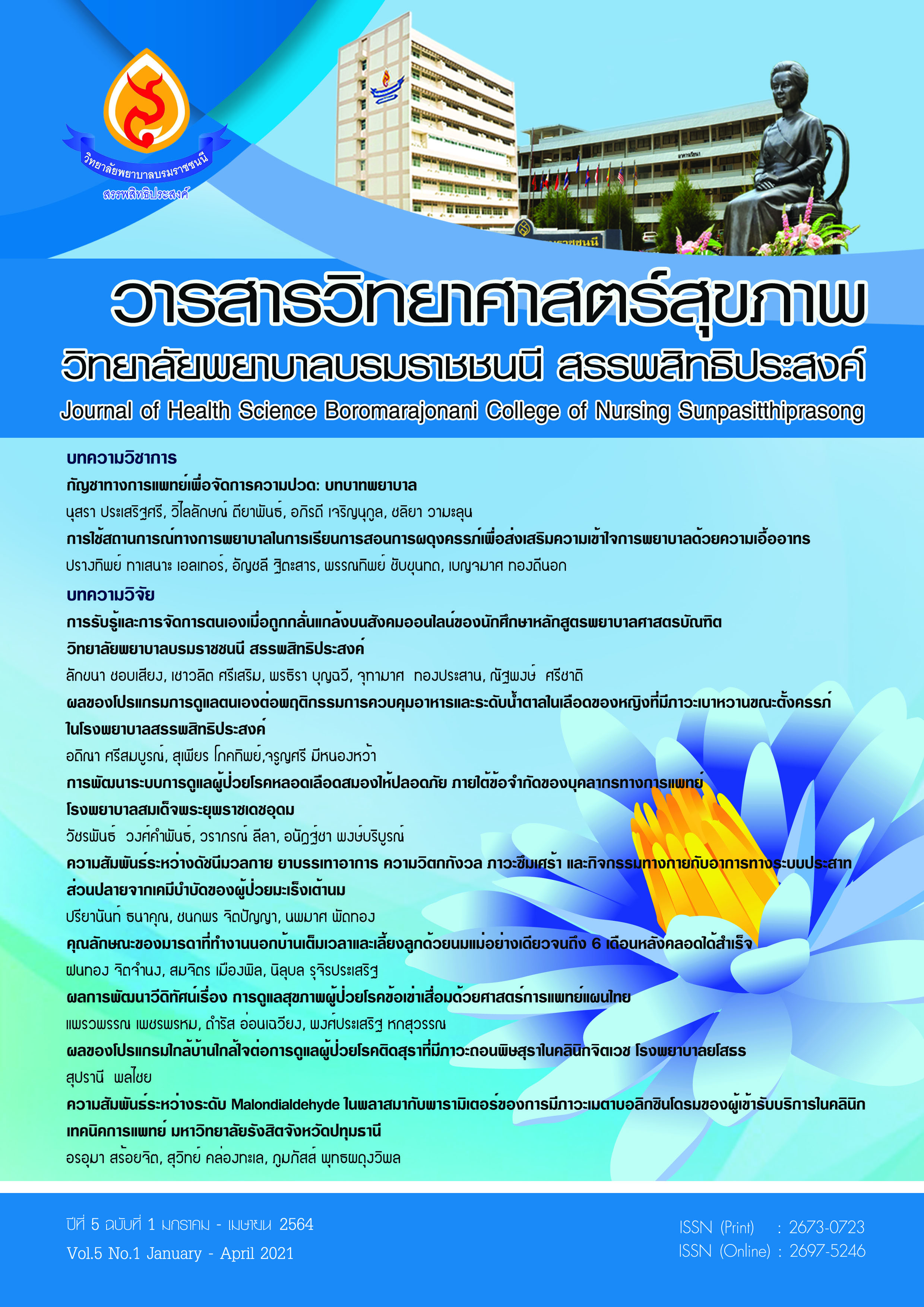
The Effect of the Self-Care Program on Diet Control Behaviors and Blood Sugar among Pregnant Women with Gestational Diabetes Mellitus in Sunpasitthipasong Hospital
Keywords:
gestational diabetes mellitus, diet control program, self-careAbstract
Gestational diabetes mellitus (GDM) is a medical complications during pregnancy and has a higher tendency. GDM can have a vital effect on the pregnancy to both the mother and the fetus. Getting the blood sugar levels controlled to reduce the potential effects is necessary. This research is a quasi-experimental research. The purpose of this study was to evaluate the effects of the self-care program on diet control behaviors and blood sugar among pregnant women with GDM in Sunpasitthipasong Hospital.The samples consisted of 40 pregnant women with insulin-needed (GDMA2) hospitalized during November 2016 to November 2018. They were divided into an experimental and a control group, 20 each. The control group received routine nursing care. The experimental group received routine nursing care and the self-care program. The interventions were the GDM self-care manual and the CD containing power point slides with the lesson plan contents. The demographic data and the diet control behavior questionnaires with the reliability by Cronbach’s alpha coefficient was 0.80, the blood sugar record form, and the phone advice record form were used to collect the data. The data were analyzed using independent-test.
The results revealed that after the program in the experimental group, compared to the control group, the statistic score of diet control behaviors was significantly higher (p = 0.006), and fasting blood sugar was statistically significantly decreased better (p = 0.030). However, the Hemoglobin A1c levels between two groups were not different. The findings suggested that the self-care program can be applied to other pregnant women with GDM. Self-care practice with proper diet control behaviors would help reduce their blood sugar levels.
References
Kim SY, Saraiva C, Curtis M, Wilson HG, Troyan J, England L, et al. Fraction of gestational diabetes mellitus attributable to overweight and obesity by race/ethnicity, California 2007-2009. Am J Public Health 2013;103:65-72. doi: 10.2105/AJPH.2013.301469
Titapant V, Pimsen S, Kannikaklang N, Hansiriratanaskul N, Wuttiviboonchok W, KnogKaew S, et al. Annual statistical report 2007. Bangkok: Faculty of Medicine, Siriraj Hospital; 2007.
Warunpitikul R, Aswakul O. The Incidence of diabetes mellitus in pregnant women and its outcomes between pregnant women with diabetes mellitus and non-diabetes mellitus at Maharat Nakhon Ratchasima hospital. Thai Journal of Obstetrics and Gynaecology 2014;22:81-87.
กลุ่มงานการพยาบาลผู้คลอด โรงพยาบาลสรรพสิทธิประสงค์. รายงานสถิติหน่วยฝากครรภ์ประจำปี. อุบลราชธานี: โรงพยาบาลสรรพสิทธิประสงค์; 2558
มณีภรณ์ โสมานุสรณ์, ดวงหทัย ศรีสุจริต, ปราชญาวตี ยมานันตกุล, ปราณี แสดคง, วัจมัย สุขวนวัฒน์. การพยาบาลหญิงตั้งครรภ์: ที่มีภาวะแทรกซ้อนจากการตั้งครรภ์. กรุงเทพมหานคร: ยุทธรินทร์การพิมพ์; 2551.
Murfet GO, Allen P & HINGSTON TJ. Maternal and neonatal health outcomes following the implementation of an innovative model of nurse practitioner-led care for diabetes in pregnancy. Journal of Advanced Nursing 2014;70:1150-63.
Eman MA. Gestational diabetes mellitus. Saudi Med J 2015;36:399-406.
Setji TL, Brown AJ & Feingios MN. Gestational diabetes mellitus. Clinical Diabetes 2005; 23:17-24. doi: https://doi.org/10.2337/diaclin.23.1.17
Bone LR. Big Babies: An exploration of gestational diabetes. International Journal of Childbirth Education 2015;30:42-46.
สุปรียา เสียงดัง. พฤติกรรมการดูแลสุขภาพตนเองของผู้ป่วยโรคเบาหวานที่ควบคุมระดับน้ำตาลในเลือดไม่ได้. วารสารเครือข่ายวิทยาลัยพยาบาลและการสาธารณสุขภาคใต้ 2560;4:191-204.
เวรุกา พรกุณา, สร้อย อนุสรณ์ธีรกุล. ผลของโปรแกรม ต่อความรู้ การควบคุมระดับน้ำตาล และการกลับมารักษาซ้ำของหญิงตั้งครรภ์ที่เป็นเบาหวานชนิดพึ่งอินซูลิน. ศรีนครินทร์เวชสาร 2560;32:135-142.
อังคณา ชูชื่น, น้ำอ้อย ภักดีวงศ์, วารินทร์ บินโฮเซ็น. ผลของโปรแกรมส่งเสริมการจัดการตนเองต่อพฤติกรรมสุขภาพและระดับน้ำตาลในเลือด ในหญิงที่เป็นเบาหวานจากการตั้งครรภ์. วารสารการพยาบาลและการดูแลสุขภาพ 2557;32:60-67.
สร้อย อนุสรณ์ธีรกุล, พัชรี จันทอง. ผลของโปรแกรมการเรียนรู้แบบมีส่วนร่วมต่อพฤติกรรมการควบคุมอาหารของหญิงตั้งครรภ์ที่เป็นเบาหวาน. วารสารพยาบาลศาสตร์และสุขภาพ 2557;37:51-59.
นันนภัส พีระพฤฒิพงศ์, น้ำอ้อย ภักดีวงศ์, อำภาพร นามวงศ์พรหม. ผลของโปรแกรมการจัดการตนเองต่อความรู้ กิจกรรมการดูแลตนเอง และค่าฮีโมโกลบินที่มีน้ำตาลเกาะในผู้เป็นเบาหวานชนิดที่ 2. วารสารสมาคมพยาบาลฯ สาขาภาคตะวันออกเฉียงเหนือ 2555;30:98-105.
จินตนา บัวทองจันทร์, อุบล สุทธิเนียม, เสมอจันทร์ ธีระสัฒน์สกุล. ผลของโปรแกรมการจัดการตนเองต่อพฤติกรรมสุขภาพในบุคคลกลุ่มเสี่ยงที่มีการเผาผลาญอาหารผิดปกติ. วารสารวิทยาลัยพยาบาลบรมราชชนนี นครราชสีมา 2556;19:46-59.
Orem ED. Nursing Concepts of practice. 5th ed. St.Louis: Mosby Year Book; 2001.
Schlesselman JJ. Planning a longitudinal study I: sample size determination. J Chron Dis 1973;26:234-65.
พัชรี จันทอง. ผลของโปรแกรมการเรียนรู้แบบมีส่วนร่วมต่อพฤติกรรมการควบคุมอาหารและระดับน้ำตาลในเลือดของหญิงตั้งครรภ์ที่เป็นเบาหวาน [วิทยานิพนธ์ปริญญาพยาบาลศาสตร มหาบัณฑิต]. ขอนแก่น: มหาวิทยาลัยขอนแก่น; 2555.
Downloads
Published
How to Cite
Issue
Section
License
บทความที่ได้รับการตีพิมพ์เป็นลิขสิทธิ์ของวารสารวิทยาศาสตร์สุขภาพ วิทยาลัยพยาบาลบรมราชชนนี สรรพสิทธิประสงค์ ข้อความที่ปรากฏในบทความแต่ละเรื่องเป็นความคิดเห็นส่วนตัวของผู้เขียนแต่ละท่านไม่เกี่ยวข้องกับวิทยาลัยพยาบาลบรมราชชนนี สรรพสิทธิประสงค์ และคณาจารย์ท่านอื่นๆ ในวิทยาลัยพยาบาลฯ ความรับผิดชอบเกี่ยวกับบทความแต่ละเรื่องผู้เขียนจะรับผิดชอบของตนเอง