Development of a health promotion model for older adults integrating Dhammanamai principles and Thai Traditional Medicine
Keywords:
Health promotion model for older adults, Thai traditional medicine, Dhammanamai, Health behaviors, Quality of lifeAbstract
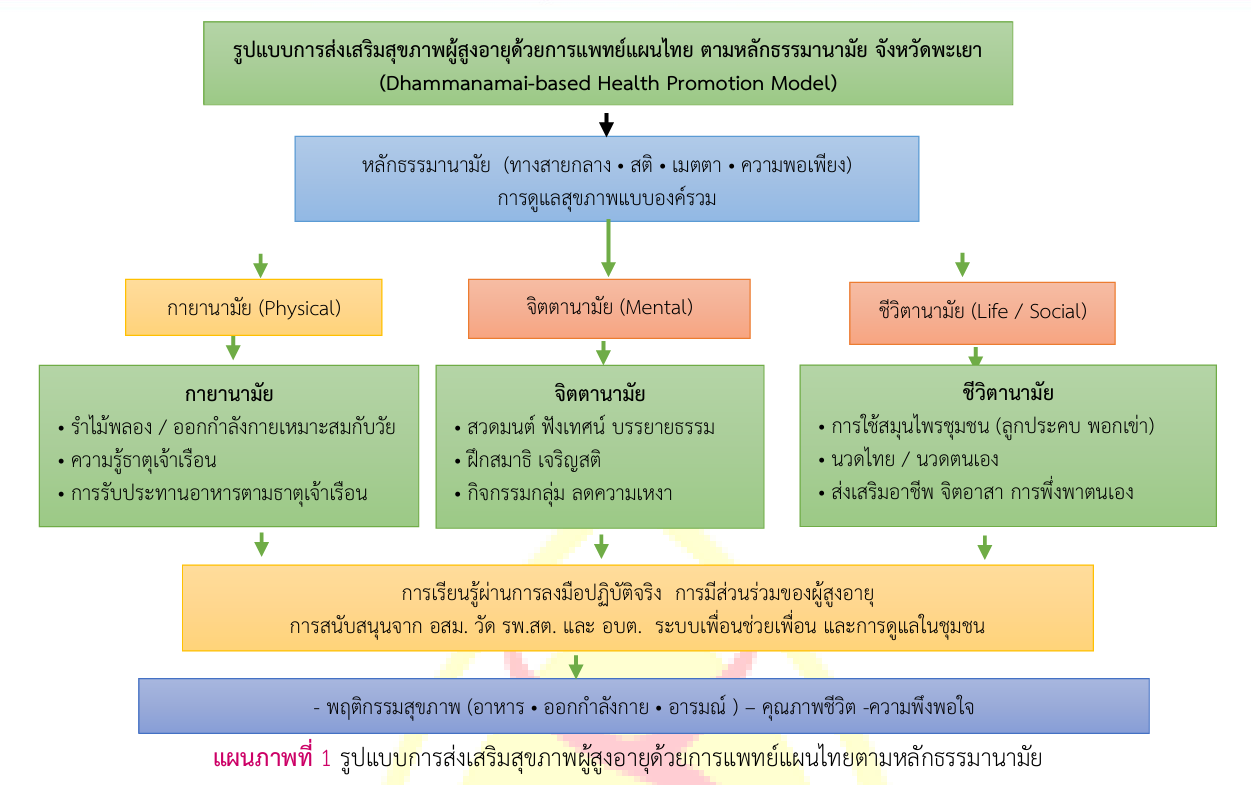
The transition toward a complete aged society presents significant challenges to the health-related quality of life of the geriatric population. To address these challenges, the implementation of a health promotion model through the integration of Thai traditional medicine and Dhammanamai principles is essential for enhancing the well-being of older adults. Accordingly, this research and development framework was designed into three phases: 1) assessing the current health situation, 2) developing the integration of health promotion model for older adults in Phayao province, and 3) evaluating its subsequent effectiveness. The initial situational phase 1 involved a multi-stakeholder group including 20 caregivers, 25 network partners, and 122 elderly individuals. Subsequently, the evaluating phase 3 employed a controlled design with 70 elderly participants which equally allocated into experimental and control groups (n=35 each). The research instruments included the integrative health promotion model of Thai traditional medicine and Dhammanamai principles, a 3E-2S based health behavior assessment, the Thai-shortened WHO Quality of Life questionnaire (WHOQOL-BREF), and a satisfaction survey. The reliability of these measures was validated with Cronbach’s alpha coefficients of .74, .84, and .90, respectively. Quantitative data were analyzed using descriptive statistics, Fisher’s exact test, and both paired and independent samples t-tests, while qualitative data were synthesized through systematic content analysis. The results revealed that the developed health promotion model comprises three primary components: 1) an emphasis on experimental learning to foster the integration of physical well-being (Kayanamai), mental well-being (Jittanamai), and healthy lifestyle practices (Chiwitanamai); 2) the engagement of older adults; and 3) the facilitation of support through community-based networks. Concurrently, post-intervention showed that the experimental group demonstrated significantly higher mean scores in both health-promoting behaviors (t=10.26 p<.001) and quality of life (t=3.60 p<.001) compared to the control group. Thus, evaluation of the developed model reported an excellent satisfaction rating among the elderly participants (𝑥̅=4.51, SD=0.5). Therefore, the developed health promotion model through the integration of Thai traditional medicine and Dhammanamai principles for older adults demonstrates significant health outcomes for community-based implementation and is scalable in various regions.
References
Boonsil, L., Worapisuttivong, N., Boonthai, P., & Tandhavadhana, S. (2024). Quality of life for elderly with Thai traditional medicine activities case study: Nakhon Si Thammarat Province. Journal of Traditional Thai Medical Research, 10(2), 1–84. https://he02.tci-thaijo.org/index.php/ttm/article/view/270879/185782 (in Thai)
Chaiwong, N., Ngoenngam, P., Kamsua, P., Wiriya, S., & Kaewjanta, S. (2024). Development of a healthcare model for the elderly in the community with integration of Thai traditional medicine knowledge. Health Science Journal of Thailand, 6(4), 18–25. https://he02.tci-thaijo.org/index.php/HSJT/article/view/266797/185093 (in Thai)
Jangpho, S. (2021). Development of a health care model for elderly by community participation,
Ban Pho sub-district, Mueang district, Nakhon Ratchasima Province. Journal of Health Research and Development, Nakhon Ratchasima Provincial Public Health Office, 7(2), 165–183. https://he02.tci-thaijo.org/index.php/journalkorat/article/view/254335/174237 (in Thai)
Cohen, J. (1988). Statistical power analysis for the behavioral sciences (2nd ed.). Lawrence Erlbaum Associates. https://utstat.toronto.edu/~brunner/oldclass/378f16/readings/CohenPower.pdf
Department of Health Service Support. (2025). Three doctors know you: Phayao provincial health report. https://3doctor.hss.moph.go.th/main/rp_ampur?region=1&prov=NTY=&provn=4Lie4Liw4LmA4Lii4Liy (in Thai)
Department of Older Persons. (2025). Statistics of older persons in Thailand. https://www.dop.go.th/th/statistics_page?cat=1&id=2578 (in Thai)
Division of Health Education, Department of Health Service Support. (2024). Guidelines for assessing health behaviors based on the 3A2S principles and emerging disease prevention. Ministry of Public Health. (in Thai)
Faculty of Medicine Siriraj Hospital, & Thai Health Promotion Foundation. (2018). Manual for promoting physical activity and functional fitness among older adults for staff and caregivers. (In Thai).
Faimuenwai, R., Kimsunguen, N., & Rueanrudipirom, K. (2021). The elderly care model: The answer
is the community health system. Thai Journal of Health Promotion and Environmental Health. 44(3), 11–22. https://thaidj.org/index.php/tjha/article/view/11365 (in Thai)
Intarit, P. (2017). Elderly health care with Thai traditional medicine. Thai Traditional Medicine Research Journal, 3(2), 36–42. https://share.google/xICdJUdkeBaTq0uSI (in Thai)
Ketsingh, U. (1988). Dhammanamai (health based on Buddhist principles) (Units 1–7). Sukhothai Thammathirat Open University. (in Thai)
Mahattnirunkul, S., Tantipiwatanaskul, W., Poompaisalchai, V., Wongwan, K., & Prommanachirangkul, R. (1997). Comparison of the WHOQOL-100 and the WHOQOL-BREF (26 items). Suan Prung Hospital, Chiang Mai, Thailand. (in Thai)
Osiri, S., Intharrit, P., Suwannarat, W., Buathara, S., Sriprasert, T., Phithaksilp, M., Bunkwan, N., & Diloklap, N. (2016). Thai traditional health promotion for the elderly. Journal of Public Health, Burapha University, 11(22), 33–43. https://he02.tci-thaijo.org/index.php/phjbuu/article/view/72687/58475 (in Thai)
Phutwat, S., Panjeen, K., Thammachot, M., Dilaham, M., Saelim, R., Wanteh, S., Marde, W., & Noipha,
K. (2020). Promoting health for the elderly with Thai traditional medicine: A case study of the Bankhlongyai elderly club, Phatthalung Province. Journal of Health System Research and Development, 13(1), 360–367. https://he02.tci-thaijo.org/index.php/RDHSJ/article/view/254856/173137 (in Thai)
Sapkaew, Y. (2016). The development of elderly’s quality of life using the elderly school curriculum. Journal of Nursing and Education, 9(2), 25-39. https://he01.tci-thaijo.org/index.php/JNAE/article/view/58020/50241 (in Thai)
Singho, T. (2025). Thai medical promotion model in the elderly health care at Sang Mex Health
Promoting Hospital, Sisaket Province. Sisaket Journal of Research and Health Development (SJRH)., 4(2), 220–234. https://share.google/6O8tN17IrvtW7ZKdO (in Thai)
Sophalee, P, Laprawat, S. (2024). Results of the program to care for health of the elderly using Thai traditional medicine with caregiver participation. Sisaket Journal of Research and Health Development (SJRH), 3(2), 131–141. https://he03.tci-thaijo.org/index.php/SJRH/article/view/2844/2140 (in Thai)
Wongkhan, K. (2018). Research and development (R&D) research design and participatory action research (PAR). Ubon Ratchathani Rajabhat University. (in Thai)
World Health Organization. (2025). Ageing: Global population. https://www.who.int/news-room/questions-and-answers/item/population-ageing
Downloads
Published
How to Cite
Issue
Section
License
Copyright (c) 2026 Journal of Nursing and Health Research

This work is licensed under a Creative Commons Attribution-NonCommercial-NoDerivatives 4.0 International License.
