
Development and effectiveness of mental health and spiritual health cares program for older persons
Keywords:
Mental health and spiritual health cares program, Elderly, Mental health, Spiritual healthAbstract
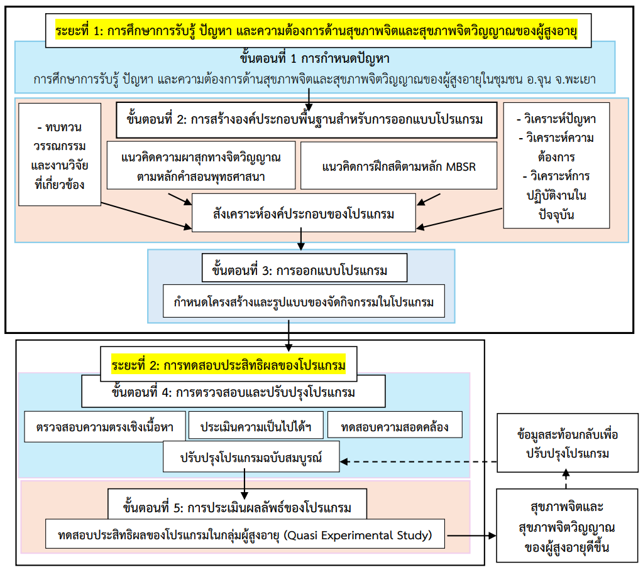
Promoting mental health and spiritual health in older persons can assist them in achieving psychological well-being, enhancing self-esteem, and living meaningful lives. This research and development study aimed to: (1) explore perceptions, problems, and needs related to mental and spiritual health among older persons; (2) develop a mental health and spiritual health care program for older persons; and (3) examine the effects of the program on depression and spiritual well-being among older persons in Chun District, Phayao Province. The study was conducted in two phases. Phase I involved a situational analysis and program development using in-depth interviews and focus group discussions with older persons, caregivers, village health volunteers, and healthcare personnel. Data were analyzed using content analysis. Phase II employed a quasi-experimental study with a non-equivalent control group pretest–posttest design. A total of 32 older persons were recruited and assigned to either an experimental group (n = 16) or a control group (n = 16). The experimental group participated in the mental health and spiritual health cares program for four weekly sessions, each lasting 120 minutes, while the control group received routine care. Research instruments included the Thai Geriatric Depression Scale and the Spiritual Well-Being Scale, with Cronbach’s alpha coefficients of .91 and .88, respectively. Data were analyzed using descriptive statistics and Mixed Analysis of Variance (Mixed ANOVA). The findings from phase I indicated that older persons emphasized inner peace, social support, meaning of life, spiritual connectedness, and religious practices as important dimensions of mental and spiritual well-being. These findings served as the foundation for program development. In Phase II, a significant interaction effect between group and time was found for spiritual well-being scores (F(1,30)=19.484, p<.001, η²p=.394) indicating that the program effectively enhanced spiritual well-being among the participants. However, no significant interaction effect was observed for depression scores (F(1,30) = 0.001, p = .981). Thus, this program may serve as an alternative approach for healthcare providers in providing mental health and spiritual health care for older persons.
References
Coelho-Júnior, H. J., Calvani, R., Panza, F., Allegri, R. F., Picca, A., Marzetti, E., & Alves, V. P. (2022). Religiosity/spirituality and mental health in older adults: A systematic review and meta-analysis of observational studies. Frontiers in Medicine, 9, Article 877213. https://doi.org/10.3389/fmed.2022.877213
Cohen, J. (1988). Statistical power analysis for the behavioral sciences (2nd ed.). Lawrence Erlbaum Associates.
Department of Older Persons. (2023). Thailand's older persons situation 2022. Amarin Corporation PLC.
Department of Older Persons. (2025). Statistics of the Thai Older Persons. https://www.dop.go.th/th/statistics_page?cat=1&id=2569
Elo, S., & Kyngäs, H. (2008). The qualitative content analysis process. Journal of Advanced Nursing, 62(1), 107–115. https://doi.org/10.1111/j.1365-2648.2007.04569.x
Hsiung, Y., Chen, Y.-H., Lin, L.-C., & Wang, Y.-H. (2023). Effects of mindfulness-based elder care (MBEC) on symptoms of depression and anxiety and spiritual well-being of institutionalized seniors with disabilities: A randomized controlled trial. BMC Geriatrics, 23(1), 497. https://doi.org/10.1186/s12877-023-04220-6
Kabat-Zinn, J. (2003). Mindfulness-based stress reduction (MBSR). Constructivism in the Human Sciences, 8(2), 73–107.
Kabat-Zinn, J. (2009). Full catastrophe living: Using the wisdom of your body and mind to face stress, pain, and illness (15th anniversary ed.). Bantam Dell.
Langgapin, S., Boonchieng, W., Chautrakarn, S., Maneeton, N., & Senawan, S. (2024). Development of a monk-led elderly mental health counseling program in Thai Buddhist communities. Religions, 15(8), 998. https://doi.org/10.3390/rel15080998
Lincoln, Y. S., & Guba, E. G. (1985). Naturalistic inquiry. Sage Publications.
McManus, D. T. (2024). The intersection of spirituality, religiosity, and lifestyle practices in religious communities to successful aging: A review article. Religions, 15(4), 478. https://doi.org/10.3390/rel15040478
Promkaewngam, S., Pothiban, L., Srisuphan, W., & Sucamvang, K. (2014). Development of the spiritual well-being scale for Thai Buddhist adults with chronic illness. Pacific Rim International Journal of Nursing Research, 18(4), 320–332.
Sheikh, J. I., & Yesavage, J. A. (1986). Geriatric Depression Scale (GDS): Recent evidence and development of a shorter version. In T. L. Brink (Ed.), Clinical gerontology: A guide to assessment and intervention (pp. 165-173). Haworth Press.
Snyder, C. R. (2002). Hope theory: Rainbows in the mind. Psychological Inquiry, 13(4), 249–275. https://doi.org/10.1207/S15327965PLI1304_01
Stelcer, B., Bendowska, A., Karkowska, D., & Baum, E. (2023). Supporting elderly patients in strengthening their personal and spiritual health resources. Frontiers in Psychology, 14. https://doi.org/10.3389/fpsyg.2023.1237138
The Technical Promotion and Support Office Region 9, Ministry of Social Development and Human Security. (2025). Annual Social Situation Report of Phayao Provinces 2025. https://drive.google.com/drive/folders/1XyBLaZsJ2no7Y8NFENY2-t5ynFWUghyg
Trapsinsaree, D., Pothiban, L., Chintanawat, R., & Wonghongkul, T. (2022). Factors predicting spiritual well-being among dependent older people. Trends in Sciences, 19(1), 1718. https://doi.org/10.48048/tis.2022.1718
Van Meijel, B., Gamel, C., van Swieten-Duijfjes, B., & Grypdonck, M. H. F. (2004). The development of evidence-based nursing interventions: Methodological considerations. Journal of Advanced Nursing, 48(1), 84–92. https://doi.org/10.1111/j.1365-2648.2004.03171.x
Wang, Y., Xu, Q., Tian, H., & Yin, P. (2024). Positive social mentalities and quality of spiritual living in old age: Roles of social participation and life meaning. Inquiry, 61. https://doi.org/10.1177/00469580241282061
Wongpakaran, N., & Wongpakaran, T. (2012). Prevalence of major depressive disorder and suicide in long-term care facilities: A report from northern Thailand. Psychogeriatrics, 12(1), 11-17.
World Health Organization. (2023). Progress report on the United Nations Decade of Healthy Ageing, 2021–2023. https://iris.who.int/handle/10665/374512
Downloads
Published
How to Cite
Issue
Section
License
Copyright (c) 2026 Journal of Nursing and Health Research

This work is licensed under a Creative Commons Attribution-NonCommercial-NoDerivatives 4.0 International License.

