
The Effectiveness of an Integrated Program Based on the Praboromarajchanok Institute Model (PBRI Model) and Myers–Briggs Personality Types on Students’ Mental Health
Keywords:
Integrated program, Praboromarajchanok Institute Model (PI Model), Myers–Briggs Type Indicator (MBTI), Mental health, StudentsAbstract
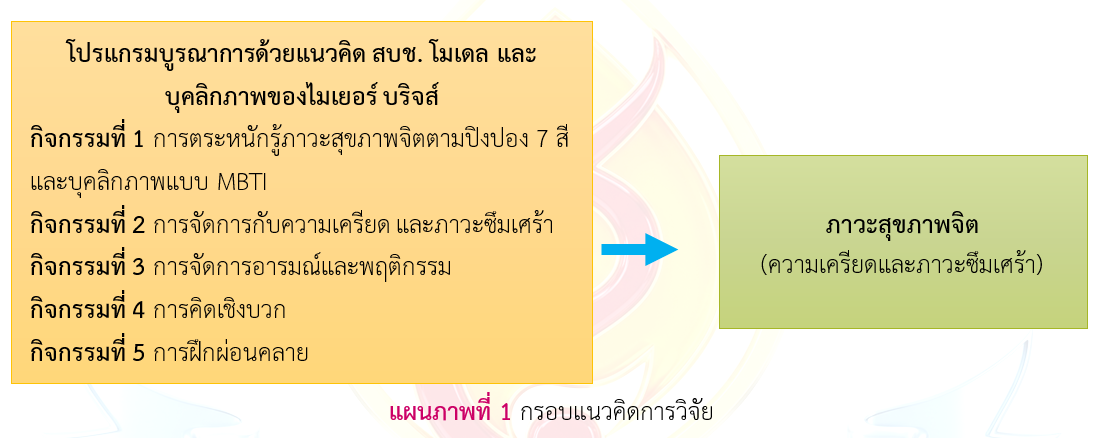
Mental health is associated with personality traits and students’ adaptation to academic and daily life challenges. Promoting personality awareness through the Myers–Briggs personality types (MBTI) concept integrated with the Praboromarajchanok Institute Model (PBRI Model) may help reduce stress and depression among students. This quasi-experimental study employed a two-group pretest–posttest design to examine the effects of an integrated program based on the PI Model and MBTI personality concepts on students’ mental health. The sample consisted of 42 first-year nursing students who were assigned to either an experimental group or a control group using matched-pair procedures based on sex, age, grade point average, income, and prior knowledge of mental health, followed by odd-even random assignment. Each group included 21 participants. The experimental group participated in the integrated program for two weeks, comprising five sessions of 120 minutes each, in addition to receiving routine mental health care information. The control group received only routine mental health care information. The research tools, which include an integrated program, have a content validity of 0.67-1.00. The stress and depression assessment scales showed Cronbach’s alpha coefficients of .84 and .85, respectively. Data were analyzed using descriptive statistics, independent t-tests, and paired t-tests. Results showed that after the intervention, the experimental group's mean depression scores were significantly lower than before the intervention (t=4.23, p<.001), while the control group showed no statistically significant change in depression scores (t=1.59, p>.05). No significant between-group difference was found post-intervention, and the experimental group's mean stress scores showed no statistically significant difference. These findings suggest that the integrated program may help reduce depression in the experimental group to some extent, but did not demonstrate a clear effect relative to the control group. Future studies should incorporate additional stress-reduction activities focusing on problem-focused coping skills and extend the intervention period.
References
Anusaksathien, K. (2024). A study of the relationship between stress and mental health of students at Naresuan University during the spread of the COVID-19. Journal of Social Sciences Naresuan University, 20(1), 33–58. https://doi.org/10.69650/jssnu.2024.263312 (in Thai)
Bundasak, T., Tantisuwichwong, S., Jangasem, N., Sosome, B., Chaichanarungruang, W., & Kwansomkid, S. (2022). Effects of life skills training program on mental health status of nursing students. Princess of Naradhiwas University Journal, 14(2), 77-94. https://li01.tci-thaijo.org/index.php/pnujr/article/view/249344 (in Thai)
Charoensuk, S. & Mokekhaow, K. (2025). The Effect of caring with “7-Color Ping-Pong Program” on depression of nursing students. The Journal of Psychiatric Nursing and Mental Health, 39(3), 64-78. (in Thai)
Jacob, U. S., & Maguvhe, M. O. (2026). Global prevalence of depression among university students: A systematic literature review. Frontiers in Education. https://doi.org/10.3389/feduc.2026.1809441
Jung, C. G. (1971). Psychological types (H. G. Baynes, Trans., Rev. ed.). Princeton University Press.
Krirkgulthorn, T., Umereweneza, S., Seetangkham, S., Boonprothum, K., Phaonoi, B., Doungsuriya, P., & Phongsakchat, P. (2019). Opinions of selected Thai nursing students on factors contributing to their academic and clinical stress. Veridian E-Journal, Silpakorn University (Humanities, Social Sciences and Arts), 12(6), 2591–2608. https://he02.tci-thaijo.org/index.php/Veridian-E-Journal/article/view/198286
Lazarus, R. S., & Folkman, S. (1984). Stress, appraisal, and coping. Springer Publishing Company.
Li, Y.-S., Tseng, H.-C., Yang, B.-H., Mills, M. E. C., & Yu, W.-P. (2025). Personality preferences and stress perception among nursing students in different nursing programmes: A cross-sectional study. BMC Medical Education, 25, 382. https://doi.org/10.1186/s12909-025-06960-y
Liangruenrom, N., Joshanloo, M., Hutaphat, W., & Kittisuksathit, S. (2025). Prevalence and correlates of depression among Thai university students: nationwide study. BJPsych Open, 11(2), e59. https://doi.org/10.1192/bjo.2025.21
Lynn, M. R. (1986). Determination and quantification of content validity. Nursing Research, 35(6), 382–385. https://doi.org/10.1097/00006199-198611000-00017
Mahatnirunkul, S., Pumpaisalchai, W., & Tapanya, P. (1997). The construction of Suanprung Stress Test for Thai population. Suanprung Journal, 13(3), 1–20. (in Thai)
Mahayosanan, P., Tapinta, D., & Kitsumban, V. (2020). Effect of positive self-talk training program on depression among chronically ill adolescent patients. Kuakarun Journal of Nursing, 27(1), 34-45. (in Thai)
McEwen, B. S., & Akil, H. (2020). Revisiting the stress concept: Implications for affective disorders. The Journal of Neuroscience, 40(1), 12–21. https://doi.org/10.1523/JNEUROSCI.0733-19.2019
Mokekhaow, K., Sukrapat, W. & Promla, W. (2024). Factors related to stress of nursing students. Journal of Nursing Science & Health, 44(2), 60-71. https://he01.tci-thaijo.org/index.php/nah/article/view/245496 (in Thai)
Myers, I. B., McCaulley, M. H., Quenk, N. L., & Hammer, A. L. (1998). MBTI Manual: A Guide to the Development and Use of the Myers-Briggs Type Indicator (3rd ed.). Consulting Psychologists Press.
Praboromarajchanok Institute. (n.d.). Praboromarajchanok Institute model (PBRI model). https://eng.pbri.ac.th/
Russell, G., & Lightman, S. (2019). The human stress response. Nature Reviews Endocrinology, 15(9), 525–534. https://doi.org/10.1038/s41574-019-0228-0
Saengnoi-on, N., Pornnopparat, S., & Rattanawongkae, A. (2024). A study of health, introvert and extrovert personality types, adversity quotient, and emotional intelligence of students at private schools in Bangkok. Journal of Psychology, 22(1), 77–94. (in Thai)
Srioad, P., Thoin, P., & Kunjeak, S. (2025). The effects of a stress management program on stress levels of first-year nursing students, Boromarajonani College of Nursing, Khon Kaen. Medical Journal of Sakon Nakhon Hospital, 28(2), 39–47. https://he05.tci-thaijo.org/index.php/JSakonNakHosp/article/view/6257he05.tci-thaijo
Tienthavorn, V. (2013). Surveillance, control and prevention system of diabetes mellitus and hypertension in Thailand: Policy to action (3rd ed.). The Ministry of Public Health. (In Thai)
World Health Organization. (2024). Mental health: strengthening our response. https://www.who.int/news-room/fact-sheets/detail/mental-health-strengthening-our-response
Downloads
Published
How to Cite
Issue
Section
License
Copyright (c) 2026 Journal of Nursing and Health Research

This work is licensed under a Creative Commons Attribution-NonCommercial-NoDerivatives 4.0 International License.

