
Effects of the motivational enhancement program on cervical cancer prevention practices of among women of reproductive age in community
Keywords:
Cervical cancer, Cervical cancer prevention, Motivation enhancement, Cervical cancer screening, Women of reproductive ageAbstract
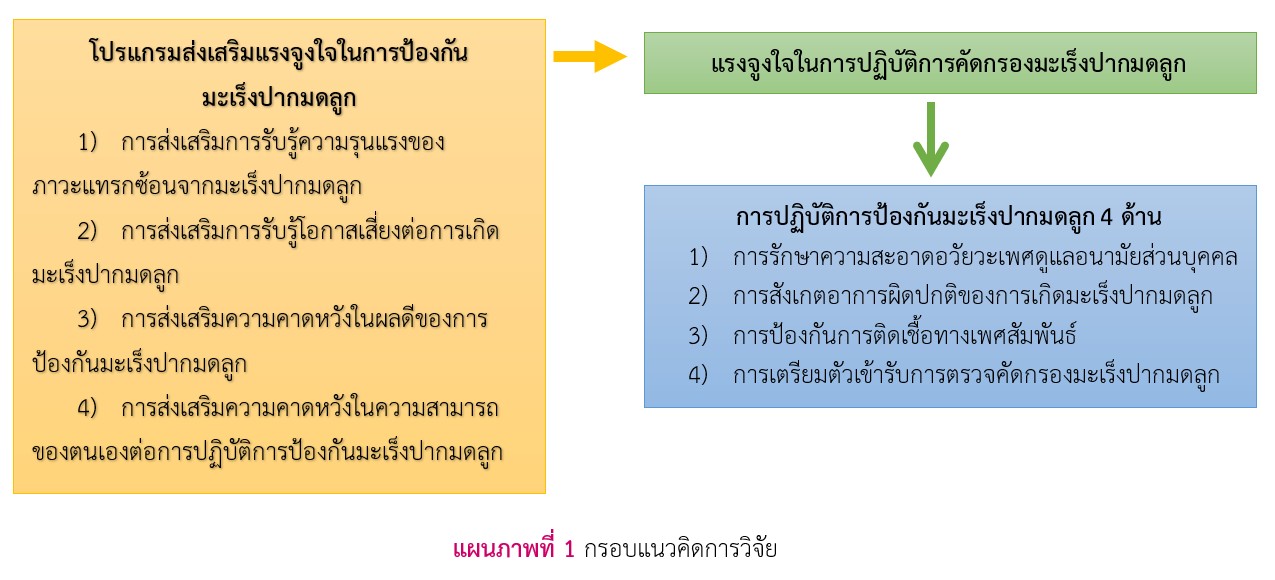
Cervical cancer affects the health and quality of life of women of reproductive age; therefore, cervical cancer prevention is essential to reduce its potential impact. This quasi-experimental research employed a two-group pretest-posttest design to examine the effectiveness of a motivational enhancement program in promoting cervical cancer prevention behaviors. The objectives were:
(1) to assess changes in cervical cancer preventive behavior levels among an experimental group before and after participating in the program, and (2) to compare the post-intervention preventive behavior levels between the experimental and control groups. The study sample consisted of 52 women of reproductive age (30–60 years), randomly assigned to either the experimental group (n=26) or the control group (n=26). The intervention tools included an activity plan within the motivation-enhancing program for cervical cancer prevention, as well as slides, videos, and positive role models. Data was collected using a validated cervical cancer prevention practices questionnaire with a content validity index of 1.0 and the reliability of the instrument was assessed using Cronbach's alpha coefficient, yielding a Cronbach's alpha of .81. Data analysis was conducted using Fisher's exact probability test and Chi-square test. The results revealed that after participating in the motivation enhancement program, the experimental group demonstrated significantly higher levels of cervical cancer prevention practices compared to both their pre-intervention scores and the control group (p<.001). These findings suggest that the motivational enhancement program is an effective intervention for improving cervical cancer prevention behaviors among women of reproductive age and may be considered for broader implementation in community health promotion initiatives.
References
Anansirikasem, P., Chalardlon, P., Petchkong, J., Kaeomaungfang, R., & Rungkhunakorn, B. (2021). The development of motivation interview and online social networks for health beliefs in cancer screening. Journal of Buddhist Anthropology, 6(12), 544-562. https://so04.tci-thaijo.org/index.php/JSBA/article/view/255327/173905 (in Thai)
Bandura, A. (1977). Social learning theory. Prentice-Hall.
Chansurai, P., Pinchaleaw, D., & Keskomon, T. (2021). The effects of a motivation enhancing program with line application on prevention behaviors and cervical cancer screening in Mueang Prachuap Khiri khan District, Prachuap Khiri Khan Province. Journal of Nursing Science Christian University of Thailand, 27(4), 65-76. https://he01.tci-thaijo.org/index.php/CUTJ/article/view/246559/170617 (in Thai)
Cheewapat, P., & Poolperm, K. (2020). HPV Vaccine: current situation and nurses’ roles. Thai Red Cross Nursing Journal, 13(1), 39-49. https://he02.tci-thaijo.org/index.php/trcnj/article/view/243804/165722 (in Thai)
Chiang Mai Provincial Public Health Office. (2023). Report Form on the Implementation of the Government Inspection and Supervision Plan (Regular Monitoring), Round 1/2023. https://www.chiangmaihealth.go.th/document/230130167507838825.pdf (in Thai)
Communication Technology Center, Ministry of Public Health. (2024). Cervical cancer incidence rate in Chiang Mai Province 2024. Health Data Center. https://hdc.moph.go.th/cmi/public/standard-report-detail/f3a9cabcd1b83af2ad8d8db6d9b6735c (in Thai)
Delam, H., Izanloo, S., Bazrafshan, M. R., & Eidi, A. (2020). Risk factors for cervical cancer: An epidemiological review. Journal of Health Sciences & Surveillance System, 8(3), 105–109. https://www.researchgate.net/profile/Hamed-Delam/publication/342876829_Risk_Factors_for_Cervical_Cancer_An_Epidemiological_Review/links/5f0a95b0299bf1881616bb9f/Risk-Factors-for-Cervical-Cancer-An-Epidemiological-Review.pdf?_tp=eyJjb250ZXh0Ijp7ImZpcnN0UGFnZSI6InB1YmxpY2F0aW9uIiwicGFnZSI6InB1YmxpY2F0aW9uIn19
Department of Health, Ministry of Public Health. (2023). Comprehensive cervical cancer control: A guide to essential practice. Department of Health. https://rh.anamai.moph.go.th/web-upload/7x027006c2abe84e89b5c85b44a692da94/m_magazine/33336/1006/file_download/fa30505ac8be02ce3aa10a5edd41cb1b.pdf (in Thai)
Eun, T. J., & Perkins, R. B. (2020). Screening for cervical cancer. The Medical clinics of North America, 104(6), 1063–1078. https://doi.org/10.1016/j.mcna.2020.08.006
Fowler, F. J., Jr. (2013). Survey research methods. SAGE Publications.
Gupta, K. K., Attri, J. P., Singh, A., Kaur, H., & Kaur, G. (2016). Basic concepts for sample size calculation: critical step for any clinical trials!. Saudi Journal of Anaesthesia, 10(3), 328-331. https://doi.org/10.4103/1658-354X.174918
Juabmee, J., Sumdaengrit, B., & Junda, T. (2021). Symptom experiences and quality of life in patients with cervical cancer after completion of treatment. Journal of Health and Nursing Research, 37(2), 203-215. https://he01.tci-thaijo.org/index.php/bcnbangkok/article/view/251396/169848 (in thai)
Malevolti, M. C., Lugo, A., Scala, M., Gallus, S., Gorini, G., Lachi, A., & Carreras, G. (2023). Dose-risk relationships between cigarette smoking and cervical cancer: a systematic review and meta-analysis. European Journal of Cancer Prevention, 32(2), 171-183. https://www.ovid.com/jnls/eurjcancerprev/pdf/10.1097/cej.0000000000000773~dose-risk-relationships-between-cigarette-smoking-and
National Cancer Institute, Department of Medical Services, Ministry of Public Health. (2018). National Cancer Control Programme (2018–2022). National Cancer Institute. https://www.nci.go.th/doc/cc/61-65.pdf (in Thai)
National Cancer Institute. (2024). Hospital-Based Cancer Registry 2022. https://nci.go.th/files/cancer_stat/1771317669_file.pdf (in Thai)
Norman, P., Boer, H., & Seydel, E. R. (2005). Predicting health behaviour: Research and practice with social cognition models. In M. Conner & P. Norman (Eds.), Predicting Health Behaviour (2nd ed., pp. 81–126). Open University Press.
Piakhanta, S., Pinchaleaw, D., & Keskomon, T. (2022). Effects of the motivation enhancing program on village health volunteers’ participation in females’ cervical cancer screening perceptions and prevention. Journal of Health and Nursing Education, 28(2), e258116-e258116. https://he02.tci-thaijo.org/index.php/Jolbcnm/article/view/258116/177326 (in Thai)
Prentice-Dunn, S., & Rogers, R. W. (1986). Protection motivation theory and preventive health: Beyond the health belief model. Health Education Research, 1(3), 153–161.
Subpaiboonkit, P., Aungwattana, S., & Tamdee, D. (2021). Effects of the motivation program on dietary behaviors and blood sugar level among uncontrolled diabetic persons. Nursing Journal CMU, 48(4), 80-92. https://he02.tci-thaijo.org/index.php/cmunursing/article/view/252262/173854 (in Thai)
Thangthum, W., Makkabphalanon, K., Phawo, P., Poolpol, W. (2023). The Effect of the disease prevention enhancement program which applied protection motivation theory on disease prevention behaviors in people at risk of diabetes: case study. Journal of Roi Kaensarn Academi, 8(7), 211–225. https://so02.tci-thaijo.org/index.php/JRKSA/article/view/264094 (in thai)
World Health Organization. (2025). Cervical cancer. https://www.who.int/news-room/fact-sheets/detail/cervical-cancer
Downloads
Published
How to Cite
Issue
Section
License
Copyright (c) 2026 Journal of Nursing and Health Research

This work is licensed under a Creative Commons Attribution-NonCommercial-NoDerivatives 4.0 International License.

