
Effectiveness Effectiveness of resilience enhancement program on stress, happiness and quality of life of older adults in elderly club
Keywords:
Resilience Program, Stress, Happiness, Quality of life, Elderly clubsAbstract
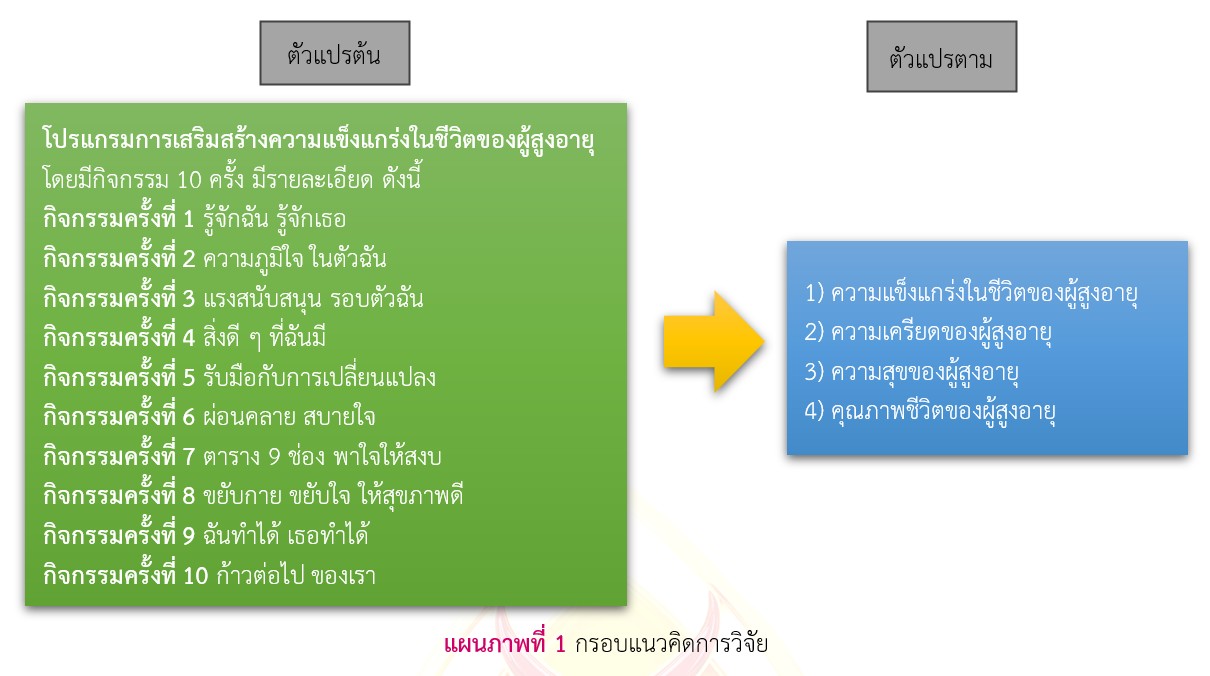
The premise of this study is that strengthening elderly resilience across the three core components (I am, I have, and I can) enables them to adapt to changes, live happily, reduce stress, and improve overall quality of life. This quasi-experimental study employed a two-group pretest-posttest design among older adults attending elderly clubs in Nakhon Si Thammarat Province, Thailand. The experimental group consisted of older adults from the Ban Don Tanod Elderly Club (n=56). The control group consisted of older adults from the Karaked Elderly Club (n=56). The intervention was the Resilience Enhancement Program for older adults, comprising 10 sessions, each lasting 120 minutes, over a period of 5 weeks. We measured scores of resilience, stress, happiness, and quality of life among elderly participants using the following tools: 1) Resilience Assessment Tool, 2) Stress Assessment Tool (SPST-20), 3) Thai Happiness Indicators, and 4) WHO Quality of Life-Older Adults (WHOQOL-OLD-TH). The Cronbach's Alpha coefficients for the reliability of these instruments were .83 .85 .83 and .87 respectively. Data were analyzed using paired sample t-tests and analysis of covariance (ANCOVA). The results indicated that the mean scores of resilience, happiness, and quality of life among the elderly in the experimental group were statistically significantly higher than those before the experiment and higher than those in the control group (p<0.001). Conversely, the mean stress score of the experimental group after the experiment was statistically significantly lower than both its baseline score and that of the control group (p<0.001). Therefore, our study demonstrated that the elderly resilience enhancement program was effective in enabling older adults to better cope with stress, achieve happiness, and obtain a good quality of life. Similar organizations assisting seniors can use this program as a guide to enhance resilience in other elderly clubs.
References
Ananchaipattana, N., Pechkwang, D., & Glomjai, T. (2025). The relationships between resilience and stress among community-dwelling older adults. Journal of Nursing and Health Research, 26(1), https://he01.tci-thaijo.org/index.php/bcnpy/article/view/276301/187033 (in Thai)
Ban Don Tanod Subdistrict Health Promoting Hospital. (2023). Elderly health screening. [Assessment document of the Subdistrict Health Promoting Hospital]
Brinkhof, L.P., Huth, K.B.S., Murre, J.M.J., de Wit, S., Krugers, H.J., & Ridderinkhof, K.R. (2021). The interplay between quality of life and resilience factors in later life: A network analysis. Frontiers in Psychology,12. https://doi.org/10.3389/fpsyg.2021.752564
Chaosuansreecharoen, R.K., Chaosuansreecharoen, P., & Kongsanit, S. (2019). Effectiveness of resilience-enhancing program in elderly residents at Ban Sritang Nursing Home. Nursing Journal of the Ministry of Public Health, 29(1), 32-47. https://he02.tci-thaijo.org/index.php/tnaph/article/view/187174/132465 (in Thai)
Chaosuansreecharoen, R.K., Chaosuansreecharoen, P., & Kongsanit, S. (2019). Predicting factors of resilience among the elderly residents of nursing home in Southern Thailand. Journal of Mental Health of Thailand, 27(2), 65-79. https://he01.tci-thaijo.org/index.php/jmht/article/view/204038/142235 (in Thai)
Choeithim, A., Prasertsuk, N. & Kerdnaimongkol, U. (2018). The happiness of the elderly in the elderly club, Bangkok. Integrated Social Science Journal, 5(1), 85-108. https://so02.tci-thaijo.org/index.php/isshmu/article/view/153968/112088 (in Thai)
Faul, F., Erdfelder, E., Lang, A. G. & Buchner A. (2007). G*Power 3: a flexible statistical power analysis program for the social, behavioral, and biomedical sciences. Behavior Research Methods, 39(2), 175-199. https://link.springer.com/article/10.3758/BF03193146
Foundation of Thai Gerontology Research and Development Institute. (2022). Situation of the Thai Older Persons 2022. https://thaitgri.org/?p=40208 (in Thai)
Grotberg, E. H. (1997). The international resilience project: Findings from the research and the effectiveness of interventions. https://files.eric.ed.gov/fulltext/ED419584.pdf
Itprasert, S. (2017). Quality of life of the elderly in Klaeng Kachet municipality, Mueang district, Rayong province. [Master of Public Administration]. Burapha University]. https://buuir.buu.ac.th/bitstream/1234567890/6229/1/Fulltext.pdf (in Thai)
Jamfa, W., Chumpeeruang, S., & Wanchulee, O. (2024). Factors influencing the resilience among elderly individuals living in Muang Nakhon Sawan Province. Journal of Nurses Association of Thailand Northern Office, 30(1), 97-114. https://he01.tci-thaijo.org/index.php/jnorthnurse/article/view/270996/183217 (in Thai)
Kaspichayawattana, J., Viwatvanich, S., Srisuk, A., & Jetmanoram, S. (2018). Learning to understand the elderly. Yuenyong Press. https://www.nurs.chula.ac.th/images/2019/announcement/%E0%B8%84%E0%B8%A1%E0%B8%AD%E0%B9%80%E0%B8%A3%E0%B8%A2%E0%B8%99%E0%B8%A3%E0%B9%80%E0%B8%82%E0%B8%B2%E0%B9%83%E0%B8%88%E0%B8%A7%E0%B8%A2%E0%B8%AA%E0%B8%87%E0%B8%AD%E0%B8%B2%E0%B8%A2.pdf (in Thai)
MacLeod, S., Musich, S., Hawkins, K., Alsgaard, K., & Wicker, E.R. (2016). The impact of resilience among older adults. Geriatric Nursing, 37, 266-272. https://doi.org/10.1016/j.gerinurse.2016.02.014
Mahattanirunkul, S., Pumphaisanchai, W., & Tapanya, P. (1997). The development of the Suanprung stress test. Academic Psychiatry and Psychology Journal, 13(3), 1-20. https://he01.tci-thaijo.org/index.php/APPJ/article/view/90246 (in Thai)
Mongkol, A., Huttapanom, W., Chetchotisakd, P., Chalookul, W., Punyoyai, L., & Suvanashiep, S. (2001). The study to develop Thai mental health indicator. Journal of the Psychiatric Association of Thailand, 46(3), 209-225. https://www.psychiatry.or.th/JOURNAL/463/v4635.htm (in Thai)
Official Statistics Registration Systems. (2021). Population of Nakhon Si Thammarat Province. https://stat.bora.dopa.go.th/stat/statnew/statMONTH/statmonth (in Thai)
Photipim, M., Pholsripradit, P. Bonyaphagorn, S., Bonyaphagorn, J. Ketbumroong, V., Norkaew, J., Sungwalee, W., & Chavengkun, W. (2021). Effect of resilience-enhancing program on resilience quotient among older dults, Nakhon Ratchasima Province. Journal of Vongchavalitkul University, 34(2), 30-43. https://sutlib2.sut.ac.th/nakhonchaiburin/nm177404.pdf (in Thai)
Ratanasiripong, P., Ratanasiripong, N., Khamwong, M., Jingmark, S., Thaniwattananon, P., & Pisaipan, P. (2021). The impact of resiliency on mental health and quality of life among older adults in Thailand. Journal of Health Research, 36(5), 908-918. https://doi.org/10.1108/JHR-02-2021-0099
Sangon, S., Nintachan, P., & Thaweekoon, T. (2018). Resilience and depression of people in a community in Prathumthani Province. The Journal of Psychiatric Nursing and Mental Health, 32(2), 84-99. https://he02.tci-thaijo.org/index.php/JPNMH/article/view/1372 (in Thai)
Sanitlou, N., Sartphet, W., & Naphaarrak, Y. (2019). Sample size calculation using GPower program. Journal of Suvarnabhumi Institute of Technology (Humanities and Social Sciences), 5(1), 496-507. https://so04.tci-thaijo.org/index.php/svittj/article/view/181958/136948 (in Thai)
The Senior Citizens Council of Thailand. (2016). Senior citizens' club handbook. Department of Older Persons. https://www.dop.go.th/download/knowledge/knowledge_th_20161706104732_1.pdf (in Thai)
Thongkhum, K., Peungposop, N., & Sakunpong, N. (2021). Resilience in the elderly: Concept and approaches to promoting resilience. The Journal of Faculty of Nursing Burapha University, 29(1), 105-116. https://he02.tci-thaijo.org/index.php/Nubuu/article/view/250260/170115 (In Thai)
Downloads
Published
How to Cite
Issue
Section
License
Copyright (c) 2026 Journal of Nursing and Health Research

This work is licensed under a Creative Commons Attribution-NonCommercial-NoDerivatives 4.0 International License.

