
The effects of a pretend play-based learning enhancement program on preschoolers’ executive function development
Keywords:
Executive function, Preschoolers, Pretend play, Learning enhancement programAbstract
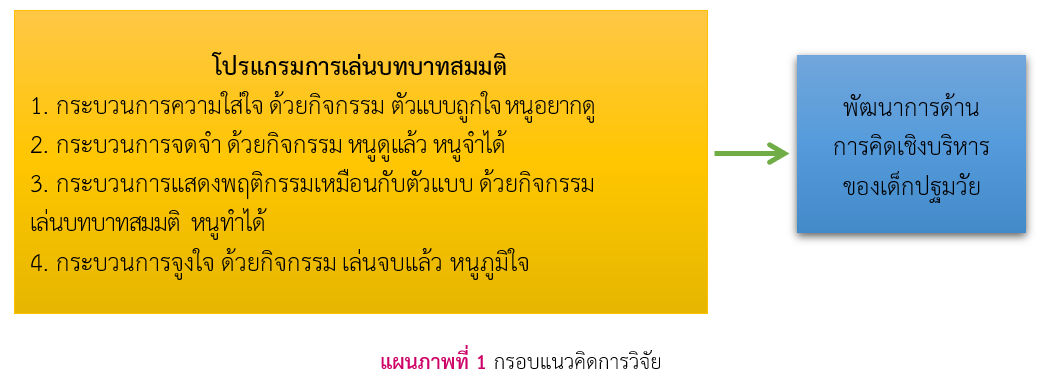
Preschoolers are in a critical period for the development of executive functions (EF). It has been found that Thai preschoolers have executive function development below the average level, which may hinder their ability to regulate behavior and achieve successful learning outcomes. Grounded in Bandura’s social cognitive learning theory, this quasi-experimental study examined the effects of a pretend play–based learning enhancement program on preschoolers’ executive function development. The participants consisted of 30 preschoolers aged 4–5 years enrolled in Kindergarten Level 2, who were divided into an experimental group (n=15) and a control group (n=15). Research instruments included a pretend play-based learning enhancement program for a period of five weeks. The scale-level content validity index was equal to 1.00 and the Executive Functions Assessment for Preschool Children (MU.EF-101), which demonstrated acceptable reliability with a Cronbach’s alpha coefficient of .77. The data were analyzed using descriptive statistics and an independent
t-test to compare the mean scores of executive function development between the experimental and control groups. Additionally, chi-square test and Fisher’s exact test were employed to examine differences in the general characteristics of preschoolers and their primary caregivers. The results revealed that after the intervention, the experimental group showed a significantly higher mean executive function score compared with the pretest (d=1.41, t=10.67, p<.001). Furthermore, the posttest executive function scores of the experimental group were significantly higher than those of the control group (d=1.46, t=3.86, p<.001). These findings suggest that a pretend play-based learning enhancement program is effective and can be implemented as an intervention to promote executive function development among preschoolers.
References
Academic and Research Support Group, Bureau of Health Promotion, Department of Health. (2018). To study the 6th of factors effecting to child development in Thailand in 2017. Nonthaburi: Academic and Research Support Group, Bureau of Health Promotion, Department of Health. http://203.157.71.148/data/cluster/mom/download/KMDenver60.pdf (in Thai)
Arpasuwan, K., Natchanan, C., and Narumon, T. (2024). Predictors of maternal behaviors on promoting executive function in preschool children. The Journal of Faculty of
Nursing Burapha University, 32(1), 26–37. https://he02.tci-thaijo.org/index.php/Nubuu/article/view/266844 (in Thai)
Bandura, A. (1986). Social Foundations of Thought and Action: A Social Cognitive Theory. Prentice Hall.
Barnes, Z. T., McDorman, M., & Romeo, R. (2025). Parent education, not income-to-needs ratio, relates to preschool home executive function environment. Journal of Experimental Child Psychology, 258, 106292. https://doi.org/10.1016/j.jecp.2025.106292
Berk, L. E., & Winsler, A. (1995). Scaffolding children's learning: Vygotsky and early childhood education. National Association for the Education of Young Children.
Bruner, J. S. (1966). Toward a theory of instruction. Harvard University Press.
Center on the Developing Child, Harvard University. (2015). Enhancing and practicing executive function skills with children from infancy to adolescence. https://children.wi.gov/Documents/Harvard%20Parenting%20Resource.pdf
Chainat Primary Educational Service Area Office. (2023). Age data table (Academic year 2023, semester 2). https://amsscnt.com/bigdatacnt/tableAge.php?op=2.2&look=&year=2566-2 (in Thai)
Department of Health, Ministry of Public Health. (2021). Department of Health Annual report 2020. Aksorn Graphic and Design. https://backenddc.anamai.moph.go.th/coverpage/88efe38d72050a3f3dfca775bfd1f16b.pdf (in Thai)
Diamond, A., & Ling, D. S. (2020). Review of the evidence on, and fundamental questions about, efforts to improve executive functions, Including working memory. In J. M. Novick, M. F. Bunting, M. R. Dougherty, & R. W. Engle (Eds.), Cognitive and working memory training: Perspectives from psychology, neuroscience, and human development (pp. 143–431).Oxford University Press. https://doi.org/10.1093/oso/9780199974467.003.0008
Duangruetai, S., Apawan, N., Somsiri, R., and Nuanchan, C., (2019). Factors related to executive functions in preschool-aged children. Journal of Thailand Nursing and Midwifery Council, 34(4), 80–94. https://he02.tci-thaijo.org/index.php/TJONC/article/view/191264 (in Thai)
Jintana, P. and Wanwisa, K. (2018). The factors associated with early childhood development in Thailand 6th B.E.2560. https://km.anamai.moph.go.th/th/research2562/download?id=75681&mid=35276&mkey=m_document&lang=th&did=25222. (in Thai)
Jongjit, K. and Santi, W. (2024). Executive Functions Foundations of Early ChildhoodDevelopmentin the 21stCentury. Journal of Roi Kaensarn Academi, 9(7). 965-980. https://so02.tci-thaijo.org/index.php/JRKSA/article/view/268737/181180 (in Thai)
Mulder H., Verhagen J., Van der Ven S. H. G., Slot P. L. & Leseman P. P. M. (2017). Early Executive Function at Age Two Predicts Emergent Mathematics and Literacy at Age Five. Frontiers in Psychology. 8,1706. https://doi.org/10.3389/fpsyg.2017.01706
Nuanchan, C., Panadda, T., Orapin, L., & Nootchanart R. (2017). Development and standardization of executive function assessment tools in early childhood. Neuroscience Research Center, Institute of Molecular Biosciences, Mahidol University. https://kb.hsri.or.th/dspace/handle/11228/4650 (in Thai)
Natruja, T., Sukanlaya, S., &Chaweng, S. (2022). Effects of using role-playing activities to enhance the social behaviors of Kindergarteners in a Multicultural Classroom. Journal of education studies, 50(3), 1-12. https://digital.car.chula.ac.th/cgi/viewcontent.cgi?article=4035&context=educujournal (in Thai)
Polit, D. F., & Beck, C. T. (2004). Nursing research: Principles and methods (7th ed.). Lippincott Williams & Wilkins.
Thibodeau, R. B., Gilpin, A. T., Brown, M. M., & Meyer, B. A. (2016). The effects of fantastical pretend-play on the development of executive functions: An intervention study. Journal of Experimental Child Psychology, 145, 120–138. https://doi.org/10.1016/j.jecp.2016.01.001
White, R. E., & Carlson, S. M. (2021). Pretending with realistic and fantastical stories facilitates executive function in 3-year-old children. Journal of Experimental Child Psychology, 206, 105071. https://pubmed.ncbi.nlm.nih.gov/33684892/
Zyga, O. (2016). The act of pretending: play, executive function, and theory of mind in early childhood. [Master of Arts (Psychological Sciences)]. Case Western Reserve University. http://rave.ohiolink.edu/etdc/view?acc_num=case1467391080
Downloads
Published
How to Cite
Issue
Section
License
Copyright (c) 2026 Journal of Nursing and Health Research

This work is licensed under a Creative Commons Attribution-NonCommercial-NoDerivatives 4.0 International License.

