
Factors related to health behaviors in controlling blood pressureamong Taiyai older persons with hypertension
Keywords:
Health belief model, Health behaviors in blood pressure control, Hypertension, Taiyai older persons (ethnic group)Abstract
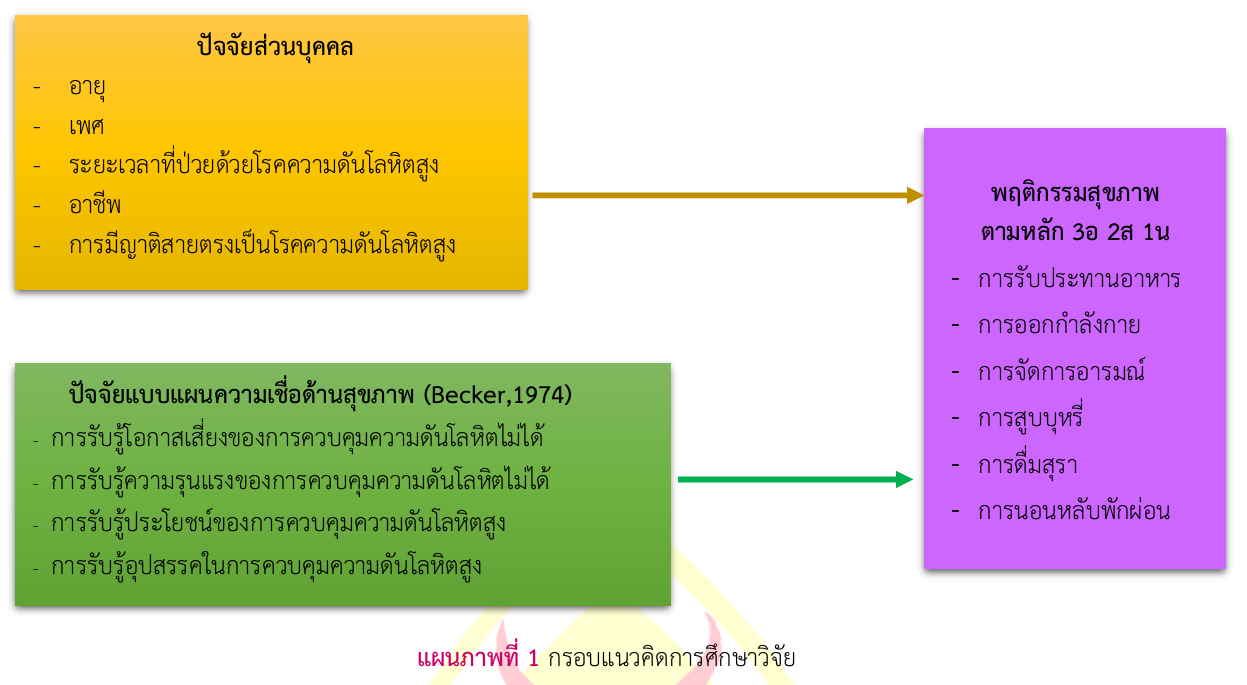
Health beliefs influence health behaviors in blood pressure control. This descriptive correlational study aimed to examine health behaviors related to blood pressure control and to investigate the factors associated with these health behaviors among Taiyai older persons with hypertension. The sample consisted of 175 Taiyai older persons with hypertension residing in Mueang District, Mae Hong Son Province, selected through multistage random sampling. The research instrument was an interview questionnaire composed of personal information, health beliefs, and health behaviors in blood pressure control. The reliability coefficients were .97 and .99, respectively. Data were analyzed using descriptive statistics, point-biserial correlation, Eta correlation, and Pearson’s correlation coefficient. The results revealed that the overall health behaviors related to blood pressure control among Taiyai older persons with hypertension were at a good level (\bar{x}=45.79, SD=7.36). Female gender and having a direct relative with hypertension were significantly positively correlated with health behaviors (rpb= .417, p<.01; rpb= .514, p<.01), respectively. In terms of the Health Belief Model, overall health beliefs were significantly positively correlated with health behaviors (rpb=.443, p<.001, respectively). These findings provide foundational information for healthcare professionals to develop strategies based on the Health Belief Model to promote health behaviors for blood pressure control among Taiyai older persons with hypertension.
References
Bureau of Policy and Strategy, Office of the Permanent Secretary, Ministry of Public Health. (2021). Key statistics 2020. War Veterans Organization Printing House (in Thai)
Gibson, C. H. (1991). A concept analysis of empowerment. Journal of Advanced Nursing, 16(3), 354–361. https://doi.org/10.1111/j.1365-2648.1991.tb01660.x
Had Kluad Subdistrict Health Promoting Hospital. (2023). Annual report fiscal year 2023 [Annual report]. Had Kluad Subdistrict Health Promoting Hospital. (in Thai)
International Diabetes Federation. (2025). International Diabetes Federation: World Diabetes Congress 2025, Bangkok. https://idf2025.org/
Kiatpao, R. (2015). Outcomes of health behavior modification program toward risk reduction for hypertension and diabetes mellitus among population at risk, Thapthan Districts, Uthaithani Province. Journal of Health Science, 24(3), 405–412. https://thaidj.org/index.php/JHS/article/download/461/411/427 (in Thai)
Leumthong, S. (2023). The effectiveness of the health promotion program to self-care behaviors and decreasing blood sugar level among pre-diabetes peoples in Wiang sub-district, Chiang Saen district, Chiang Rai. Journal of Science and Technology Northern, 4(4), 14–25. https://he03.tci-thaijo.org/index.php/scintc/article/view/2064 (in Thai)
MeeYam, K. (2018). Effects of health promotion program in risk factors to metabolic syndrome among navy in sattahip district chonburi province. Burapha University. https://buuir.buu.ac.th/bitstream/1234567890/8815/1/56910081.pdf (in Thai)
Ngoichansri, J. (2024). Effectiveness of the health promotion program according to the principles of 3A. 2S. in the elderly at risk for diabetes in behavior change. Primary Care Unit Muang Sukkasem Community Health Center Sakon Nakhon Hospital. Journal of Environmental Health and Community Health, 9(7), 333–345. https:// thaijo.org/index.php/ech/article/view/2748 (in Thai)
Patcharawan, J., Petcharut, S., Chatlada, D .(2020). Development and validation of a health promotion program for diabetes prevention in high-risk elderly. Journal of the Office of disease prevention and control,7 Khon kaen, 27(1), 52-62. https://flas.reru.ac.th/instructor/research/64a64f085cc08PATCHARAWAN_JANPECH_001.PDF.pdf (in Thai)
Petch, R. (2025). Currently, approximately 6.1 million Thais have diabetes. Diabetes is becoming more common among working-age and younger people. World Diabetes Day 2025, Diabetes Association of Thailand. https://www.dmthai.org/new/index.php/activities-and-news/diabetes-day/khxkhid-neuxng-ni-wan-bea-hwan-lok-2568 (in Thai)
Rogers, R.W. (1983). Cognitive and physiological processes in fear appeals and attitude change: A revised theory of protection motivation. In J. Cacioppo & R. Petty (Eds.), Social Psychophysiology. Guilford Press.
Thangthum, W., Khunatpakorn, M., Phongphan, P., & Wasana, P. (2023). The effect of the disease prevention enhancement program which applied protection motivation theory on disease prevention behaviors in people at risk of diabetes: Case study. Journal of Roi Kaensarn Academi, 8(7), 211–224. https://so02.tci-thaijo.org/index.php/JRKSA/article/download/264094/176848/1045810 (in Thai)
Thongsuk, W. (2019). Effects of the empowerment program on health behaviors, body mass index and blood pressure level in uncontrolled hypertension. Nursing Journal volume, 47(4) ,229-241. https://he02.tci-thaijo.org/index.php/cmunursing/article/view/243083 (in Thai)
Downloads
Published
How to Cite
Issue
Section
License
Copyright (c) 2026 Journal of Nursing and Health Research

This work is licensed under a Creative Commons Attribution-NonCommercial-NoDerivatives 4.0 International License.

