
Factors associated with quality of life among older adults screening positive for cognitive impairment in a social welfare development center: A mixed methods study
Keywords:
Quality of life of older adults, Older adults, Cognitive impairment, Depression, Activities of daily livingAbstract
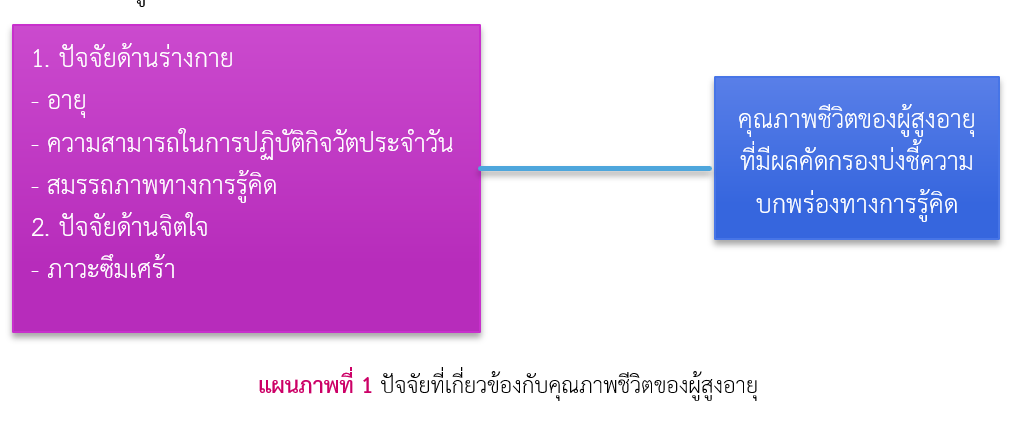
The quality of life of older adults screening positive for cognitive impairment significantly affects their daily functioning. This explanatory sequential mixed-methods study aimed to examine factors associated with quality of life and to explore approaches for improving the quality of life among older adults screening positive for cognitive impairment. The quantitative phrase comprised 38 older adults screening positive for cognitive impairment at a social welfare development center for older persons, selected via simple random sampling. For the qualitative phase, key informants included the center director, caregivers, and older adults screening positive for cognitive impairment. Data were collected using the Thai Geriatric Depression Scale, the Thai Barthel Index for Activities of Daily Living, the Thai Mini-Mental State Examination, and the Thai version of the World Health Organization Quality of Life Scale for Older Adults. The instruments demonstrated Cronbach’s alpha coefficients of .85, .87, .80, and .75, respectively. In addition, in-depth interviews were conducted. Data analysis utilized Pearson’s correlation, eta correlation, Spearman’s rank correlation, and content analysis. The findings revealed that the overall quality of life of older adults screening positive for cognitive impairment was at a moderate level, though the death and dying domain was rated at a good level. Regarding associated factors, depression showed a very high significant negative correlation with quality of life (rₛ=-.900, p<.001). Conversely, cognitive function demonstrated a high significant positive correlation (rₛ=.782, p<.001), while the ability to perform basic activities of daily living showed a low significant positive correlation (rₛ=.324, p=.047). Guidelines for improving the quality of life of older adults screening positive for cognitive impairment include mitigating depression through social interaction activities, integrating cognitive stimulation activities into activities of daily living training, and fostering a care environment that enhances participation and self-esteem of older adults.
References
Aajami, Z., Kazazi, L., Toroski, M., Bahrami, M., & Borhaninejad, V. (2020). Relationship between Depression and Cognitive Impairment among Elderly: A Cross-sectional Study. Journal of caring sciences, 9(3), 148–153. https://doi.org/10.34172/jcs.2020.022
Creswell, J. W., & Plano Clark, V. L. (2017). Designing and Conducting Mixed Methods Research (3rd ed.). SAGE Publications.
Department of Medical Services. (2021). Screening and assessment manual for older persons 2021. Ministry of Public Health. (In Thai)
Department of Older Persons. (2024). Statistics of older persons. https://www.dop.go.th/th/statistics_page?cat=1&id=2559 (in Thai)
Fu, X., Ji, S., Li, J., Chen, T., Liu, X., & Kuang, W. (2025). Cognitive impairment and dependency in activities of daily living: a cross-lagged analysis. Frontiers in aging neuroscience, 17, 1663237. https://doi.org/10.3389/fnagi.2025.1663237
Gopalakrishnan, P., Tiwari, S., Nagaraja, R., & Krishnan, G. (2024). Quality of life in persons with mild cognitive impairment: A systematic review and meta-analysis. Dementia & Neuropsychologia, 18, Article e20230093. https://doi.org/10.1590/1980-5764-DN-2023-0093
Jitapunkul, S. (2001). Principles of geriatric medicine (3rd ed.). Faculty of Medicine, Chulalongkorn University. (in Thai)
Li, H., Xu, M., Yin, W., Zhuge, X., Dong, P., Shi, Y., Li, Z., Zhang, X., Wang, J., & Chen, Z. (2025). The relationship between cognitive impairment and quality of life in rural older adults with chronic diseases-parallel mediating effects of depressive symptoms and frailty. BMC geriatrics, 25(1), 747. https://doi.org/10.1186/s12877-025-06446-y
Malterud, K., Siersma, V. D., & Guassora, A. D. (2016). Sample size in qualitative interview studies: Guided by information power. Qualitative Health Research, 26(13), 1753–1760. https://doi.org/10.1177/1049732315617444
Raimo, S., Maggi, G., Ilardi, C. R., Cavallo, N. D., Torchia, V., Pilgrom, M. A., Cropano, M., Roldán-Tapia, M. D., & Santangelo, G. (2024). The relation between cognitive functioning and activities of daily living in normal aging, mild cognitive impairment, and dementia: a meta-analysis. Neurological sciences : official journal of the Italian Neurological Society and of the Italian Society of Clinical Neurophysiology, 45(6), 2427–2443. https://doi.org/10.1007/s10072-024-07366-2
Song, R., Fan, X., & Seo, J. (2023). Physical and cognitive function to explain the quality of life among older adults with cognitive impairment: Exploring cognitive function as a mediator. BMC Psychology, 11, 51. doi:10.1186/s40359-023-01087-5
Stern, Y., Albert, M., Barnes, C. A., Cabeza, R., Pascual-Leone, A., & Rapp, P. R. (2023). A framework for concepts of reserve and resilience in aging. Neurobiology of Aging, 124, 100-103. https://doi.org/10.1016/j.neurobiolaging.2022.10.015
Sudnongbua, S. (2021). Elderly care: Situation and quality of life care. Chulalongkorn University Press. (In Thai).
Tanaka, M., Uemura, J. I., Tanikaga, M., Mizuno, J., & Nakamura, Y. (2025). Factors Affecting the Quality of Life of Institutionalized Older Adults With Dementia. OTJR : occupation, participation and health, 15394492251403393. Advance online publication. https://doi.org/10.1177/15394492251403393
WHOQOL Group. (1995). The World Health Organization Quality of Life assessment (WHOQOL): Position paper from the World Health Organization. Social Science & Medicine, 41(10), 1403–1409. https://doi.org/10.1016/0277-9536(95)00112-K
World Health Organization. (2025). Dementia. https://www.who.int/news-room/fact-sheets/detail/dementia
Downloads
Published
How to Cite
Issue
Section
License
Copyright (c) 2026 Journal of Nursing and Health Research

This work is licensed under a Creative Commons Attribution-NonCommercial-NoDerivatives 4.0 International License.

