
ปัจจัยที่สัมพันธ์กับพฤติกรรมของผู้ดูแลในการป้องกันการบาดเจ็บของเด็กปฐมวัยในชุมชน
คำสำคัญ:
การป้องกันการบาดเจ็บ, เด็กปฐมวัย, พฤติกรรมของผู้ดูแล, ชุมชนบทคัดย่อ
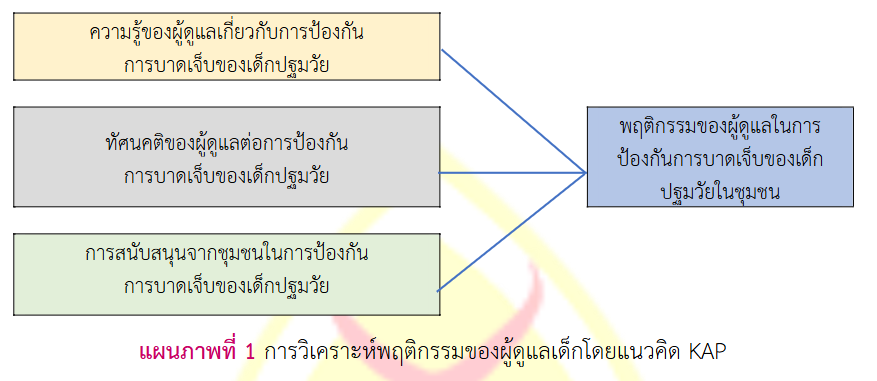
การบาดเจ็บจากอุบัติเหตุเป็นปัญหาสาธารณสุขและเป็นสาเหตุการเสียชีวิตที่สำคัญของเด็กปฐมวัย ในเด็กอายุต่ำกว่า 15 ปีในประเทศไทย โดยมีผู้เสียชีวิตเฉลี่ยเกือบวันละ 6 คน สะท้อนความรุนแรงของปัญหาที่ส่งผลกระทบต่อเด็ก ครอบครัว และสังคม แม้การบาดเจ็บส่วนใหญ่สามารถป้องกันได้ แต่ยังคงพบอุบัติการณ์สูง โดยเฉพาะในเด็กปฐมวัยที่มีข้อจำกัดด้านพัฒนาการและการรับรู้ความเสี่ยง การวิจัยเชิงพรรณนาแบบหาความสัมพันธ์ครั้งนี้มีวัตถุประสงค์ เพื่อศึกษาพฤติกรรมของผู้ดูแลในการป้องกันการบาดเจ็บของเด็กปฐมวัยในชุมชน และปัจจัยที่สัมพันธ์กับพฤติกรรมดังกล่าว กลุ่มตัวอย่างคือ ผู้ดูแลหลักของเด็กปฐมวัยที่กำลังศึกษาอยู่ในศูนย์พัฒนาเด็กก่อนวัยเรียนเขตคลองสามวา กรุงเทพมหานคร จำนวน 138 คน ได้มาจากการสุ่มแบบเจาะจง เครื่องมือวิจัยประกอบด้วย 1) แบบทดสอบความรู้เกี่ยวกับการป้องกันการบาดเจ็บ 2) แบบประเมินทัศนคติ 3) แบบประเมินการสนับสนุนจากชุมชน และ 4) แบบประเมินพฤติกรรมของผู้ดูแลในการป้องกันการบาดเจ็บของเด็กปฐมวัย มีค่าดัชนีความสอดคล้องระหว่าง 0.67–1.00 และหาค่าความเชื่อมั่นของแบบทดสอบความรู้มีค่าคูเดอร์–ริชาร์ดสัน 21 เท่ากับ .76 ส่วนแบบประเมินทัศนคติ การสนับสนุนจากชุมชน และพฤติกรรม มีค่าสัมประสิทธิ์แอลฟาของครอนบาค เท่ากับ .87 .87 และ .94 ตามลำดับ วิเคราะห์ข้อมูลด้วยสถิติพรรณนาและสัมประสิทธิ์สหสัมพันธ์สเปียร์แมน ผลการวิจัย พบว่า พฤติกรรมของผู้ดูแลในการป้องกันการบาดเจ็บของเด็กปฐมวัยอยู่ในระดับสูง (𝑥̅=72.14, SD=7.76) ความรู้ ทัศนคติ และการสนับสนุนจากชุมชนมีความสัมพันธ์เชิงบวกกับพฤติกรรมของผู้ดูแลอย่างมีนัยสำคัญทางสถิติ (rs=.390, p<.001, rs=.550, p<.001, rs=.620, p<.001) ตามลำดับ ดังนั้น ควรส่งเสริมบทบาทขององค์กรชุมชนในการจัดกิจกรรมให้ความรู้ รณรงค์ และสร้างเครือข่ายความปลอดภัยในพื้นที่
เอกสารอ้างอิง
Acoba, E. F. (2024). Social support and mental health: the mediating role of perceived stress. Frontiers in Psychology, 15:1330720. https://doi.org/10.3389/fpsyg.2024.1330720
Andrade, C., Menon, V., Ameen, S., & Kumar Praharaj, S. (2020). Designing and conducting knowledge, attitude, and practice surveys in psychiatry: practical guidance. Indian Journal of Psychological Medicine, 42(5), 478-481. https://doi.org/10.1177/0253717620946111
Best, J. W., & Kahn, J. V. (2013). Research in education (10th ed.). Pearson Education Inc. https://www.academia.edu/100602091/Research_in_education_Kahn_James_V_Best_John_W_#title
Bloom, B. S., Madaus, G. F., & Hastings, J. T. (1971). Handbook on formative and summative evaluation of student learning. McGraw-Hill. https://archive.org/details/handbookonformat00bloo/page/n7/mode/2up
Budziszewski, R., Thompson, R., Lucido, T., Walker, J., Meyer, L. K., Arthur, L. G., & Grewal, H. (2021). Measuring the effectiveness of a car seat program in an urban, level one pediatric trauma center. Injury Epidemiology, 8(1), 19. https://doi.org/10.1186/s40621-021-00313-1
Cohen, J. (1988). Statistical power analysis for the behavioral sciences (2nd ed.). Routledge. https://doi.org/10.4324/9780203771587
Conatser, R. L. (2024). Child passenger safety: Implementation and evaluation of a virtual educational intervention for parents and caregivers. Accident Analysis & Prevention, 203, 107618. https://doi.org/10.1016/j.aap.2024.107618
Division of Injury Prevention, Department of Disease Control. (2022). The situation of injury-related deaths among children in Thailand, 2015–2019. https://ddc.moph.go.th/uploads/publish/1343520221109024056.pdf
Gallagher, L., Breslin, G., Leavey, G., Curran, E., & Rosato, M. (2023). Determinants of unintentional injuries in preschool age children in high-income countries: a systematic review. Child: Care, Health and Development, 50(1), e13161. https://doi.org/10.1111/cch.13161
Jahangir, S., Patil, D. S., Gangopadhyay, J., & Vogt, T. C. (2025). Understanding intergenerational dynamics and social support's impact on health and well-being of older adults in South Asia: a scoping review. Systematic Reviews, 14(1), 86. https://doi.org/10.1186/s13643-025-02833-z
Jones, S., Tyson, S., Yorke, J., & Davis, N. (2020). The impact of injury: the experiences of children and families after a child’s traumatic injury. Clinical Rehabilitation, 35(4), 614-625. https://doi.org/10.1177/0269215520975127
Kendrick, D. (2019). Unintentional injuries and their prevention. Oxford University Press. https://doi.org/10.1093/med/9780198788850.003.0014
Kvalnes, Ø., & Hansen Sandseter, E. B. (2023). Risky play, then and now. Risky play: an ethical challenge (pp. 13-29). Springer International Publishing. https://doi.org/10.1007/978-3-031-25552-6_2
Lael-Monfared, E., Rakhshanderou, S., Ramezankhani, A., & Ghaffari, M. (2023). Behavioural and environmental risk factors for household injuries: semistructured interviews with health professionals and mothers in Iran. BMJ Paediatrics Open, 7(1), e001762. https://doi.org/10.1136/bmjpo-2022-001762
Mauritzson, E., McKee, K. J., Elf, M., & Borg, J. (2023). Older adults' experiences, worries and preventive measures regarding home hazards: a survey on home safety in Sweden. International Journal of Environmental Research and Public Health, 20(2), 1458. https://doi.org/10.3390/ijerph20021458
McFarland, L., Baker, L. M., Lee-Pang, L., & Mulcahy, R. (2025). Implementing child safe standards in early education settings: understanding the ecology of policy and practices. Australasian Journal of Early Childhood, 50(4), 349-363. https://doi.org/10.1177/18369391251358016
Rungchutiphopan, W., Nilnate, W., Sirisophon, A., & Niramittawin, L. (2023). Selected factors related to caregivers’ ability to provide care for the safety of preschool children. Thai Red Cross Nursing Journal, 16(3), 102–114. https://he02.tci-thaijo.org/index.php/trcnj/article/view/266427 (in Thai)
Salam, A., Aziz, D. A., Ansar, F., Sajjad, A., & Asjid, M. (2022). Role of primary caregivers regarding unintentional injury prevention among preschool children: a cross-sectional survey in low- and middle-income country. Cureus, 14(8), e28599. https://doi.org/10.7759/cureus.28599
Sarnkhao, S., Tamdee, D., & Boonchiang, W. (2020). Factors related to family member practices for early childhood injury prevention in community. Nursing Journal, 47(1), 209–221. https://he02.tci-thaijo.org/index.php/cmunursing/article/view/240778 (in Thai)
Shaban, M. M., Sharaa, H. M., & Nashwan, A. J. (2023). Effect of community-based intervention on knowledge and practice of rural mothers toward children home injuries. International Journal of Africa Nursing Sciences, 19, 100593.
Stehr, P., Reifegerste, D., Rossmann, C., Caspar, K., Schulze, A., & Lindemann, A.-K. (2022). Effective communication with caregivers to prevent unintentional injuries in children under seven years. A systematic review. Patient Education and Counseling, 105(8), 2721-2730. https://doi.org/10.1016/j.pec.2022.04.015
Stralczynská, B. L., Chroustová, K., Skrehot, P., Chytrý, V., Bílek, M., & Marádová, E. (2022). Childhood injuries and their sustainable prevention from the perspective of parents and grandparents. Sustainability, 14(17), 10592. https://doi.org/10.3390/su141710592
Swanson, M. H., Morgan, C. H., Johnston, A., & Schwebel, D. C. (2023). Caregiver accounts of unintentional childhood injury events in rural Uganda. Journal of Safety Research, 85, 101-113. https://doi.org/10.1016/j.jsr.2023.01.010
Wang, Z., Klunklin, P., & Jintrawet, U. (2021). Knowledge, attitude, and practices of unintentional home injury prevention among parents of preschoolers in the People’s Republic of China. Nursing Journal, 48(2), 232–245. https://he02.tci-thaijo.org/index.php/cmunursing/article/view/253391 (in Thai)
ดาวน์โหลด
เผยแพร่แล้ว
รูปแบบการอ้างอิง
ฉบับ
ประเภทบทความ
สัญญาอนุญาต
ลิขสิทธิ์ (c) 2026 วารสารวิจัยการพยาบาลและสุขภาพ

อนุญาตภายใต้เงื่อนไข Creative Commons Attribution-NonCommercial-NoDerivatives 4.0 International License.

