
การพัฒนาและประเมินประสิทธิผลของโปรแกรมการดูแลสุขภาพจิตและสุขภาพจิตวิญญาณสำหรับผู้สูงอายุ
คำสำคัญ:
โปรแกรมการดูแลสุขภาพจิตและสุขภาพจิตวิญญาณ, ผู้สูงอายุ, สุขภาพจิต, สุขภาพจิตวิญญาณบทคัดย่อ
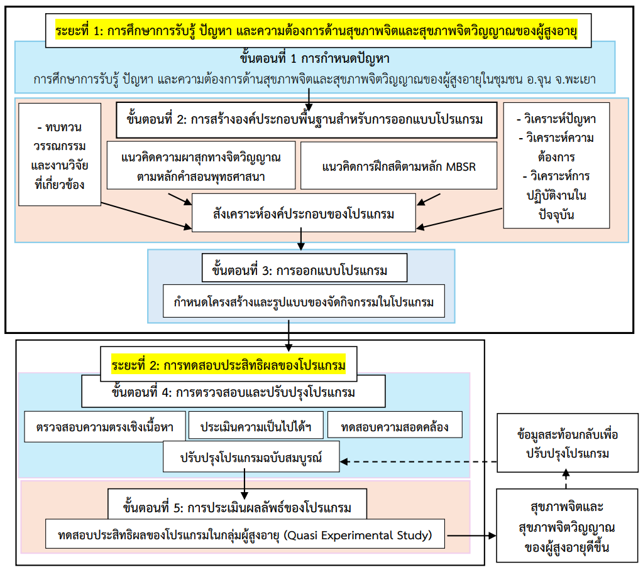
การส่งเสริมสุขภาพจิตและสุขภาพจิตวิญญาณของผู้สูงอายุ ช่วยให้ผู้สูงอายุมีความสุขทางใจ เพิ่มความรู้สึกมีคุณค่าในตนเอง และสามารถดำรงชีวิตได้อย่างมีความหมาย การวิจัยและพัฒนาครั้งนี้มีวัตถุประสงค์เพื่อ 1) ศึกษาการรับรู้ ปัญหา และความต้องการด้านสุขภาพจิตและสุขภาพจิตวิญญาณของผู้สูงอายุ 2) พัฒนาโปรแกรมการดูแลสุขภาพจิตและสุขภาพจิตวิญญาณสำหรับผู้สูงอายุ และ 3) ประเมินประสิทธิผลของโปรแกรมต่อภาวะซึมเศร้าและความผาสุกทางจิตวิญญาณของผู้สูงอายุ อำเภอจุน จังหวัดพะเยา การวิจัยแบ่งเป็น 2 ระยะ ได้แก่ ระยะที่ 1 การศึกษาสถานการณ์และพัฒนาโปรแกรม โดยการสัมภาษณ์เชิงลึกและการสนทนากลุ่ม วิเคราะห์ข้อมูลด้วยการวิเคราะห์เนื้อหา ระยะที่ 2 เป็นการวิจัยกึ่งทดลองแบบกลุ่มควบคุมไม่เท่าเทียมกัน วัดผลก่อนและหลังการทดลอง กลุ่มตัวอย่างจำนวน 32 คน แบ่งเป็นกลุ่มทดลองและกลุ่มควบคุม กลุ่มละ 16 คน กลุ่มทดลองได้รับโปรแกรมจำนวน 4 ครั้ง สัปดาห์ละ 1 ครั้ง ครั้งละ 120 นาที ส่วนกลุ่มควบคุมได้รับการดูแลตามปกติ เครื่องมือวิจัยประกอบด้วยแบบวัดภาวะซึมเศร้าในผู้สูงอายุไทยและแบบวัดความผาสุกทางจิตวิญญาณ มีค่าความเชื่อมั่นสัมประสิทธิ์อัลฟาของครอนบาค เท่ากับ .91 และ .88 ตามลำดับ วิเคราะห์ข้อมูลด้วยสถิติเชิงพรรณนาและสถิติ การวิเคราะห์ความแปรปรวนแบบผสม ผลการวิจัยระยะที่ 1 พบว่า ผู้สูงอายุให้ความสำคัญกับความสงบทางใจ การได้รับการสนับสนุนทางสังคม การมีสิ่งยึดเหนี่ยวทางจิตใจ การค้นหาความหมายของชีวิต และการปฏิบัติกิจกรรมทางศาสนา ซึ่งถูกนำมาใช้เป็นพื้นฐานในการพัฒนาโปรแกรม ผลการวิจัยระยะที่ 2 พบว่า คะแนนความผาสุกทางจิตวิญญาณมีปฏิสัมพันธ์ระหว่างกลุ่มและระยะเวลาการวัดอย่างมีนัยสำคัญทางสถิติ (F(1,30)=19.484, p<.001, η²p=.394) แสดงว่าโปรแกรมสามารถส่งเสริมความผาสุกทางจิตวิญญาณของผู้สูงอายุได้อย่างมีนัยสำคัญทางสถิติ โดยมีขนาดอิทธิพลในระดับสูง (η²p=.394) ขณะที่คะแนนภาวะซึมเศร้าไม่พบปฏิสัมพันธ์ระหว่างกลุ่มและระยะเวลาการวัดอย่างมีนัยสำคัญทางสถิติ (F(1,30)=0.832, p=.369, η²p=.027) ดังนั้นโปรแกรม นี้ จึงเป็นทางเลือกหนึ่งสำหรับบุคลากรสุขภาพที่จะนำไปใช้ในการดูแลด้านจิตใจและจิตวิญญาณของผู้สูงอายุได้
เอกสารอ้างอิง
Coelho-Júnior, H. J., Calvani, R., Panza, F., Allegri, R. F., Picca, A., Marzetti, E., & Alves, V. P. (2022). Religiosity/spirituality and mental health in older adults: A systematic review and meta-analysis of observational studies. Frontiers in Medicine, 9, Article 877213. https://doi.org/10.3389/fmed.2022.877213
Cohen, J. (1988). Statistical power analysis for the behavioral sciences (2nd ed.). Lawrence Erlbaum Associates.
Department of Older Persons. (2023). Thailand's older persons situation 2022. Amarin Corporation PLC.
Department of Older Persons. (2025). Statistics of the Thai Older Persons. https://www.dop.go.th/th/statistics_page?cat=1&id=2569
Elo, S., & Kyngäs, H. (2008). The qualitative content analysis process. Journal of Advanced Nursing, 62(1), 107–115. https://doi.org/10.1111/j.1365-2648.2007.04569.x
Hsiung, Y., Chen, Y.-H., Lin, L.-C., & Wang, Y.-H. (2023). Effects of mindfulness-based elder care (MBEC) on symptoms of depression and anxiety and spiritual well-being of institutionalized seniors with disabilities: A randomized controlled trial. BMC Geriatrics, 23(1), 497. https://doi.org/10.1186/s12877-023-04220-6
Kabat-Zinn, J. (2003). Mindfulness-based stress reduction (MBSR). Constructivism in the Human Sciences, 8(2), 73–107.
Kabat-Zinn, J. (2009). Full catastrophe living: Using the wisdom of your body and mind to face stress, pain, and illness (15th anniversary ed.). Bantam Dell.
Langgapin, S., Boonchieng, W., Chautrakarn, S., Maneeton, N., & Senawan, S. (2024). Development of a monk-led elderly mental health counseling program in Thai Buddhist communities. Religions, 15(8), 998. https://doi.org/10.3390/rel15080998
Lincoln, Y. S., & Guba, E. G. (1985). Naturalistic inquiry. Sage Publications.
McManus, D. T. (2024). The intersection of spirituality, religiosity, and lifestyle practices in religious communities to successful aging: A review article. Religions, 15(4), 478. https://doi.org/10.3390/rel15040478
Promkaewngam, S., Pothiban, L., Srisuphan, W., & Sucamvang, K. (2014). Development of the spiritual well-being scale for Thai Buddhist adults with chronic illness. Pacific Rim International Journal of Nursing Research, 18(4), 320–332.
Sheikh, J. I., & Yesavage, J. A. (1986). Geriatric Depression Scale (GDS): Recent evidence and development of a shorter version. In T. L. Brink (Ed.), Clinical gerontology: A guide to assessment and intervention (pp. 165-173). Haworth Press.
Snyder, C. R. (2002). Hope theory: Rainbows in the mind. Psychological Inquiry, 13(4), 249–275. https://doi.org/10.1207/S15327965PLI1304_01
Stelcer, B., Bendowska, A., Karkowska, D., & Baum, E. (2023). Supporting elderly patients in strengthening their personal and spiritual health resources. Frontiers in Psychology, 14. https://doi.org/10.3389/fpsyg.2023.1237138
The Technical Promotion and Support Office Region 9, Ministry of Social Development and Human Security. (2025). Annual Social Situation Report of Phayao Provinces 2025. https://drive.google.com/drive/folders/1XyBLaZsJ2no7Y8NFENY2-t5ynFWUghyg
Trapsinsaree, D., Pothiban, L., Chintanawat, R., & Wonghongkul, T. (2022). Factors predicting spiritual well-being among dependent older people. Trends in Sciences, 19(1), 1718. https://doi.org/10.48048/tis.2022.1718
Van Meijel, B., Gamel, C., van Swieten-Duijfjes, B., & Grypdonck, M. H. F. (2004). The development of evidence-based nursing interventions: Methodological considerations. Journal of Advanced Nursing, 48(1), 84–92. https://doi.org/10.1111/j.1365-2648.2004.03171.x
Wang, Y., Xu, Q., Tian, H., & Yin, P. (2024). Positive social mentalities and quality of spiritual living in old age: Roles of social participation and life meaning. Inquiry, 61. https://doi.org/10.1177/00469580241282061
Wongpakaran, N., & Wongpakaran, T. (2012). Prevalence of major depressive disorder and suicide in long-term care facilities: A report from northern Thailand. Psychogeriatrics, 12(1), 11-17.
World Health Organization. (2023). Progress report on the United Nations Decade of Healthy Ageing, 2021–2023. https://iris.who.int/handle/10665/374512
ดาวน์โหลด
เผยแพร่แล้ว
รูปแบบการอ้างอิง
ฉบับ
ประเภทบทความ
สัญญาอนุญาต
ลิขสิทธิ์ (c) 2026 วารสารวิจัยการพยาบาลและสุขภาพ

อนุญาตภายใต้เงื่อนไข Creative Commons Attribution-NonCommercial-NoDerivatives 4.0 International License.

