
ประสิทธิผลของโปรแกรมบูรณาการด้วยแนวคิดสถาบันพระบรมราชชนกโมเดล (สบช. โมเดล) และบุคลิกภาพของไมเยอร์ บริจส์ ต่อภาวะสุขภาพจิตของนักศึกษา
คำสำคัญ:
โปรแกรมบูรณาการ, สถาบันพระบรมราชชนก โมเดล (สบช. โมเดล), บุคลิกภาพของไมเยอร์ บริจส์ (MBTI), ภาวะสุขภาพจิต, นักศึกษาบทคัดย่อ
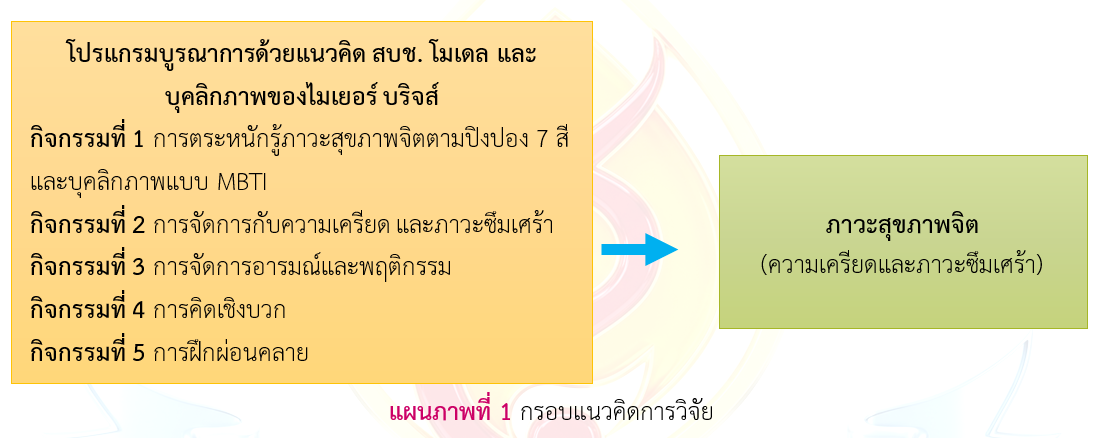
ภาวะสุขภาพจิตมีความสัมพันธ์กับบุคลิกภาพและการปรับตัวของนักศึกษาในการเรียนและการใช้ชีวิต การส่งเสริมการตระหนักรู้บุคลิกภาพด้วยแนวคิดบุคลิกภาพของไมเยอร์ บริจส์ ร่วมกับ สบช.โมเดล อาจช่วยลดความเครียด และภาวะซึมเศร้าได้ การวิจัยนี้เป็นการวิจัยกึ่งทดลองแบบ 2 กลุ่ม วัดผลก่อนและหลังการทดลอง มีวัตถุประสงค์ เพื่อศึกษาผลของโปรแกรมบูรณาการด้วยแนวคิด สบช. โมเดล และบุคลิกภาพของไมเยอร์ บริจส์ ต่อภาวะสุขภาพจิตของนักศึกษา กลุ่มตัวอย่างคือ นักศึกษาพยาบาลชั้นปีที่ 1 จำนวน 42 คน แบ่งเป็นกลุ่มทดลองและกลุ่มควบคุมโดยการจับคู่ตาม เพศ อายุ คะแนนเฉลี่ย รายได้ และการได้รับความรู้เกี่ยวกับภาวะสุขภาพจิต แล้วสุ่มเลขคี่-คู่ กลุ่มละ 21 คน กลุ่มทดลองเข้าโปรแกรมบูรณาการเป็นระยะเวลา 2 สัปดาห์ จำนวน 5 ครั้งๆละ 120 นาทีและได้รับข้อมูลการดูแลสุขภาพจิตตามปกติ กลุ่มควบคุมได้รับข้อมูลการดูแลสุขภาพจิตตามปกติ เครื่องมือวิจัย ประกอบด้วย โปรแกรมบูรณาการ มีค่าความตรงของเนื้อหาเท่ากับ 0.67-1.00 แบบประเมินความเครียดและแบบประเมินภาวะซึมเศร้า มีค่าความเชื่อมั่นสัมประสิทธิ์แอลฟาของครอนบาค เท่ากับ .84 และ .85 ตามลำดับ การวิเคราะห์ข้อมูลด้วยสถิติเชิงพรรณนา การทดสอบทีแบบอิสระและแบบจับคู่ ผลการศึกษา พบว่า หลังการทดลอง กลุ่มทดลองมีคะแนนเฉลี่ยภาวะซึมเศร้าต่ำกว่าก่อนการทดลองอย่างมีนัยสำคัญทางสถิติ (t=4.23, p<.001) ขณะที่กลุ่มควบคุมไม่พบการเปลี่ยนแปลงของคะแนนภาวะซึมเศร้าอย่างมีนัยสำคัญทางสถิติ (t=1.59, p>.05) และเมื่อเปรียบเทียบหลังการทดลอง ไม่พบความแตกต่างอย่างมีนัยสำคัญระหว่างกลุ่มหลังการทดลอง นอกจากนี้คะแนนเฉลี่ยความเครียดของกลุ่มทดลองไม่พบความแตกต่างอย่างมีนัยสำคัญทางสถิติ ผลการวิจัยชี้ให้เห็นว่าโปรแกรมบูรณาการอาจช่วยลดภาวะซึมเศร้าในกลุ่มทดลองได้ในระดับหนึ่ง แต่ไม่แสดงประสิทธิผลในกลุ่มควบคุมที่ชัดเจน จึงควรเพิ่มกิจกรรมลดความเครียดที่เน้นทักษะการเผชิญปัญหาที่เน้นปัญหา และระยะเวลาในการทดลองในการศึกษาครั้งต่อไป
เอกสารอ้างอิง
Anusaksathien, K. (2024). A study of the relationship between stress and mental health of students at Naresuan University during the spread of the COVID-19. Journal of Social Sciences Naresuan University, 20(1), 33–58. https://doi.org/10.69650/jssnu.2024.263312 (in Thai)
Bundasak, T., Tantisuwichwong, S., Jangasem, N., Sosome, B., Chaichanarungruang, W., & Kwansomkid, S. (2022). Effects of life skills training program on mental health status of nursing students. Princess of Naradhiwas University Journal, 14(2), 77-94. https://li01.tci-thaijo.org/index.php/pnujr/article/view/249344 (in Thai)
Charoensuk, S. & Mokekhaow, K. (2025). The Effect of caring with “7-Color Ping-Pong Program” on depression of nursing students. The Journal of Psychiatric Nursing and Mental Health, 39(3), 64-78. (in Thai)
Jacob, U. S., & Maguvhe, M. O. (2026). Global prevalence of depression among university students: A systematic literature review. Frontiers in Education. https://doi.org/10.3389/feduc.2026.1809441
Jung, C. G. (1971). Psychological types (H. G. Baynes, Trans., Rev. ed.). Princeton University Press.
Krirkgulthorn, T., Umereweneza, S., Seetangkham, S., Boonprothum, K., Phaonoi, B., Doungsuriya, P., & Phongsakchat, P. (2019). Opinions of selected Thai nursing students on factors contributing to their academic and clinical stress. Veridian E-Journal, Silpakorn University (Humanities, Social Sciences and Arts), 12(6), 2591–2608. https://he02.tci-thaijo.org/index.php/Veridian-E-Journal/article/view/198286
Lazarus, R. S., & Folkman, S. (1984). Stress, appraisal, and coping. Springer Publishing Company.
Li, Y.-S., Tseng, H.-C., Yang, B.-H., Mills, M. E. C., & Yu, W.-P. (2025). Personality preferences and stress perception among nursing students in different nursing programmes: A cross-sectional study. BMC Medical Education, 25, 382. https://doi.org/10.1186/s12909-025-06960-y
Liangruenrom, N., Joshanloo, M., Hutaphat, W., & Kittisuksathit, S. (2025). Prevalence and correlates of depression among Thai university students: nationwide study. BJPsych Open, 11(2), e59. https://doi.org/10.1192/bjo.2025.21
Lynn, M. R. (1986). Determination and quantification of content validity. Nursing Research, 35(6), 382–385. https://doi.org/10.1097/00006199-198611000-00017
Mahatnirunkul, S., Pumpaisalchai, W., & Tapanya, P. (1997). The construction of Suanprung Stress Test for Thai population. Suanprung Journal, 13(3), 1–20. (in Thai)
Mahayosanan, P., Tapinta, D., & Kitsumban, V. (2020). Effect of positive self-talk training program on depression among chronically ill adolescent patients. Kuakarun Journal of Nursing, 27(1), 34-45. (in Thai)
McEwen, B. S., & Akil, H. (2020). Revisiting the stress concept: Implications for affective disorders. The Journal of Neuroscience, 40(1), 12–21. https://doi.org/10.1523/JNEUROSCI.0733-19.2019
Mokekhaow, K., Sukrapat, W. & Promla, W. (2024). Factors related to stress of nursing students. Journal of Nursing Science & Health, 44(2), 60-71. https://he01.tci-thaijo.org/index.php/nah/article/view/245496 (in Thai)
Myers, I. B., McCaulley, M. H., Quenk, N. L., & Hammer, A. L. (1998). MBTI Manual: A Guide to the Development and Use of the Myers-Briggs Type Indicator (3rd ed.). Consulting Psychologists Press.
Praboromarajchanok Institute. (n.d.). Praboromarajchanok Institute model (PBRI model). https://eng.pbri.ac.th/
Russell, G., & Lightman, S. (2019). The human stress response. Nature Reviews Endocrinology, 15(9), 525–534. https://doi.org/10.1038/s41574-019-0228-0
Saengnoi-on, N., Pornnopparat, S., & Rattanawongkae, A. (2024). A study of health, introvert and extrovert personality types, adversity quotient, and emotional intelligence of students at private schools in Bangkok. Journal of Psychology, 22(1), 77–94. (in Thai)
Srioad, P., Thoin, P., & Kunjeak, S. (2025). The effects of a stress management program on stress levels of first-year nursing students, Boromarajonani College of Nursing, Khon Kaen. Medical Journal of Sakon Nakhon Hospital, 28(2), 39–47. https://he05.tci-thaijo.org/index.php/JSakonNakHosp/article/view/6257he05.tci-thaijo
Tienthavorn, V. (2013). Surveillance, control and prevention system of diabetes mellitus and hypertension in Thailand: Policy to action (3rd ed.). The Ministry of Public Health. (In Thai)
World Health Organization. (2024). Mental health: strengthening our response. https://www.who.int/news-room/fact-sheets/detail/mental-health-strengthening-our-response
ดาวน์โหลด
เผยแพร่แล้ว
รูปแบบการอ้างอิง
ฉบับ
ประเภทบทความ
สัญญาอนุญาต
ลิขสิทธิ์ (c) 2026 วารสารวิจัยการพยาบาลและสุขภาพ

อนุญาตภายใต้เงื่อนไข Creative Commons Attribution-NonCommercial-NoDerivatives 4.0 International License.

