
ประสิทธิผลของโปรแกรมการเสริมสร้างความแข็งแกร่งในชีวิตต่อความเครียด ความสุข และคุณภาพชีวิตของผู้สูงอายุในชมรมผู้สูงอายุ
คำสำคัญ:
การสร้างเสริมความแข็งแกร่งในชีวิต, ความเครียด, ความสุข, คุณภาพชีวิต, ชมรมผู้สูงอายุบทคัดย่อ
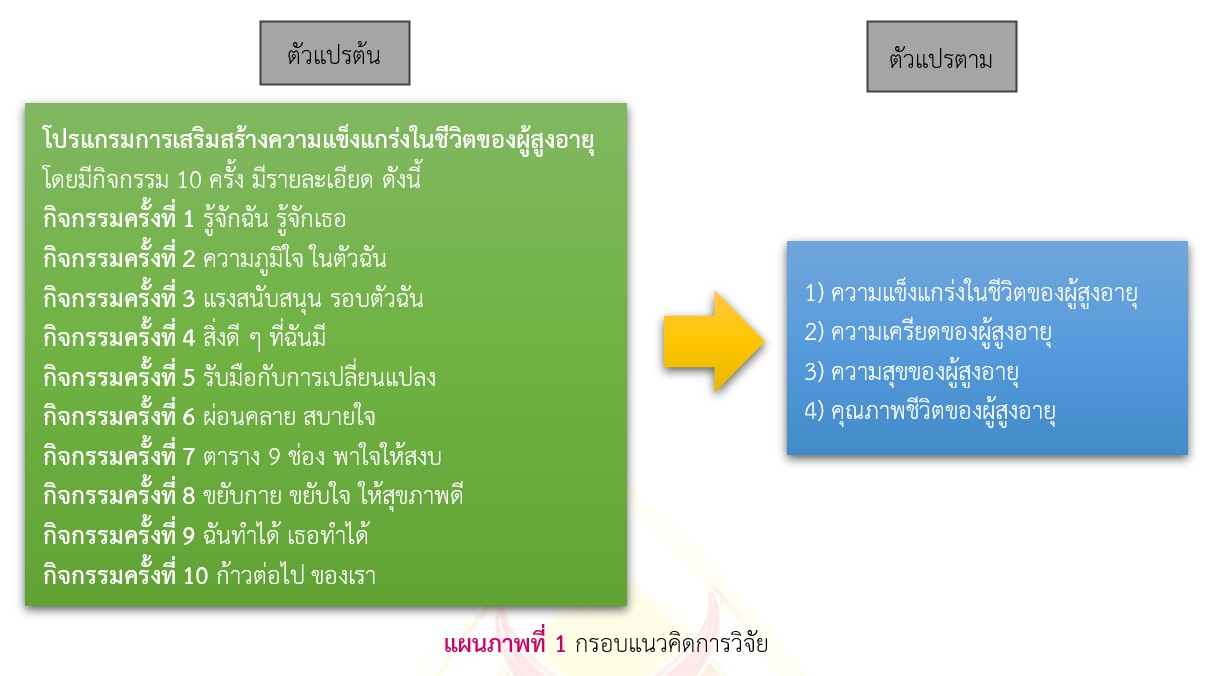
การเสริมสร้างความแข็งแกร่งในชีวิตของผู้สูงอายุทั้ง 3 องค์ประกอบ คือ ฉันเป็น ฉันมี และฉันสามารถสามารถช่วยให้ผู้สูงอายุปรับตัวต่อการเปลี่ยนแปลง ใช้ชีวิตได้อย่างมีความสุข และมีคุณภาพชีวิตที่ดี การศึกษาครั้งนี้เป็นการวิจัยกึ่งทดลอง แบบ 2 กลุ่ม วัดก่อนและหลังการทดลอง มีวัตถุประสงค์เพื่อเปรียบเทียบคะแนนเฉลี่ยความแข็งแกร่งในชีวิต ความเครียด ความสุข และคุณภาพชีวิตของผู้สูงอายุในชมรมผู้สูงอายุระหว่างก่อนและหลังการทดลองของกลุ่มทดลอง และระหว่างกลุ่มทดลองและกลุ่มควบคุม กลุ่มทดลอง คือ ผู้สูงอายุในชมรมผู้สูงอายุ
บ้านดอนโตนด และกลุ่มควบคุม คือ ผู้สูงอายุในชมรมผู้สูงอายุการะเกด กลุ่มละ 56 คน เครื่องมือดำเนินการวิจัย คือ โปรแกรมการสร้างเสริมความแข็งแกร่งในชีวิตของผู้สูงอายุ จำนวน 10 ครั้ง ๆ ละ 120 นาที ระยะเวลา 5 สัปดาห์ เครื่องมือเก็บรวบรวมข้อมูล คือ 1) แบบประเมินความแข็งแกร่งในชีวิต 2) แบบประเมินความเครียด 3) แบบประเมินดัชนีชี้วัดความสุขคนไทย และ 4) แบบวัดคุณภาพชีวิตผู้สูงอายุ ค่าความเชื่อมั่นสัมประสิทธิ์แอลฟาของครอนบาคของแบบประเมิน เท่ากับ .83 .85 .83 และ .87 ตามลำดับ วิเคราะห์ข้อมูลด้วยสถิติ การทดสอบค่าทีแบบจับคู่ และการวิเคราะห์ความแปรปรวนร่วม ผลการศึกษา พบว่า คะแนนเฉลี่ยความแข็งแกร่งในชีวิต ความสุข และคุณภาพชีวิตของผู้สูงอายุของกลุ่มทดลองหลังการทดลองสูงกว่าก่อนการทดลอง และสูงกว่ากลุ่มควบคุมอย่างมีนัยสำคัญทางสถิติ (p<.001) และคะแนนเฉลี่ยความเครียดของผู้สูงอายุของกลุ่มทดลองหลังการทดลองต่ำกว่าก่อนการทดลอง และต่ำกว่ากลุ่มควบคุมอย่างมีนัยสำคัญทางสถิติ (p<.001) ดังนั้นโปรแกรมการเสริมสร้างความแข็งแกร่งในชีวิตของผู้สูงอายุมีผลทำให้ผู้สูงอายุสามารถรับมือกับความเครียดได้ดี มีความสุข และมีคุณภาพชีวิตที่ดี หน่วยงานที่เกี่ยวข้องสามารถนำโปรแกรมไปประยุกต์ใช้เพื่อเสริมสร้างความแข็งแกร่งในชีวิตของผู้สูงอายุในชมรมผู้สูงอายุอื่น ๆ ต่อไป
เอกสารอ้างอิง
Ananchaipattana, N., Pechkwang, D., & Glomjai, T. (2025). The relationships between resilience and stress among community-dwelling older adults. Journal of Nursing and Health Research, 26(1), https://he01.tci-thaijo.org/index.php/bcnpy/article/view/276301/187033 (in Thai)
Ban Don Tanod Subdistrict Health Promoting Hospital. (2023). Elderly health screening. [Assessment document of the Subdistrict Health Promoting Hospital]
Brinkhof, L.P., Huth, K.B.S., Murre, J.M.J., de Wit, S., Krugers, H.J., & Ridderinkhof, K.R. (2021). The interplay between quality of life and resilience factors in later life: A network analysis. Frontiers in Psychology,12. https://doi.org/10.3389/fpsyg.2021.752564
Chaosuansreecharoen, R.K., Chaosuansreecharoen, P., & Kongsanit, S. (2019). Effectiveness of resilience-enhancing program in elderly residents at Ban Sritang Nursing Home. Nursing Journal of the Ministry of Public Health, 29(1), 32-47. https://he02.tci-thaijo.org/index.php/tnaph/article/view/187174/132465 (in Thai)
Chaosuansreecharoen, R.K., Chaosuansreecharoen, P., & Kongsanit, S. (2019). Predicting factors of resilience among the elderly residents of nursing home in Southern Thailand. Journal of Mental Health of Thailand, 27(2), 65-79. https://he01.tci-thaijo.org/index.php/jmht/article/view/204038/142235 (in Thai)
Choeithim, A., Prasertsuk, N. & Kerdnaimongkol, U. (2018). The happiness of the elderly in the elderly club, Bangkok. Integrated Social Science Journal, 5(1), 85-108. https://so02.tci-thaijo.org/index.php/isshmu/article/view/153968/112088 (in Thai)
Faul, F., Erdfelder, E., Lang, A. G. & Buchner A. (2007). G*Power 3: a flexible statistical power analysis program for the social, behavioral, and biomedical sciences. Behavior Research Methods, 39(2), 175-199. https://link.springer.com/article/10.3758/BF03193146
Foundation of Thai Gerontology Research and Development Institute. (2022). Situation of the Thai Older Persons 2022. https://thaitgri.org/?p=40208 (in Thai)
Grotberg, E. H. (1997). The international resilience project: Findings from the research and the effectiveness of interventions. https://files.eric.ed.gov/fulltext/ED419584.pdf
Itprasert, S. (2017). Quality of life of the elderly in Klaeng Kachet municipality, Mueang district, Rayong province. [Master of Public Administration]. Burapha University]. https://buuir.buu.ac.th/bitstream/1234567890/6229/1/Fulltext.pdf (in Thai)
Jamfa, W., Chumpeeruang, S., & Wanchulee, O. (2024). Factors influencing the resilience among elderly individuals living in Muang Nakhon Sawan Province. Journal of Nurses Association of Thailand Northern Office, 30(1), 97-114. https://he01.tci-thaijo.org/index.php/jnorthnurse/article/view/270996/183217 (in Thai)
Kaspichayawattana, J., Viwatvanich, S., Srisuk, A., & Jetmanoram, S. (2018). Learning to understand the elderly. Yuenyong Press. https://www.nurs.chula.ac.th/images/2019/announcement/%E0%B8%84%E0%B8%A1%E0%B8%AD%E0%B9%80%E0%B8%A3%E0%B8%A2%E0%B8%99%E0%B8%A3%E0%B9%80%E0%B8%82%E0%B8%B2%E0%B9%83%E0%B8%88%E0%B8%A7%E0%B8%A2%E0%B8%AA%E0%B8%87%E0%B8%AD%E0%B8%B2%E0%B8%A2.pdf (in Thai)
MacLeod, S., Musich, S., Hawkins, K., Alsgaard, K., & Wicker, E.R. (2016). The impact of resilience among older adults. Geriatric Nursing, 37, 266-272. https://doi.org/10.1016/j.gerinurse.2016.02.014
Mahattanirunkul, S., Pumphaisanchai, W., & Tapanya, P. (1997). The development of the Suanprung stress test. Academic Psychiatry and Psychology Journal, 13(3), 1-20. https://he01.tci-thaijo.org/index.php/APPJ/article/view/90246 (in Thai)
Mongkol, A., Huttapanom, W., Chetchotisakd, P., Chalookul, W., Punyoyai, L., & Suvanashiep, S. (2001). The study to develop Thai mental health indicator. Journal of the Psychiatric Association of Thailand, 46(3), 209-225. https://www.psychiatry.or.th/JOURNAL/463/v4635.htm (in Thai)
Official Statistics Registration Systems. (2021). Population of Nakhon Si Thammarat Province. https://stat.bora.dopa.go.th/stat/statnew/statMONTH/statmonth (in Thai)
Photipim, M., Pholsripradit, P. Bonyaphagorn, S., Bonyaphagorn, J. Ketbumroong, V., Norkaew, J., Sungwalee, W., & Chavengkun, W. (2021). Effect of resilience-enhancing program on resilience quotient among older dults, Nakhon Ratchasima Province. Journal of Vongchavalitkul University, 34(2), 30-43. https://sutlib2.sut.ac.th/nakhonchaiburin/nm177404.pdf (in Thai)
Ratanasiripong, P., Ratanasiripong, N., Khamwong, M., Jingmark, S., Thaniwattananon, P., & Pisaipan, P. (2021). The impact of resiliency on mental health and quality of life among older adults in Thailand. Journal of Health Research, 36(5), 908-918. https://doi.org/10.1108/JHR-02-2021-0099
Sangon, S., Nintachan, P., & Thaweekoon, T. (2018). Resilience and depression of people in a community in Prathumthani Province. The Journal of Psychiatric Nursing and Mental Health, 32(2), 84-99. https://he02.tci-thaijo.org/index.php/JPNMH/article/view/1372 (in Thai)
Sanitlou, N., Sartphet, W., & Naphaarrak, Y. (2019). Sample size calculation using GPower program. Journal of Suvarnabhumi Institute of Technology (Humanities and Social Sciences), 5(1), 496-507. https://so04.tci-thaijo.org/index.php/svittj/article/view/181958/136948 (in Thai)
The Senior Citizens Council of Thailand. (2016). Senior citizens' club handbook. Department of Older Persons. https://www.dop.go.th/download/knowledge/knowledge_th_20161706104732_1.pdf (in Thai)
Thongkhum, K., Peungposop, N., & Sakunpong, N. (2021). Resilience in the elderly: Concept and approaches to promoting resilience. The Journal of Faculty of Nursing Burapha University, 29(1), 105-116. https://he02.tci-thaijo.org/index.php/Nubuu/article/view/250260/170115 (In Thai)
ดาวน์โหลด
เผยแพร่แล้ว
รูปแบบการอ้างอิง
ฉบับ
ประเภทบทความ
สัญญาอนุญาต
ลิขสิทธิ์ (c) 2026 วารสารวิจัยการพยาบาลและสุขภาพ

อนุญาตภายใต้เงื่อนไข Creative Commons Attribution-NonCommercial-NoDerivatives 4.0 International License.

