
ผลของโปรแกรมสร้างเสริมสุขภาพต่อพฤติกรรมการป้องกันโรคเบาหวานของกลุ่มเสี่ยงโรคเบาหวานในโรงพยาบาลส่งเสริมสุขภาพตำบล
คำสำคัญ:
การเสริมสร้างพลังอำนาจ, กลุ่มเสี่ยงโรคเบาหวาน, โปรแกรมการสร้างเสริมสุขภาพ, พฤติกรรมการป้องกันโรคเบาหวานบทคัดย่อ
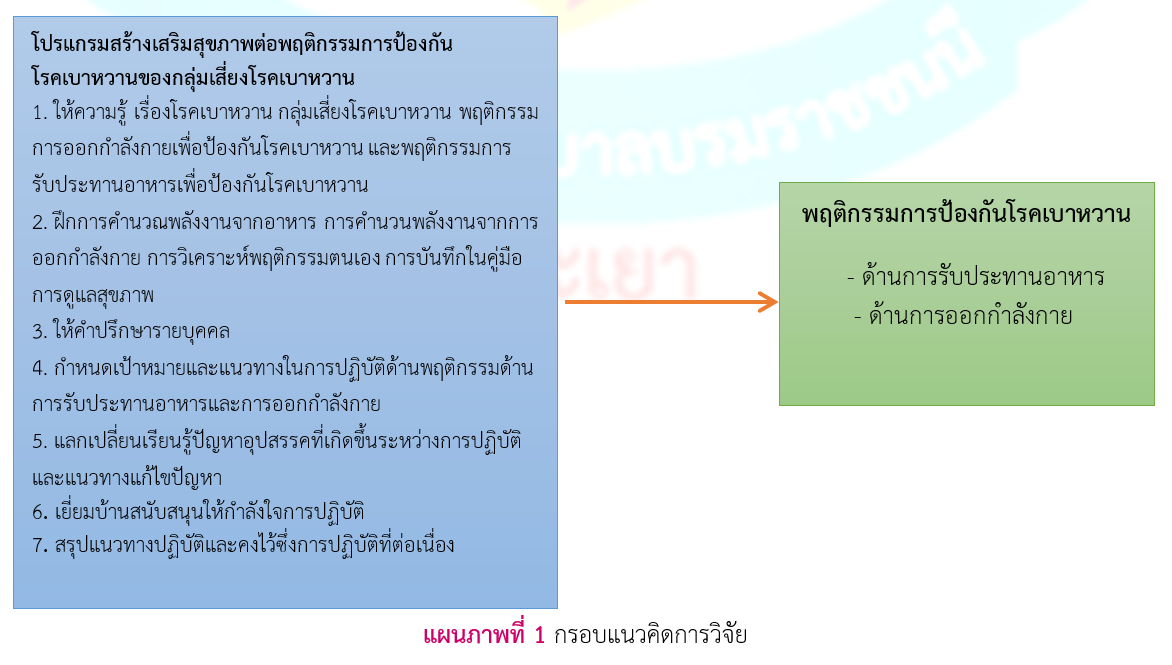
โรคเบาหวานเป็นปัญหาสาธารณสุขที่มีอัตราเพิ่มสูงขึ้นทุกปีโดยเฉพาะในช่วงวัยรุ่นและวัยทำงานที่มีพฤติกรรมสุขภาพที่ไม่เหมาะสม การวิจัยกึ่งทดลองแบบสองกลุ่มวัดผลก่อนและหลังการทดลอง มีวัตถุประสงค์เพื่อเปรียบเทียบพฤติกรรมการป้องกันโรคเบาหวานของกลุ่มเสี่ยงโรคเบาหวาน โรงพยาบาลส่งเสริมสุขภาพ ตำบลหาดกรวด อำเภอเมือง จังหวัดอุตรดิตถ์ ก่อนและหลังได้รับโปรแกรมสร้างเสริมสุขภาพ โดยประยุกต์ใช้แนวคิดการเสริมสร้างพลังอำนาจ ของกิ๊บสัน กลุ่มตัวอย่างคือประชากรกลุ่มเสี่ยงโรคเบาหวานในตำบลหาดกรวด อายุ 35 ปีขึ้นไป ทั้งหมด 70 คน แบ่งเป็น กลุ่มทดลองและกลุ่มควบคุม กลุ่มละ 35 คน เครื่องมือที่ใช้ในการวิจัย ประกอบด้วย โปรแกรมสร้างเสริมสุขภาพร่วมกับการประยุกต์ใช้แนวคิดการเสริมสร้างพลังอำนาจจำนวน 6 ครั้ง ระยะเวลา 8 สัปดาห์ กิจกรรมประกอบด้วย การให้ความรู้ การฝึกคำนวณพลังงานจากอาหาร การออกกำลังกาย ให้คำปรึกษารายบุคคล กำหนดเป้าหมายและแนวทางปรับพฤติกรรมตนเอง แลกเปลี่ยนเรียนรู้ และการเยี่ยมบ้าน กลุ่มควบคุมได้รับการดูแลสุขภาพตามปกติ และแบบสอบถามพฤติกรรมการป้องกันโรคเบาหวานด้านการรับประทานอาหารและด้านการออกกำลังกาย ตรวจสอบคุณภาพเครื่องมือมีค่าสัมประสิทธิ์แอลฟ่าของครอนบาค เท่ากัน คือ .81 วิเคราะห์ข้อมูลด้วยสถิตเชิงพรรณนา และสถิติการทดสอบค่าทีคู่และทีอิสระ ผลการศึกษา พบว่า ภายหลังการทดลองกลุ่มทดลองมีคะแนนเฉลี่ยด้านการออกกำลังกาย (t= 2.94, p<0.05) และด้านการรับประทานอาหาร (t= 2.08, p<0.05) สูงกว่าก่อนทดลอง อย่างมีนัยสำคัญทางสถิติ อย่างไรก็ตามเมื่อเปรียบเทียบระหว่างกลุ่มทดลองและกลุ่มควบคุม พบว่า คะแนนเฉลี่ยพฤติกรรมสุขภาพทั้งสองด้านไม่มีความแตกต่างกันอย่างมีนัยสำคัญทางสถิติ (p>.05) โปรแกรมสร้างเสริมสุขภาพ ส่งผลทำให้พฤติกรรมการป้องกันโรคเบาหวานด้านการรับประทานอาหารและการออกกำลังกายในกลุ่มเสี่ยงโรคเบาหวานดีขึ้น บุคลากรสุขภาพสามารถนำโปรแกรมนี้ไปประยุกต์ใช้กับกลุ่มเสี่ยงโรคเบาหวานที่เหมาะสมต่อไป
เอกสารอ้างอิง
Bureau of Policy and Strategy, Office of the Permanent Secretary, Ministry of Public Health. (2021). Key statistics 2020. War Veterans Organization Printing House (in Thai)
Petch, R. (2025). Currently, approximately 6.1 million Thais have diabetes. Diabetes is becoming more common among working-age and younger people. World Diabetes Day 2025, Diabetes Association of Thailand. https://www.dmthai.org/new/index.php/activities-and-news/diabetes-day/khxkhid-neuxng-ni-wan-bea-hwan-lok-2568 (in Thai)
Gibson, C. H. (1991). A concept analysis of empowerment. Journal of Advanced Nursing, 16(3), 354–361. https://doi.org/10.1111/j.1365-2648.1991.tb01660.x
Had Kluad Subdistrict Health Promoting Hospital. (2023). Annual report fiscal year 2023 [Annual report]. Had Kluad Subdistrict Health Promoting Hospital. (in Thai)
International Diabetes Federation. (2025). International Diabetes Federation: World Diabetes Congress 2025, Bangkok. https://idf2025.org/
Kiatpao, R. (2015). Outcomes of health behavior modification program toward risk reduction for hypertension and diabetes mellitus among population at risk, Thapthan Districts, Uthaithani Province. Journal of Health Science, 24(3), 405–412. https://thaidj.org/index.php/JHS/article/download/461/411/427 (in Thai)
Leumthong, S. (2023). The effectiveness of the health promotion program to self-care behaviors and decreasing blood sugar level among pre-diabetes peoples in Wiang sub-district, Chiang Saen district, Chiang Rai. Journal of Science and Technology Northern, 4(4), 14–25. https://he03.tci-thaijo.org/index.php/scintc/article/view/2064 (in Thai)
MeeYam, K. (2018). Effects of health promotion program in risk factors to metabolic syndrome among navy in sattahip district chonburi province. Burapha University. https://buuir.buu.ac.th/bitstream/1234567890/8815/1/56910081.pdf (in Thai)
Ngoichansri, J. (2024). Effectiveness of the health promotion program according to the principles of 3A. 2S. in the elderly at risk for diabetes in behavior change. Primary Care Unit Muang Sukkasem Community Health Center Sakon Nakhon Hospital. Journal of Environmental Health and Community Health, 9(7), 333–345. https:// thaijo.org/index.php/ech/article/view/2748 (in Thai)
Patcharawan, J., Petcharut, S., Chatlada, D .(2020). Development and validation of a health promotion program for diabetes prevention in high-risk elderly. Journal of the Office of disease prevention and control,7 Khon kaen, 27(1), 52-62. https://flas.reru.ac.th/instructor/research/64a64f085cc08PATCHARAWAN_JANPECH_001.PDF.pdf (in Thai)
Rogers, R.W. (1983). Cognitive and physiological processes in fear appeals and attitude change: A revised theory of protection motivation. In J. Cacioppo & R. Petty (Eds.), Social Psychophysiology. Guilford Press.
Thangthum, W., Khunatpakorn, M., Phongphan, P., & Wasana, P. (2023). The effect of the disease prevention enhancement program which applied protection motivation theory on disease prevention behaviors in people at risk of diabetes: Case study. Journal of Roi Kaensarn Academi, 8(7), 211–224. https://so02.tci-thaijo.org/index.php/JRKSA/article/download/264094/176848/1045810 (in Thai)
Thongsuk, W. (2019). Effects of the empowerment program on health behaviors, body mass index and blood pressure level in uncontrolled hypertension. Nursing Journal volume, 47(4) ,229-241. https://he02.tci-thaijo.org/index.php/cmunursing/article/view/243083 (in Thai)
ดาวน์โหลด
เผยแพร่แล้ว
รูปแบบการอ้างอิง
ฉบับ
ประเภทบทความ
สัญญาอนุญาต
ลิขสิทธิ์ (c) 2026 วารสารวิจัยการพยาบาลและสุขภาพ

อนุญาตภายใต้เงื่อนไข Creative Commons Attribution-NonCommercial-NoDerivatives 4.0 International License.

