
ผลของโปรแกรมส่งเสริมการเรียนรู้ด้วยการเล่นบทบาทสมมติต่อพัฒนาการ ด้านการคิดเชิงบริหารของเด็กปฐมวัย
คำสำคัญ:
การคิดเชิงบริหาร, เด็กปฐมวัย, การเล่นบทบาทสมมติ, โปรแกรมส่งเสริมการเรียนรู้บทคัดย่อ
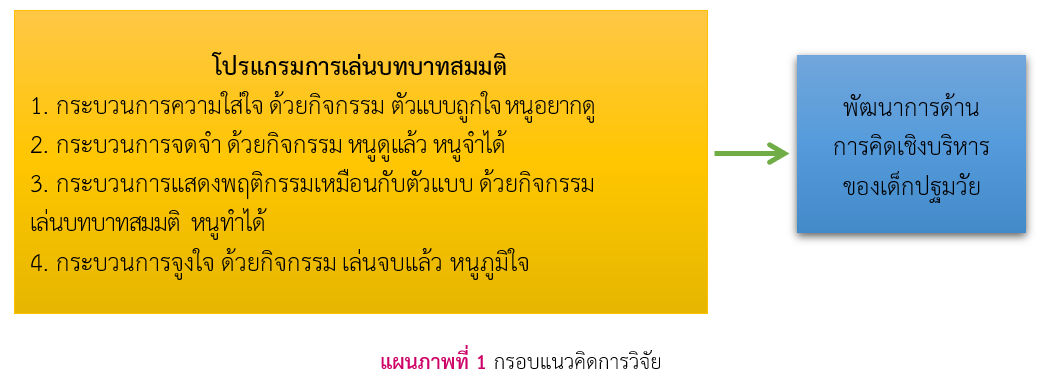
เด็กปฐมวัยเป็นช่วงวัยที่ควรได้รับการส่งเสริมพัฒนาการด้านการคิดเชิงบริหาร เนื่องจากพบว่าเด็กปฐมวัยในประเทศไทยมีพัฒนาการด้านการคิดเชิงบริหารต่ำกว่าเกณฑ์เฉลี่ย ส่งผลให้เด็กปฐมวัยไม่สามารถกำกับตนเองให้ไปสู่ความสำเร็จได้ การวิจัยแบบกึ่งทดลองแบบสองกลุ่มวัดผลก่อนและหลังการทดลองครั้งนี้ มีวัตถุประสงค์เพื่อศึกษาผลของโปรแกรมส่งเสริมการเรียนรู้ด้วยการเล่นบทบาทสมมติต่อพัฒนาการด้านการคิดเชิงบริหารของเด็กปฐมวัย โดยใช้กรอบแนวคิดจากทฤษฎีการเรียนรู้ทางปัญญาสังคมของแบนดูรา กลุ่มตัวอย่างคือเด็กปฐมวัยอายุ 4–5 ปี ชั้นอนุบาล 2 จำนวน 30 ราย แบ่งเป็นกลุ่มทดลองและกลุ่มควบคุม กลุ่มละ 15 ราย เครื่องมือวิจัยประกอบด้วย โปรแกรมส่งเสริมการเรียนรู้ด้วยการเล่นบทบาทสมมติ มีระยะเวลา 5 สัปดาห์ ค่าความตรงตามเนื้อหาเท่ากับ 1 และแบบประเมินพัฒนาการด้านการคิดเชิงบริหาร ในเด็กวัยก่อนเรียน มีค่าความเชื่อมั่นของเครื่องมือสัมประสิทธิ์แอลฟาของครอนบาค เท่ากับ .77 วิเคราะห์ข้อมูลโดยใช้สถิติเชิงพรรณนา การทดสอบทีอิสระ เพื่อเปรียบเทียบคะแนนเฉลี่ยพัฒนาการด้านการคิดเชิงบริหาร สถิติทดสอบไคสแควร์และสถิติการทดสอบฟิชเชอร์ เพื่อเปรียบเทียบข้อมูลทั่วไปของเด็กปฐมวัยและผู้ดูแลหลักของเด็กปฐมวัย ผลการวิจัย พบว่า หลังได้รับโปรแกรมกลุ่มทดลองมีคะแนนเฉลี่ยพัฒนาการด้านการคิดเชิงบริหาร สูงกว่าก่อนทดลอง (d=1.41, t=10.67, p<.001) และสูงกว่ากลุ่มควบคุม อย่างมีนัยสำคัญทางสถิติ (d=1.46, t=3.86, p<.001) ดังนั้น โปรแกรมส่งเสริมการเรียนรู้ด้วยการเล่นบทบาทสมมติสามารถนำไปใช้ในการส่งเสริมพัฒนาการด้านการคิดเชิงบริหารในเด็กปฐมวัยได้
เอกสารอ้างอิง
Academic and Research Support Group, Bureau of Health Promotion, Department of Health. (2018). To study the 6th of factors effecting to child development in Thailand in 2017. Nonthaburi: Academic and Research Support Group, Bureau of Health Promotion, Department of Health. http://203.157.71.148/data/cluster/mom/download/KMDenver60.pdf (in Thai)
Arpasuwan, K., Natchanan, C., and Narumon, T. (2024). Predictors of maternal behaviors on promoting executive function in preschool children. The Journal of Faculty of
Nursing Burapha University, 32(1), 26–37. https://he02.tci-thaijo.org/index.php/Nubuu/article/view/266844 (in Thai)
Bandura, A. (1986). Social Foundations of Thought and Action: A Social Cognitive Theory. Prentice Hall.
Barnes, Z. T., McDorman, M., & Romeo, R. (2025). Parent education, not income-to-needs ratio, relates to preschool home executive function environment. Journal of Experimental Child Psychology, 258, 106292. https://doi.org/10.1016/j.jecp.2025.106292
Berk, L. E., & Winsler, A. (1995). Scaffolding children's learning: Vygotsky and early childhood education. National Association for the Education of Young Children.
Bruner, J. S. (1966). Toward a theory of instruction. Harvard University Press.
Center on the Developing Child, Harvard University. (2015). Enhancing and practicing executive function skills with children from infancy to adolescence. https://children.wi.gov/Documents/Harvard%20Parenting%20Resource.pdf
Chainat Primary Educational Service Area Office. (2023). Age data table (Academic year 2023, semester 2). https://amsscnt.com/bigdatacnt/tableAge.php?op=2.2&look=&year=2566-2 (in Thai)
Department of Health, Ministry of Public Health. (2021). Department of Health Annual report 2020. Aksorn Graphic and Design. https://backenddc.anamai.moph.go.th/coverpage/88efe38d72050a3f3dfca775bfd1f16b.pdf (in Thai)
Diamond, A., & Ling, D. S. (2020). Review of the evidence on, and fundamental questions about, efforts to improve executive functions, Including working memory. In J. M. Novick, M. F. Bunting, M. R. Dougherty, & R. W. Engle (Eds.), Cognitive and working memory training: Perspectives from psychology, neuroscience, and human development (pp. 143–431).Oxford University Press. https://doi.org/10.1093/oso/9780199974467.003.0008
Duangruetai, S., Apawan, N., Somsiri, R., and Nuanchan, C., (2019). Factors related to executive functions in preschool-aged children. Journal of Thailand Nursing and Midwifery Council, 34(4), 80–94. https://he02.tci-thaijo.org/index.php/TJONC/article/view/191264 (in Thai)
Jintana, P. and Wanwisa, K. (2018). The factors associated with early childhood development in Thailand 6th B.E.2560. https://km.anamai.moph.go.th/th/research2562/download?id=75681&mid=35276&mkey=m_document&lang=th&did=25222. (in Thai)
Jongjit, K. and Santi, W. (2024). Executive Functions Foundations of Early ChildhoodDevelopmentin the 21stCentury. Journal of Roi Kaensarn Academi, 9(7). 965-980. https://so02.tci-thaijo.org/index.php/JRKSA/article/view/268737/181180 (in Thai)
Mulder H., Verhagen J., Van der Ven S. H. G., Slot P. L. & Leseman P. P. M. (2017). Early Executive Function at Age Two Predicts Emergent Mathematics and Literacy at Age Five. Frontiers in Psychology. 8,1706. https://doi.org/10.3389/fpsyg.2017.01706
Nuanchan, C., Panadda, T., Orapin, L., & Nootchanart R. (2017). Development and standardization of executive function assessment tools in early childhood. Neuroscience Research Center, Institute of Molecular Biosciences, Mahidol University. https://kb.hsri.or.th/dspace/handle/11228/4650 (in Thai)
Natruja, T., Sukanlaya, S., &Chaweng, S. (2022). Effects of using role-playing activities to enhance the social behaviors of Kindergarteners in a Multicultural Classroom. Journal of education studies, 50(3), 1-12. https://digital.car.chula.ac.th/cgi/viewcontent.cgi?article=4035&context=educujournal (in Thai)
Polit, D. F., & Beck, C. T. (2004). Nursing research: Principles and methods (7th ed.). Lippincott Williams & Wilkins.
Thibodeau, R. B., Gilpin, A. T., Brown, M. M., & Meyer, B. A. (2016). The effects of fantastical pretend-play on the development of executive functions: An intervention study. Journal of Experimental Child Psychology, 145, 120–138. https://doi.org/10.1016/j.jecp.2016.01.001
White, R. E., & Carlson, S. M. (2021). Pretending with realistic and fantastical stories facilitates executive function in 3-year-old children. Journal of Experimental Child Psychology, 206, 105071. https://pubmed.ncbi.nlm.nih.gov/33684892/
Zyga, O. (2016). The act of pretending: play, executive function, and theory of mind in early childhood. [Master of Arts (Psychological Sciences)]. Case Western Reserve University. http://rave.ohiolink.edu/etdc/view?acc_num=case1467391080
ดาวน์โหลด
เผยแพร่แล้ว
รูปแบบการอ้างอิง
ฉบับ
ประเภทบทความ
สัญญาอนุญาต
ลิขสิทธิ์ (c) 2026 วารสารวิจัยการพยาบาลและสุขภาพ

อนุญาตภายใต้เงื่อนไข Creative Commons Attribution-NonCommercial-NoDerivatives 4.0 International License.

