
ปัจจัยที่มีความสัมพันธ์กับพฤติกรรมสุขภาพในการควบคุมความดันโลหิตของผู้สูงอายุโรคความดันโลหิตสูงชาวไทใหญ่
คำสำคัญ:
แบบแผนความเชื่อด้านสุขภาพ, พฤติกรรมสุขภาพในการควบคุมความดันโลหิต, โรคความดันโลหิตสูง, ผู้สูงอายุชาวไทใหญ่ (กลุ่มชาติพันธุ์)บทคัดย่อ
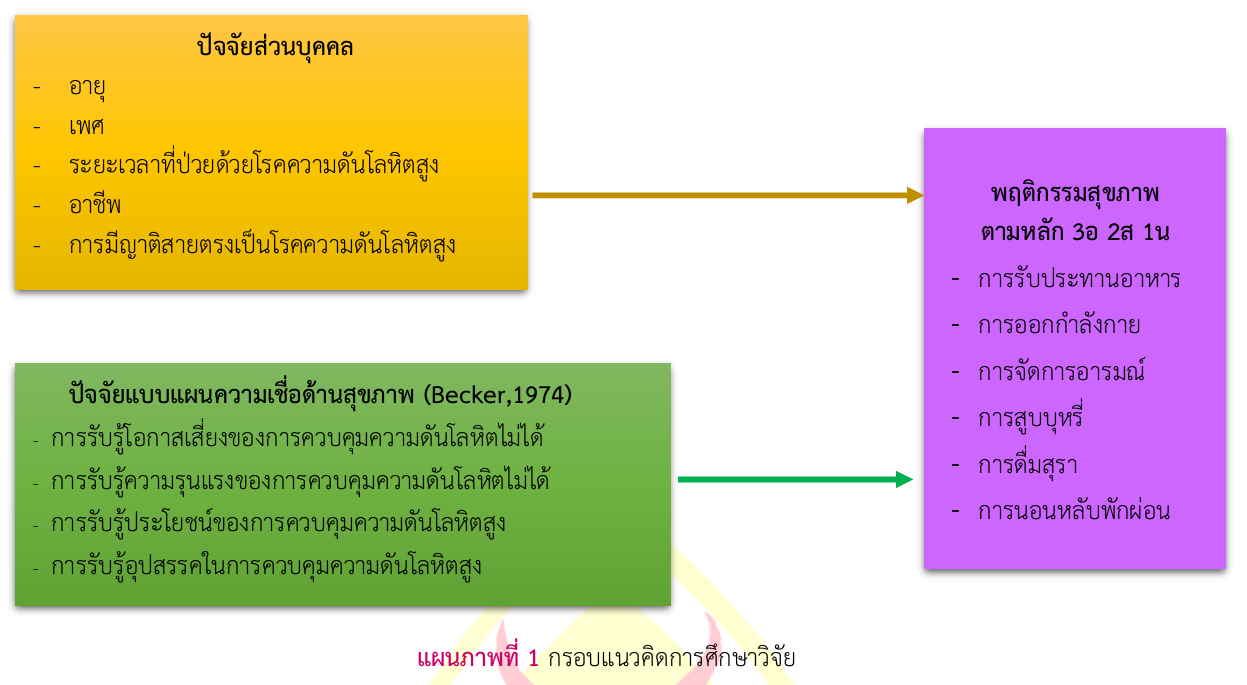
ความเชื่อด้านสุขภาพส่งผลต่อพฤติกรรมสุขภาพในการควบคุมความดันโลหิต การศึกษาเชิงพรรณนาแบบหาความสัมพันธ์นี้ มีวัตถุประสงค์เพื่อศึกษาพฤติกรรมสุขภาพในการควบคุมความดันโลหิตและศึกษาปัจจัยที่มีความสัมพันธ์กับพฤติกรรมสุขภาพในการควบคุมความดันโลหิตของผู้สูงอายุโรคความดันโลหิตสูงชาวไทใหญ่กลุ่มตัวอย่าง ได้แก่ ผู้สูงอายุโรคความดันโลหิตสูงชาวไทใหญ่ในเขตอำเภอเมือง จังหวัดแม่ฮ่องสอน 175 คน คัดเลือกจากการสุ่มแบบหลายขั้นตอน เครื่องมือที่ใช้เป็นแบบสัมภาษณ์ ได้แก่ ข้อมูลส่วนบุคคล ความเชื่อด้านสุขภาพ และพฤติกรรมสุขภาพในการควบคุมความดันโลหิต มีค่าความเชื่อมั่น เท่ากับ .97 และ .99 ตามลำดับ วิเคราะห์ข้อมูลด้วยสถิติเชิงพรรณนา สถิติสหสัมพันธ์แบบพอยท์ไบซีเรียล สถิติทดสอบหาค่าสัมประสิทธิ์สหสัมพันธ์อีต้า และสถิติสหสัมพันธ์ของเพียร์สัน ผลการศึกษา พบว่า พฤติกรรมสุขภาพในการควบคุมความดันโลหิตของผู้สูงอายุโรคความดันโลหิตสูงชาวไทใหญ่โดยรวมอยู่ในระดับดี (\bar{x}=45.79, SD=7.36) และ ปัจจัยด้านเพศหญิงและการมีญาติสายตรงป่วยด้วยโรคความดันโลหิต มีความสัมพันธ์ทางบวกกับพฤติกรรมสุขภาพในการควบคุมความดันโลหิตไม่ได้ อย่างมีนัยสำคัญทางสถิติ (rpb=.417, p<.01 และ rpb=.514, p<.01) ตามลำดับ และการรับรู้ตามแบบแผนความเชื่อด้านสุขภาพโดยรวม พบว่า มีความสัมพันธ์ทางบวกกับพฤติกรรมสุขภาพในการควบคุมความดันโลหิตไม่ได้ อย่างมีนัยสำคัญทางสถิติ (rpb=.443, p<.001) ผลการศึกษานี้สามารถนำไปใช้เป็นข้อมูลพื้นฐานสำหรับบุคลากรทางด้านสุขภาพเพื่อใช้ในการวางแผนส่งเสริมการรับรู้ตามแบบแผนความเชื่อด้านสุขภาพและพฤติกรรมสุขภาพในการควบคุมความดันโลหิตในผู้สูงอายุโรคความดันโลหิตสูงชาวไทใหญ่
เอกสารอ้างอิง
Bureau of Policy and Strategy, Office of the Permanent Secretary, Ministry of Public Health. (2021). Key statistics 2020. War Veterans Organization Printing House (in Thai)
Gibson, C. H. (1991). A concept analysis of empowerment. Journal of Advanced Nursing, 16(3), 354–361. https://doi.org/10.1111/j.1365-2648.1991.tb01660.x
Had Kluad Subdistrict Health Promoting Hospital. (2023). Annual report fiscal year 2023 [Annual report]. Had Kluad Subdistrict Health Promoting Hospital. (in Thai)
International Diabetes Federation. (2025). International Diabetes Federation: World Diabetes Congress 2025, Bangkok. https://idf2025.org/
Kiatpao, R. (2015). Outcomes of health behavior modification program toward risk reduction for hypertension and diabetes mellitus among population at risk, Thapthan Districts, Uthaithani Province. Journal of Health Science, 24(3), 405–412. https://thaidj.org/index.php/JHS/article/download/461/411/427 (in Thai)
Leumthong, S. (2023). The effectiveness of the health promotion program to self-care behaviors and decreasing blood sugar level among pre-diabetes peoples in Wiang sub-district, Chiang Saen district, Chiang Rai. Journal of Science and Technology Northern, 4(4), 14–25. https://he03.tci-thaijo.org/index.php/scintc/article/view/2064 (in Thai)
MeeYam, K. (2018). Effects of health promotion program in risk factors to metabolic syndrome among navy in sattahip district chonburi province. Burapha University. https://buuir.buu.ac.th/bitstream/1234567890/8815/1/56910081.pdf (in Thai)
Ngoichansri, J. (2024). Effectiveness of the health promotion program according to the principles of 3A. 2S. in the elderly at risk for diabetes in behavior change. Primary Care Unit Muang Sukkasem Community Health Center Sakon Nakhon Hospital. Journal of Environmental Health and Community Health, 9(7), 333–345. https:// thaijo.org/index.php/ech/article/view/2748 (in Thai)
Patcharawan, J., Petcharut, S., Chatlada, D .(2020). Development and validation of a health promotion program for diabetes prevention in high-risk elderly. Journal of the Office of disease prevention and control,7 Khon kaen, 27(1), 52-62. https://flas.reru.ac.th/instructor/research/64a64f085cc08PATCHARAWAN_JANPECH_001.PDF.pdf (in Thai)
Petch, R. (2025). Currently, approximately 6.1 million Thais have diabetes. Diabetes is becoming more common among working-age and younger people. World Diabetes Day 2025, Diabetes Association of Thailand. https://www.dmthai.org/new/index.php/activities-and-news/diabetes-day/khxkhid-neuxng-ni-wan-bea-hwan-lok-2568 (in Thai)
Rogers, R.W. (1983). Cognitive and physiological processes in fear appeals and attitude change: A revised theory of protection motivation. In J. Cacioppo & R. Petty (Eds.), Social Psychophysiology. Guilford Press.
Thangthum, W., Khunatpakorn, M., Phongphan, P., & Wasana, P. (2023). The effect of the disease prevention enhancement program which applied protection motivation theory on disease prevention behaviors in people at risk of diabetes: Case study. Journal of Roi Kaensarn Academi, 8(7), 211–224. https://so02.tci-thaijo.org/index.php/JRKSA/article/download/264094/176848/1045810 (in Thai)
Thongsuk, W. (2019). Effects of the empowerment program on health behaviors, body mass index and blood pressure level in uncontrolled hypertension. Nursing Journal volume, 47(4) ,229-241. https://he02.tci-thaijo.org/index.php/cmunursing/article/view/243083 (in Thai)
ดาวน์โหลด
เผยแพร่แล้ว
รูปแบบการอ้างอิง
ฉบับ
ประเภทบทความ
สัญญาอนุญาต
ลิขสิทธิ์ (c) 2026 วารสารวิจัยการพยาบาลและสุขภาพ

อนุญาตภายใต้เงื่อนไข Creative Commons Attribution-NonCommercial-NoDerivatives 4.0 International License.

