
ปัจจัยที่มีความสัมพันธ์กับคุณภาพชีวิตของผู้สูงอายุที่มีผลคัดกรองบ่งชี้ความบกพร่องทางการรู้คิดในศูนย์พัฒนาการจัดสวัสดิการสังคมผู้สูงอายุแห่งหนึ่ง: การวิจัยผสานวิธี
คำสำคัญ:
คุณภาพชีวิตผู้สูงอายุ, ผู้สูงอายุ, ภาวะบกพร่องทางการรู้คิด, ภาวะซึมเศร้า, กิจวัตรประจำวันขั้นพื้นฐานบทคัดย่อ
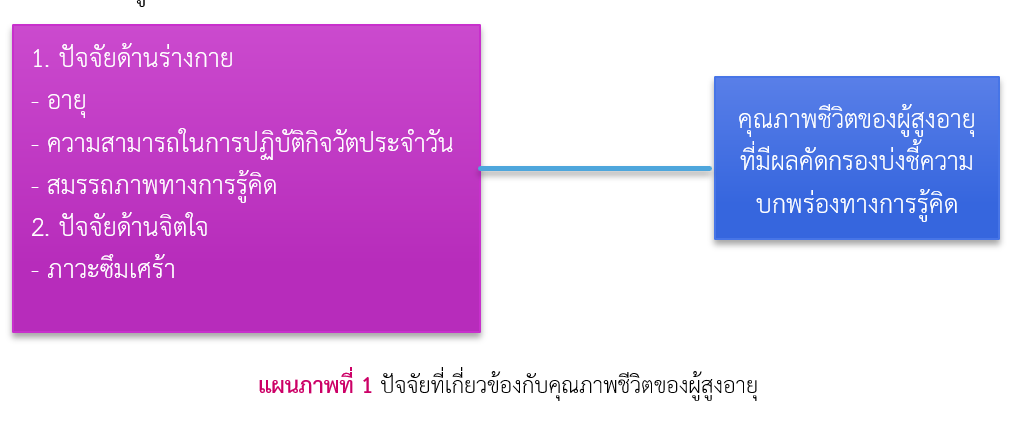
คุณภาพชีวิตของผู้สูงอายุที่มีผลคัดกรองบ่งชี้ความบกพร่องทางการรู้คิดส่งผลกระทบต่อการใช้ชีวิตประจำวัน การวิจัยแบบผสมผสานเชิงอธิบายตามลำดับครั้งนี้ มีวัตถุประสงค์เพื่อศึกษาปัจจัยที่มีความสัมพันธ์และแนวทางการพัฒนาคุณภาพชีวิตของผู้สูงอายุที่มีผลคัดกรองบ่งชี้ความบกพร่องทางการรู้คิด กลุ่มตัวอย่างการวิจัยเชิงปริมาณคือผู้สูงอายุที่มีผลคัดกรองบ่งชี้ความบกพร่องทางการรู้คิดในศูนย์พัฒนาการจัดสวัสดิการสังคมผู้สูงอายุแห่งหนึ่ง จำนวน 38 คน คัดเลือกกลุ่มตัวอย่างโดยการสุ่มแบบง่าย การวิจัยเชิงคุณภาพ ผู้ให้ข้อมูลสำคัญ ได้แก่ ผู้อำนวยการ ผู้ดูแลผู้สูงอายุ และผู้สูงอายุที่มีผลคัดกรองบ่งชี้ความบกพร่องทางการรู้คิด เก็บข้อมูลโดยใช้แบบวัดความเศร้าในผู้สูงอายุ ฉบับภาษาไทย แบบประเมินความสามารถในการปฏิบัติกิจวัตรประจำวันพื้นฐาน ดัชนีบาร์เทล ฉบับภาษาไทย แบบทดสอบสมรรถภาพสมองเบื้องต้น ฉบับภาษาไทย และแบบวัดคุณภาพชีวิตผู้สูงอายุขององค์การอนามัยโลก ฉบับภาษาไทย มีค่าสัมประสิทธิ์อัลฟาของครอนบาค เท่ากับ .85 .87 .80 และ .75 ตามลำดับ และแนวสัมภาษณ์เชิงลึก วิเคราะห์ข้อมูลโดยใช้สถิติสหสัมพันธ์ของเพียร์สัน สหสัมพันธ์อีต้า สหสัมพันธ์ของสเปียร์แมน และใช้เทคนิคการวิเคราะห์เนื้อหา ผลการวิจัย พบว่า ผู้สูงอายุที่มีผลคัดกรองบ่งชี้ความบกพร่องทางการรู้คิดมีคุณภาพชีวิตโดยรวมอยู่ในระดับปานกลาง โดยด้านการตายและความตายอยู่ในระดับดี เมื่อพิจารณาปัจจัยที่มีความสัมพันธ์กับคุณภาพชีวิต พบว่า ภาวะซึมเศร้าเป็นปัจจัยที่มีความสัมพันธ์ทางลบกับคุณภาพชีวิตอย่างมีนัยสำคัญทางสถิติในระดับสูงมาก (rₛ=-.900, p<.001) ส่วน ปัจจัยที่มีความสัมพันธ์ทางบวกกับคุณภาพชีวิตอย่างมีนัยสำคัญทางสถิติ ได้แก่ สมรรถภาพทางสมอง ซึ่งมีความสัมพันธ์ในระดับสูง (rₛ=.782, p<.001) และความสามารถในการปฏิบัติกิจวัตรประจำวันพื้นฐาน ซึ่งมีความสัมพันธ์ในระดับต่ำ (rₛ=.324, p=.047) แนวทางการพัฒนาคุณภาพชีวิตของผู้สูงอายุที่มีผลคัดกรองบ่งชี้ความบกพร่องทางการรู้คิด คือ การลดภาวะซึมเศร้าโดยการจัดกิจกรรมที่ส่งเสริมการมีปฏิสัมพันธ์ทางสังคม การบูรณาการกิจกรรมกระตุ้นสมองเข้ากับการฝึกกิจวัตรประจำวัน และการจัดบริบทการดูแลที่เอื้อต่อการมีส่วนร่วมและการดำรงคุณค่าในตนเองของผู้สูงอายุ
เอกสารอ้างอิง
Aajami, Z., Kazazi, L., Toroski, M., Bahrami, M., & Borhaninejad, V. (2020). Relationship between Depression and Cognitive Impairment among Elderly: A Cross-sectional Study. Journal of caring sciences, 9(3), 148–153. https://doi.org/10.34172/jcs.2020.022
Creswell, J. W., & Plano Clark, V. L. (2017). Designing and Conducting Mixed Methods Research (3rd ed.). SAGE Publications.
Department of Medical Services. (2021). Screening and assessment manual for older persons 2021. Ministry of Public Health. (In Thai)
Department of Older Persons. (2024). Statistics of older persons. https://www.dop.go.th/th/statistics_page?cat=1&id=2559 (in Thai)
Fu, X., Ji, S., Li, J., Chen, T., Liu, X., & Kuang, W. (2025). Cognitive impairment and dependency in activities of daily living: a cross-lagged analysis. Frontiers in aging neuroscience, 17, 1663237. https://doi.org/10.3389/fnagi.2025.1663237
Gopalakrishnan, P., Tiwari, S., Nagaraja, R., & Krishnan, G. (2024). Quality of life in persons with mild cognitive impairment: A systematic review and meta-analysis. Dementia & Neuropsychologia, 18, Article e20230093. https://doi.org/10.1590/1980-5764-DN-2023-0093
Jitapunkul, S. (2001). Principles of geriatric medicine (3rd ed.). Faculty of Medicine, Chulalongkorn University. (in Thai)
Li, H., Xu, M., Yin, W., Zhuge, X., Dong, P., Shi, Y., Li, Z., Zhang, X., Wang, J., & Chen, Z. (2025). The relationship between cognitive impairment and quality of life in rural older adults with chronic diseases-parallel mediating effects of depressive symptoms and frailty. BMC geriatrics, 25(1), 747. https://doi.org/10.1186/s12877-025-06446-y
Malterud, K., Siersma, V. D., & Guassora, A. D. (2016). Sample size in qualitative interview studies: Guided by information power. Qualitative Health Research, 26(13), 1753–1760. https://doi.org/10.1177/1049732315617444
Raimo, S., Maggi, G., Ilardi, C. R., Cavallo, N. D., Torchia, V., Pilgrom, M. A., Cropano, M., Roldán-Tapia, M. D., & Santangelo, G. (2024). The relation between cognitive functioning and activities of daily living in normal aging, mild cognitive impairment, and dementia: a meta-analysis. Neurological sciences : official journal of the Italian Neurological Society and of the Italian Society of Clinical Neurophysiology, 45(6), 2427–2443. https://doi.org/10.1007/s10072-024-07366-2
Song, R., Fan, X., & Seo, J. (2023). Physical and cognitive function to explain the quality of life among older adults with cognitive impairment: Exploring cognitive function as a mediator. BMC Psychology, 11, 51. doi:10.1186/s40359-023-01087-5
Stern, Y., Albert, M., Barnes, C. A., Cabeza, R., Pascual-Leone, A., & Rapp, P. R. (2023). A framework for concepts of reserve and resilience in aging. Neurobiology of Aging, 124, 100-103. https://doi.org/10.1016/j.neurobiolaging.2022.10.015
Sudnongbua, S. (2021). Elderly care: Situation and quality of life care. Chulalongkorn University Press. (In Thai).
Tanaka, M., Uemura, J. I., Tanikaga, M., Mizuno, J., & Nakamura, Y. (2025). Factors Affecting the Quality of Life of Institutionalized Older Adults With Dementia. OTJR : occupation, participation and health, 15394492251403393. Advance online publication. https://doi.org/10.1177/15394492251403393
WHOQOL Group. (1995). The World Health Organization Quality of Life assessment (WHOQOL): Position paper from the World Health Organization. Social Science & Medicine, 41(10), 1403–1409. https://doi.org/10.1016/0277-9536(95)00112-K
World Health Organization. (2025). Dementia. https://www.who.int/news-room/fact-sheets/detail/dementia
ดาวน์โหลด
เผยแพร่แล้ว
รูปแบบการอ้างอิง
ฉบับ
ประเภทบทความ
สัญญาอนุญาต
ลิขสิทธิ์ (c) 2026 วารสารวิจัยการพยาบาลและสุขภาพ

อนุญาตภายใต้เงื่อนไข Creative Commons Attribution-NonCommercial-NoDerivatives 4.0 International License.

