
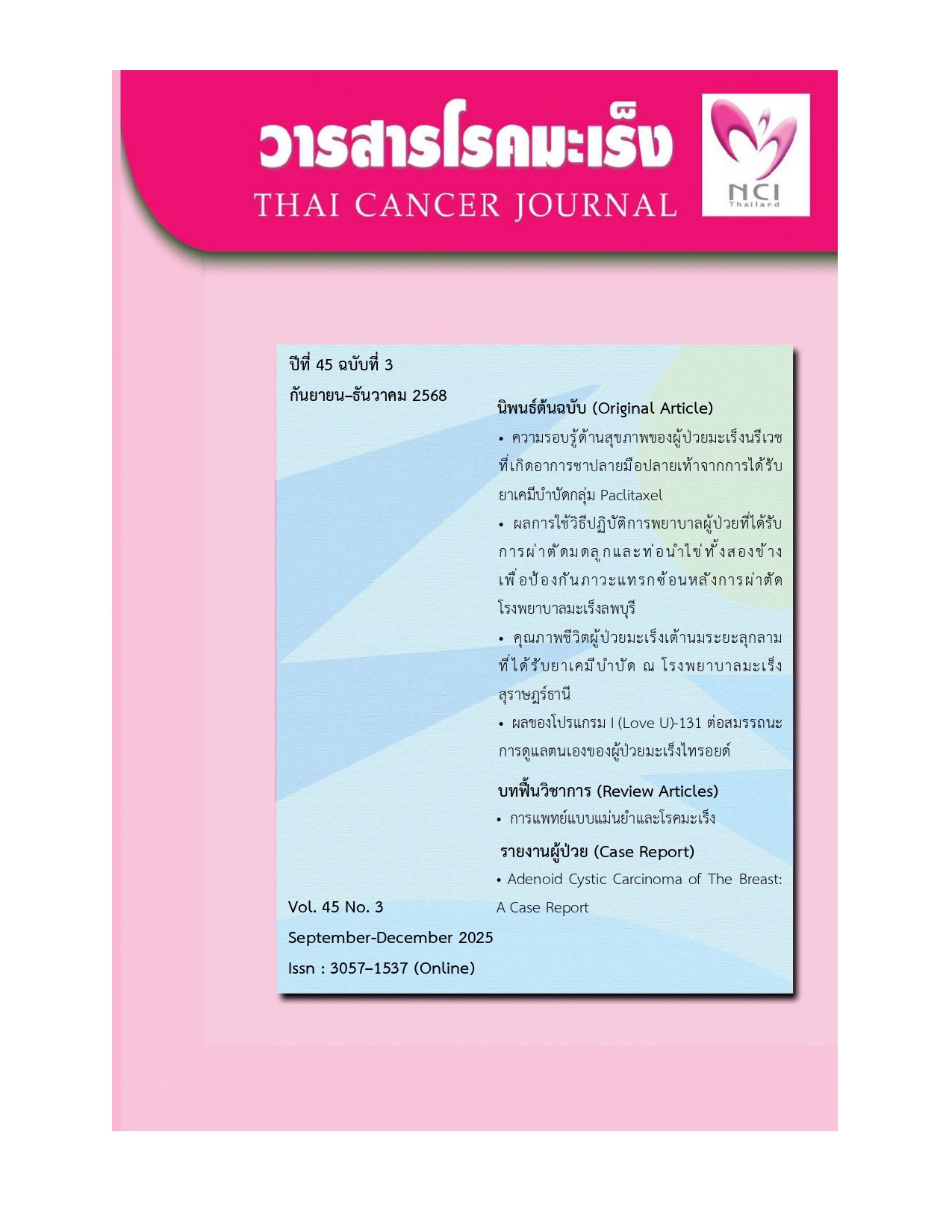
Quality of Life in Advanced Breast Cancer Patients Receiving Chemotherapy in SuratThani Cancer Hospital
Article Sidebar
Main Article Content
Abstract
Breast cancer is the most common cancer found in female patients worldwide. According to global cancer statistics for 2022, there were nearly 20 million new cancer cases globally, with breast cancer accounting for 11.6%. In Thailand, according to a statistical report from the Health Data Center (HDC) in 2022, there were 38,555 cases of breast cancer. At the provincial level, based on data from SuratThani Cancer Hospital during the 5-year period (fiscal years 2020–2024), there were a total of 2,653 new cases. Breast cancer significantly impacts both the physical and mental health of women. Therefore, the researcher conducted this study with the objectives of examining the quality of life in advanced breast cancer patients receiving chemotherapy, and studying the problems, needs, and opinions regarding the promotion of their quality of life. This study employed a mixed-methods approach, combining both quantitative and qualitative methods using the same purposively selected sample group of 110 participants. A breast cancer-specific quality of life measurement scale and an interview form were used. Data were analyzed using frequencies, percentages, means, standard deviations, and content analysis. The findings indicated that mixed-methods research, combining both quantitative and qualitative approaches, yielded more complete results than single-method research. Specifically, the quantitative findings based on the 5 dimensions of the quality of life measurement scale showed an overall moderate level of quality of life, with a score of 59.655 (41.43%). The qualitative findings provided data in 3 dimensions: 5 problem areas, 4 identified needs, and 3 opinions regarding quality of life promotion. These findings enhanced the comprehensiveness of the study and increased the practical value of the results. The quantitative research assessed quality of life in cancer-specific aspects, while in the qualitative research, participants described illness in terms of physical symptoms and emotional suffering. The quantitative research did not include economic aspects, whereas the qualitative findings revealed economic issues as significant problems contributing to greater hardship among many patients and significantly impacted their quality of life.
Article Details

This work is licensed under a Creative Commons Attribution-NonCommercial-NoDerivatives 4.0 International License.
บทความทีตีพิมพ์ในวารสารโรคมะเร็งนี้ถือว่าเป็นลิขสิทธิ์ของมูลนิธิสถาบันมะเร็งแห่งชาติ และผลงานวิชาการหรือวิจัยของคณะผู้เขียน ไม่ใช่ความคิดเห็นของบรรณาธิการหรือผู้จัดทํา
References
Bray F, Laversanne M, Sung H, Ferlay J, Siegel RL, Soerjomataram I, et al. Global cancer statistics 2022: GLOBOCAN estimates of incidence and mortality worldwide for 36 cancers in 185 countries. CA Cancer J Clin. 2024 May-Jun;74(3):229–63. Available from: https://pubmed.ncbi.nlm.nih.gov/38572751
Ministry of Public Health. Non-communicable disease [Internet]. [cited 2024 Nov 23]. Available from: https://hdcservice.moph.go.th/hdc/main/index.php
Surat Thani Cancer Hospital. Cancer Statistics. Cancer Statistics and Registry; 2024.
Radiotherapy and Oncology Department of Radiology, King Chulalongkorn Hospital. Advancecancer [Internet]. [cited 2025 Jan 12]. Available from: https://www.Chulacancer.net/health-tips-view.php?id=833
Siriraj Piyamaharajkarun Hospital. Learn more about breast cancer treatment methods [Internet]. [cited 2024 Nov 23]. Available from: https://www.siphhospital.com/th/news/article/share/breast-cancer-treatment
Korpunsilp S, Pongmesa T. Quality of life of breast cancer women during chemotherapy with fluorouracil, doxorubicin and cyclophosphamide (FAC) regimen. Songklanagarind Med J. 2017;35(4):373-84.
Creswell JW, Plano Clark VL. Designing and Conducting Mixed Methods Research. 3rd ed. Thousand Oaks, CA: SAGE; 2018.
Cohen J, Cohen P. Applied multiple regression/correlation analysis for the behavioral sciences. 2nd ed. Hillsdale, New Jersey: Lawrence Alabama Associates; 1983.
Cella DF, Tulsky DS, Gray G, Sarafian B, Linn E, Bonomi A, et al. The functional assessment of cancer therapy scale: development and validation of the general measure. J Clin Oncol [Internet]. 1993;11(3):570–9. Available from: https://pubmed.ncbi.nlm.nih.gov/8445433/
Facit.org. Functional Assessment of Cancer Therapy–Breast web sites [Internet]. [cited 2024 Nov 12]. Available from: https://www.facit.org/license-registration-form
Facit.org. Functional Assessment of Cancer Therapy – Breast. Overview web sites. Available from: https://www.facit.org/measures/fact-b. Accessed November 12, 2024
National Cancer Institute. National Cancer Control Programme พ.ศ. 2567–2575 [Internet]. [cited 2025 Jan 12]. Available from: https://www.nci.go.th/th/New_web2024/officer/download/nccp/NCCP_67_75.pdf
Prasertsri T, Tareepian N. Health promoting behaviors and quality of life in patients with breast cancer receiving chemotherapy. J Nurs Health Care. 2015;33(2):92-101.
Meecharoen W, Kalated T, Nutra K. Quality of life of cancer patients receiving chemotherapy and their family caregivers. J Nurs Health Care. 2018;36(4):52-61.
Poothavee P. Relationships between basic conditioning factors, health promoting behaviors, social support and quality of life in breast cancer patient receiving chemotherapy at Daycare Centre Udonthani Hospital. Udonthani Hosp Med J. 2018;26(3):144-52.
Krajeajan S. Illness representation, coping and quality of life among breast cancer patients [Master of Nursing Science]. Chiang Mai: Chiang Mai University; 2019.
Lertpanit P, Namvongprom A, Pakdevong N. Symptom experiences and quality of life of patients with advanced cancer receiving chemotherapy. APHEIT Int J. 2017;6(1):45-55.
