ประสิทธิผลของโปรแกรมการส่งเสริมการกำกับตนเอง เพื่อป้องกันการติดเชื้อในกระแสโลหิตที่สัมพันธ์กับการใส่สายสวนหลอดเลือดดำส่วนกลางของพยาบาลในหอผู้ป่วยวิกฤต
คำสำคัญ:
การติดเชื้อในกระแสโลหิตที่สัมพันธ์กับการใส่สายสวนหลอดเลือดดำส่วนกลาง, การกำกับตนเอง, หอผู้ป่วยวิกฤต, การป้องกันการติดเชื้อ, พยาบาลบทคัดย่อ
ความเป็นมาและความสำคัญ: การติดเชื้อในกระแสโลหิตที่สัมพันธ์กับการใส่สายสวนหลอดเลือดดำส่วนกลางส่งผลให้ค่าใช้จ่ายและอัตราเสียชีวิตผู้ป่วยเพิ่มขึ้น พยาบาลมีส่วนสำคัญในการป้องกันการติดเชื้อดังกล่าว
วัตถุประสงค์: เพื่อศึกษาประสิทธิผลของโปรแกรมส่งเสริมการกำกับตนเองเพื่อป้องกันการติดเชื้อในกระแสโลหิตที่สัมพันธ์ กับการใส่สายสวนหลอดเลือดดำส่วนกลางของพยาบาลในหอผู้ป่วยวิกฤต
วิธีดำเนินการวิจัย: การวิจัยกึ่งทดลองแบบ 2 กลุ่ม วัดผลก่อนและหลังการทดลอง แบ่งพยาบาลหอผู้ป่วยวิกฤต จำนวน 48 คน เป็นกลุ่มทดลองและกลุ่มควบคุม กลุ่มละ 24 คน ดำเนินโปรแกรมฯ 14 สัปดาห์ ใช้แบบสอบถามข้อมูลส่วนบุคคลแบบสังเกตการปฏิบัติ และแบบบันทึกอุบัติการณ์การติดเชื้อในกระแสโลหิต มีค่าดัชนีความตรงตามเนื้อหา 0.98 และค่าความเชื่อ มั่นของแบบสังเกตการปฏิบัติ 1.00 วิเคราะห์ข้อมูลโดยสถิติพรรณนา Chi-square และ Fisher’s exact
ผลการวิจัย: ภายหลังได้รับโปรแกรมฯ กลุ่มทดลองมีสัดส่วนการปฏิบัติที่ถูกต้องในการป้องกันการติดเชื้อเพิ่มขึ้นจาก ร้อยละ 64.31 เป็น 99.26 (p < .001) และมากกว่ากลุ่มควบคุมที่ปฏิบัติถูกต้องร้อยละ 72.14 (p < .001) กลุ่มทดลองมีอุบัติการณ์ การติดเชื้อลดลงจาก 7.98 ครั้ง เป็น 2.92 ครั้งต่อ 1,000 วันใส่สายสวนหลอดเลือดดำส่วนกลาง (p = .348) และลดลง 1.95 เท่า เมื่อเทียบกับกลุ่มควบคุม (p = .548)
สรุป: โปรแกรม ฯ สัมพันธ์กับการเพิ่มการปฏิบัติที่ถูกต้อง และมีแนวโน้มลดอุบัติการณ์ได้
Downloads
เอกสารอ้างอิง
Rosenthal V, Yin R, Nercelles P, Rivera-Molina S, Jyoti S, Dongol R, et al. International nosocomial infection control consortium (INICC) report of health care associated infections, data summary of 45 countries for 2015 to 2020, adult and pediatric units, device-associated module. American Journal of Infection Control. 2024;52(9):1002-11. doi:10.1016/j.ajic.2023.12.019.
Tertiary care hospital. Hospital infection surveillance data [unpublished]. Bangkok: Tertiary care hospital; 2025. (in Thai)
Alshahrani KM, Alhuwaishel AZ, Alangari NM, Asiri MA, Al-Sahrani NA, Alasmari AA, et al. Clinical impacts and risk factors for central line-associated bloodstream infection: a systematic review. Cureus. 2023;15(6): e40954. doi:10.7759/cureus.40954
Centers for Disease Control and Prevention. Guidelines for the prevention of intravascular catheter-related infections, 2011 [Internet]. 2011 [cited 2026 May 4]; 2017:1-80. Available from: https://www.cdc.gov/infection-control/media/pdfs/Guideline-BSI-H.pdf
Haddadin Y, Annamaraju P, Regunath H. Central line-associated bloodstream infections. In: StatPearls [Internet]. Treasure Island (FL): StatPearls Publishing; 2022. Available from: https://www.ncbi.nlm.nih.gov/books/NBK430891
O’Grady NP. Prevention of central line-associated bloodstream infections. New England Journal of Medicine. 2023;389(12):1121-31. doi:10.1056/NEJMra2213296.
Aloush SM, Alsaraireh FA. Nurses’ compliance with central line-associated bloodstream infection prevention guidelines. Saudi Medical Journal. 2018;39(3):273-9. doi:10.15537/smj.2018.3.21497
Lin FF, Murphy N, Martinez A, Marshall AP. Facilitators and barriers to evidence-based practice in central venous access device insertion and management in an intensive care unit: a qualitative study. Intensive and Critical Care Nursing. 2024;80:103553. doi: 10.1016/j.iccn.2023.103553.
Drews FA, Martinello RA, Hebden JN, St. John KH, Pegues DA. Disinfection of central venous access device needleless connectors: a human factors analysis. Infection Control & Hospital Epidemiology. 2024;45(8): 959-64. doi:10.1017/ice.2024.22
Henderson J, Willisa E, Rodericka A, Bailc K, Brideson G. Why do nurses miss infection control activities? A qualitative study. Collegian. 2020; 27:11-7.
Jun J, Kovner CT, Stimpfel AW. Barriers and facilitators of nurses’ use of clinical practice guidelines: an integrative review. International Journal of Nursing Studies. 2016; 60:54-68 doi:10.1016/j.ijnurstu.2016.03.006.
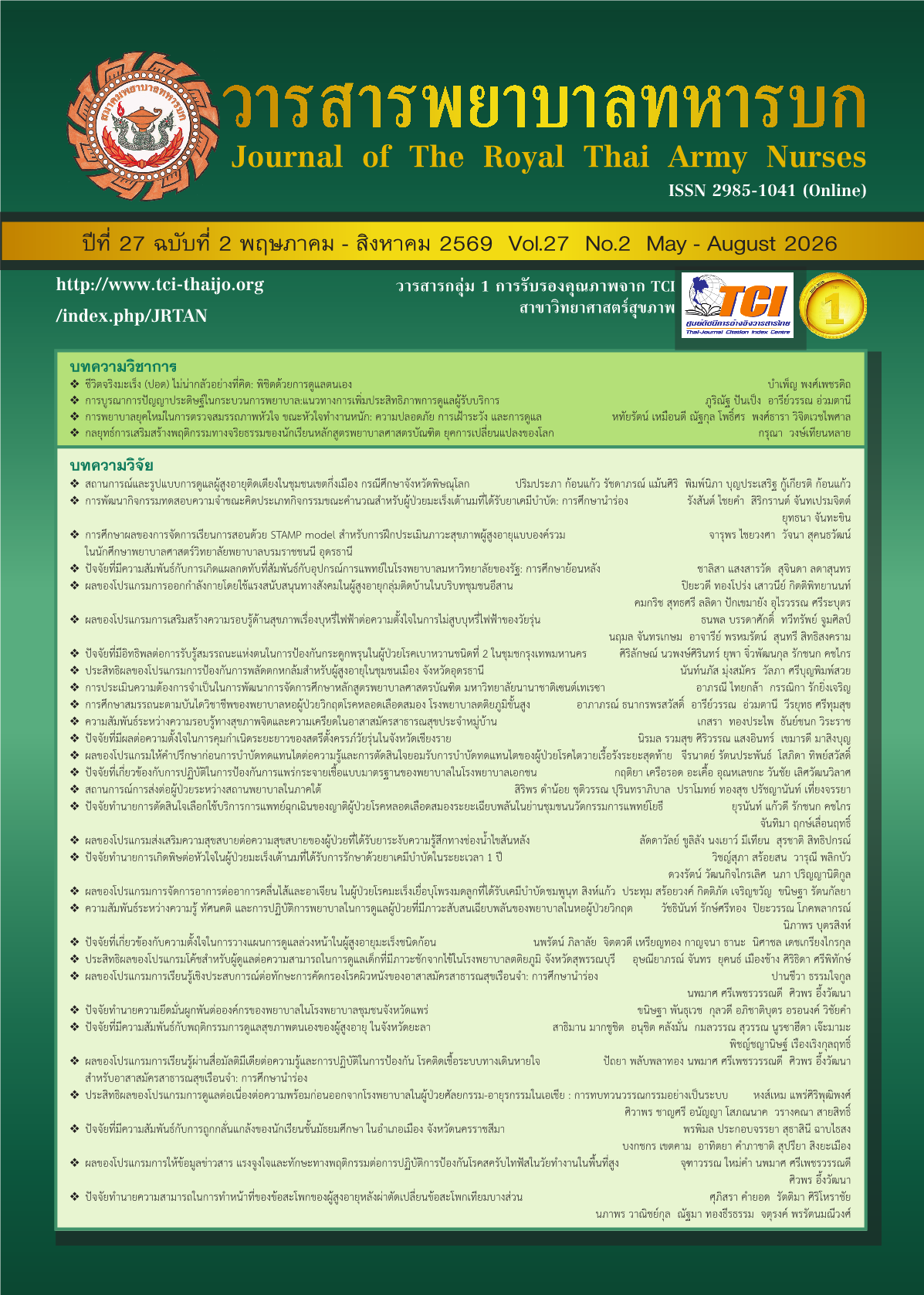
Krueerod K, Unahalekhaka A, Lertwatthanawilat W. Factors related to standard precautions practices among nurses in private hospitals. Journal of The Royal Thai Army Nurses. 2026;27(2):155-63. (in Thai)
Buetti N, Marschall J, Drees M, Fakih MG, Hadaway L, Maragakis LL, et al. Strategies to prevent central line-associated blood stream infections in acute-care hospitals: 2022 update. Infect Control Hosp Epidemiology. 2022;43:553-69. doi:10.1017/ice.2022.87.
Bandura A. Social cognitive theory of selfregulation. Organizational Behavior and Human Decision Processes. 1991;50(2):248-87.
Gray JR, Grove SK, Sutherland S. Burns and Grove’s the practice of nursing research: appraisal, synthesis and generation of evidence. 8th ed. St. Louis: Elsevier; 2017.
Kongkaew R, Lertwatthanawilas W, Viseskul N. Effects of self-regulation enhancement on aseptic technique practices of wound management among registered nurses in accident and emergency department. Nursing Journal CMU. 2021;48(2):51-62. (in Thai)
Yaseen M, Al-Hameed F, Osman K, Al-Janadi M, Al-Shamrani M, Al-Saedi A, et al. A project to reduce the rate of central line-associated bloodstream infection in ICU patients to a target of zero. BMJ Quality Improvement Reports. 2016;5(1): u212545.w4986. doi: 10.1136/bmjquality.u212545.w4986
ดาวน์โหลด
เผยแพร่แล้ว
รูปแบบการอ้างอิง
ฉบับ
ประเภทบทความ
สัญญาอนุญาต
ลิขสิทธิ์ (c) 2026 วารสารพยาบาลทหารบก

อนุญาตภายใต้เงื่อนไข Creative Commons Attribution-NonCommercial-NoDerivatives 4.0 International License.
บทความหรือข้อคิดเห็นใดใดที่ปรากฏในวารสารพยาบาลทหารบกเป็นวรรณกรรมของผู้เขียน ซึ่งบรรณาธิการหรือสมาคมพยาบาลทหารบก ไม่จำเป็นต้องเห็นด้วย
บทความที่ได้รับการตีพิมพ์เป็นลิขสิทธิ์ของวารสารพยาบาลทหารบก
The ideas and opinions expressed in the Journal of The Royal Thai Army Nurses are those of the authors and not necessarily those
of the editor or Royal Thai Army Nurses Association.