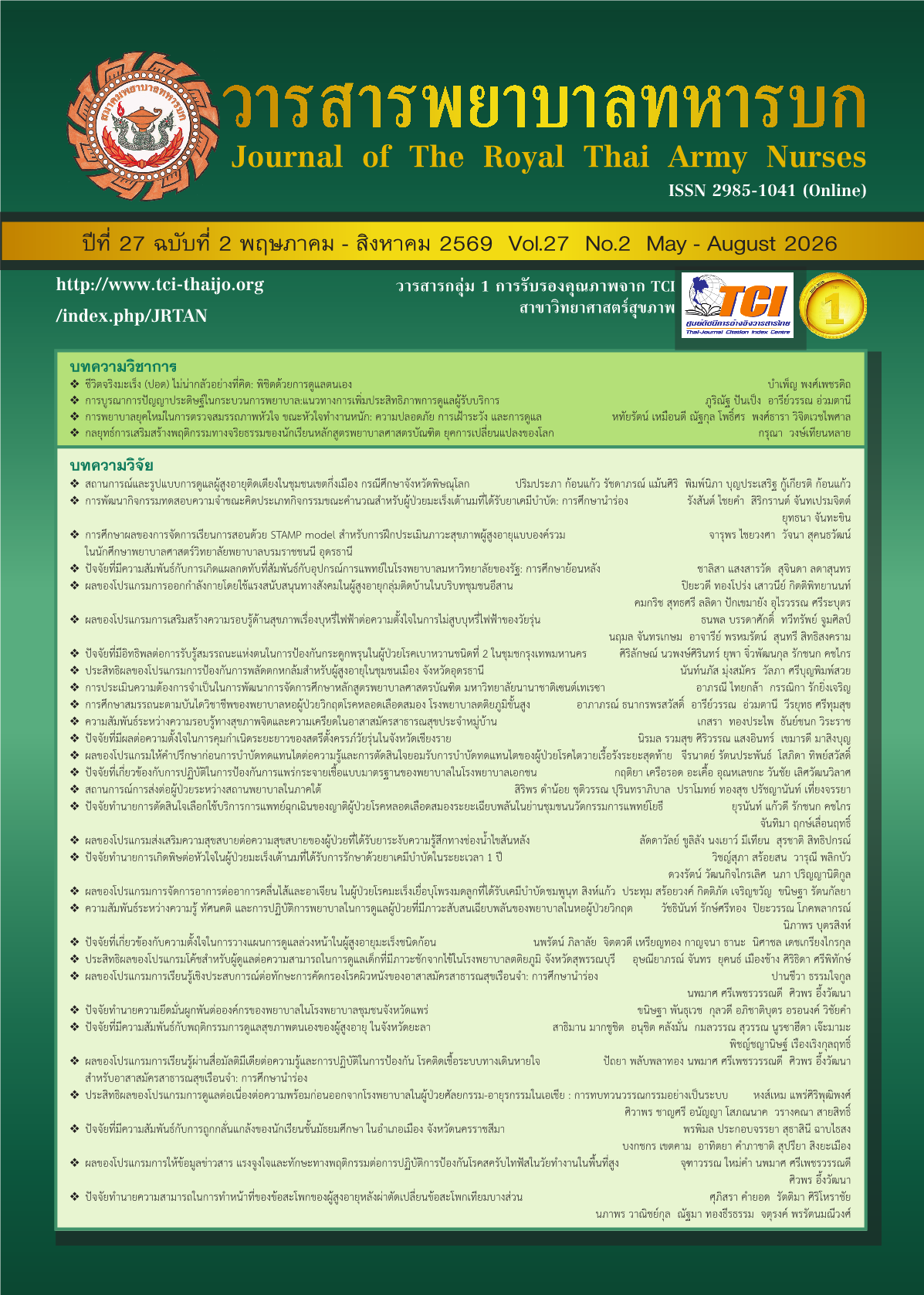
ชีวิตจริงมะเร็ง(ปอด)ไม่น่ากลัวอย่างที่คิด: พิชิตด้วยการดูแลตนเอง
คำสำคัญ:
การดูแลตนเอง, ผู้ป่วยมะเร็งปอด, ชีวิตจริง, การจัดการกับปัญหาบทคัดย่อ
การดูแลสุขภาพตนเองของผู้ป่วยมะเร็งปอด เป็นการปฏิบัติเพื่อดูแลสุขภาพของตนเอง ซึ่งชีวิตจริงบุคคลย่อมรู้จักตนเองและดูแลตนเองได้ดีที่สุด เพื่อให้ปลอดภัยจากโรคภัยและการเจ็บป่วย โดยมุ่งจัดการกับปัญหาหรือแก้ไขปัญหาเกี่ยวกับสุขภาพ ลดกิจกรรมเสี่ยงต่าง ๆ สามารถปฏิบัติเพื่อให้เกิดประโยชน์สูงสุดแก่ตนเอง การเรียนรู้และกระทำในกิจกรรมต่าง ๆ ซึ่งบุคคลได้ตัดสินใจและกระทำด้วยตนเอง เพื่อตอบสนองความต้องการของตนเอง ในการส่งเสริม ป้องกัน รักษาพยาบาล และฟื้นฟูสุขภาพ สามารถดำรงชีวิตอยู่อย่างปกติสุข การดูแลตนเองในผู้ป่วยมะเร็งตามความสามารถในการดูแลตนเอง 3 ระดับ คือ 1)ความสามารถและคุณสมบัติพื้นฐาน ในการที่จะรู้(Knowing) กับการจะกระทำ(Doing) 2)พลังความสามารถในการดูแลตนเอง 10 ประการได้แก่ ความสนใจและเอาใจใส่ในตนเอง สามารถควบคุมพลังงานทางด้านร่างกายของตนเอง การปฏิบัติการดูแลตนเองอย่างต่อเนื่อง สามารถใช้เหตุใช้ผล มีแรงจูงใจ มีทักษะในการตัดสินใจ มีความสามารถแสวงหาความรู้ มีทักษะในการใช้กระบวนการทางความคิดและสติปัญญา การสร้างสัมพันธภาพกับบุคคลอื่น เพื่อปรับการปฏิบัติการดูแลตนเอง มีความสามารถในการจัดระบบการดูแลตนเอง และ3)สามารถในการปฏิบัติการเพื่อการดูแลตนเอง การคาดการณ์ การปรับเปลี่ยนและการลงมือปฏิบัติในด้านการดูแลด้านร่างกาย จิตใจ จิตวิญญาณ และสังคม ส่งผลต่อร่างกายสามารถควบคุมภาวะเบี่ยงเบน ให้กลับสู่ภาวะปกติ มีชีวิตยืนยาวและดำรงชีวิตได้อย่างปกติสุข
Downloads
เอกสารอ้างอิง
Ajanupap S. 33 Health Paths [E-book]: Self-Care Training Manual. Nonthaburi : Department Thai Traditional and Alternative Medicine Development Ministry of Public Health. 2016. (in Thai)
National Cancer Institute, Department of Medicine. National Cancer Control Program, Ministry of Public Health (2013-2017). Bangkok: Center for Agricultural Cooperatives of Thailand. 2013. (in Thai)
Lyer S & Taylor-Stokes G. Roughley A Symptom burden and quality of life in advanced non-small cell lung cancer patients in France and Germany. Lung Cancer. 2013; 81(2):288-93. (in Thai)
National Institute of Health and Clinical Excellence Pemetrexed for first-line treatment of non-small cell lung cancer. London: National Institute of Health and Clinical Excellence. 2021. (in Thai)
Howe M & Burkes RL. Collaborative Care in NSCLC; the Role of Early Palliative Care.Front Oncol. 2014;1(4):192.
Hendriksen E, Williams E, Sporn N, Greer J, DeGrange. A, & Koopman C. Worried together: a qualitative study of shared anxiety in patients with metastatic non-small cell lung cancer and their family caregivers. Support Care Cancer. 2015 ;23(4):1035-41.
Semsarn S & Chaiviboontham S. A Case Study of Palliative Nursing Care for Persons with Advanced Lung Cancer: Roles of Advanced Practice Nurses. Ramathibodi Nursing Journal . 2017;23( 1):11-26. (in Thai)
Melanie P. J. Schellekens, Desiree G. M. van den Hurk, Judith B. Prins, Johan Molema, A. Rogier T. Donders, Willem H. Woertman, et al. Study protocol of a randomized controlled trial comparing mindfulness-based stress Reduction with treatment as usual in reducing psychological distress inpatients with lung cancer and their partners: the MILON study. Biomed. Central Cancer. 2014 ;1 (1): 143.
Orem D E, Taylor S G & Renpenning K M. Nursing: Concepts of practice (6th ed.). St. Louis: Mosby. 2001.
Jennifer S T, Joseph A. Greer, Sonal Admane, Emily R. Gallagher, Vicki A. Jackson, Thomas J. Lynch, et. al. Longitudinal perceptions of prognosis and goals of therapy in patients with metastatic non-small cell lung cancer: results of a randomized study of early palliative care. Journal of Clinical Oncology. 2011; 29(17):2319-26.
Mullen C & Thomas J. End-of-life care: common core competencies. British Journal of Healthcare Assistants. 2009 ;3(10):490-23.
Hendrix CC, Bailey DE, Jr., Steinhauser KE, Olsen MK, Stechuchak KM, Lowman SG, et al. Effects of enhanced caregiver training program on cancer caregiver’s self -efficacy, preparedness, and psychological well-being. Support Care Cancer. 2016; (1): 327–36.
Pichayapinyo P. The theory of self-care deficit of Orem’s nursing. In Pichayapinyo P., P. Lapvongwattana, Kerdmongkol P., & Powwattana A. Nursing theory and application: Person, family, and community. Bangkok: Danex Intercorporation. 2013. (in Thai)
Badr H, Smith CB, Goldstein NE, Gomez JE. & Redd WH. Yadic. psychosocial intervention for advanced lung cancer patients and the family caregivers: results of a randomized pilot trial. Cancer. 2015; 121(1):150-8.
Petchsuk R, Cheevakasemsook A & Seanprasarn P. The Development of a Seamless Health Service Model for Breast Cancer Patients from Hospital to Community. Journal of The Royal Thai Army Nurses. 2025;26(2):70-9. (in Thai)
ดาวน์โหลด
เผยแพร่แล้ว
รูปแบบการอ้างอิง
ฉบับ
ประเภทบทความ
สัญญาอนุญาต
ลิขสิทธิ์ (c) 2026 วารสารพยาบาลทหารบก

อนุญาตภายใต้เงื่อนไข Creative Commons Attribution-NonCommercial-NoDerivatives 4.0 International License.
บทความหรือข้อคิดเห็นใดใดที่ปรากฏในวารสารพยาบาลทหารบกเป็นวรรณกรรมของผู้เขียน ซึ่งบรรณาธิการหรือสมาคมพยาบาลทหารบก ไม่จำเป็นต้องเห็นด้วย
บทความที่ได้รับการตีพิมพ์เป็นลิขสิทธิ์ของวารสารพยาบาลทหารบก
The ideas and opinions expressed in the Journal of The Royal Thai Army Nurses are those of the authors and not necessarily those
of the editor or Royal Thai Army Nurses Association.